Village vs Subdivision: Key Differences, Meaning & Examples
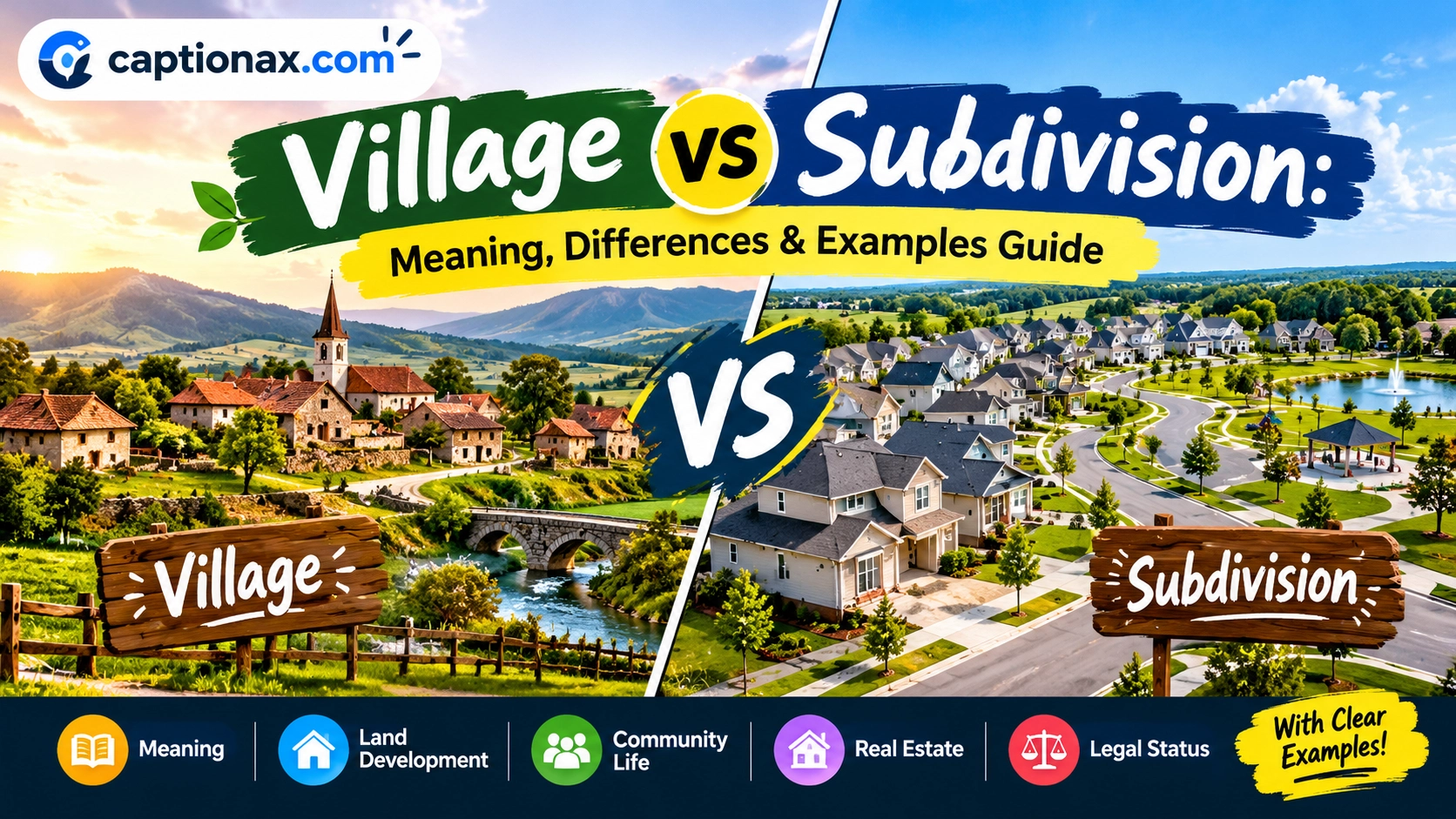
Have you ever wondered whether a Village vs Subdivision mean the same thing? Both can describe places where people live, but they represent different concepts. A village is generally a settlement or community, while a subdivision refers to land divided into smaller parcels or a development created through that process.
Understanding the difference between village vs subdivision helps you use the terms correctly in everyday English, geography, urban planning, and real estate. It can also help you interpret property listings, understand land-development documents, and distinguish a community from the individual housing developments within it.
For example, a historic settlement with homes, shops, and a shared identity may be called a village. A developer who divides a large property into individual housing lots may create a residential subdivision. Both places can contain houses, roads, and families, yet the words describe different aspects of those places.
The distinction is not always a simple choice between two types of communities. A subdivision can exist within a village, town, or city. Furthermore, the official meaning of village and the legal requirements for a subdivision vary by jurisdiction.
This guide explains both terms, compares their main differences, provides practical examples, and shows you how to choose the right word for your situation.
Village vs Subdivision: What Is the Difference?
The main difference between a village and a subdivision is what each term describes. A village generally identifies a settlement or community, whereas a subdivision identifies the division of land into smaller parcels or the development associated with that division.
A village may develop over generations or be deliberately planned. A subdivision usually involves a land-division process, often to create lots for residential construction or other permitted uses.
| Feature | Village | Subdivision |
| Basic meaning | A settlement or community | Divided land or a resulting development |
| Main focus | People, place, and community | Property, lots, and land development |
| Formation | May grow over time or be planned | Usually involves a deliberate land-division process |
| Land use | May include homes, shops, farms, and public spaces | May be residential, commercial, or another permitted use |
| Government | May or may not be an official municipality | Does not automatically constitute a separate municipality |
| Legal meaning | Depends on the jurisdiction | Depends on applicable land-use laws |
| Relationship | May contain several developments | May exist within a village, town, or city |
The table describes general usage rather than universal legal rules. For example, a village can be a planned settlement, and a subdivision does not have to be exclusively residential.
The easiest way to remember the difference:
- Village = the community or settlement.
- Subdivision = the division of land or the development created through that division.
What Is a Village?
A village is generally a settlement where people live and form a recognizable community. It may be rural, suburban, or part of a more developed region, depending on the location and how the term is used.
Villages can include houses, shops, schools, farms, public spaces, roads, and other facilities. Some have a long history and a strong cultural identity, while others have developed more recently.
In certain jurisdictions, village also has a formal administrative meaning. In others, it simply describes a place or appears in a community’s name.
Common characteristics of a village
- Community identity: Residents may share local traditions, history, and community activities.
- Residential areas: Houses and other dwellings form part of the settlement.
- Local facilities: Shops, schools, markets, or public spaces may serve residents.
- Mixed land uses: A village may contain homes, businesses, agricultural land, and public buildings.
- Varied development: Buildings and roads may reflect different periods of growth.
- Possible local government: Some villages have their own municipal administration; others fall under a larger authority.
Not every village has all these characteristics. A small rural settlement may have few services, while a village near a major city may have extensive housing and commercial development.
Examples of villages
Imagine a community surrounded by farmland, with a central street, a local market, a primary school, and homes that have developed over several decades. People might describe it as a village.
Another settlement might use the village as its official administrative designation under local law. In that case, the term has a legal meaning in addition to its everyday meaning.
Example sentence: “My grandparents grew up in a village known for its traditional markets and agricultural heritage.”
The word village works here because the sentence focuses on the community and its history.
What Is a Subdivision?
A Subdivision is commonly understood in real estate as land divided into smaller lots or parcels. The resulting lots may be used for homes, commercial properties, or other purposes permitted by the applicable planning rules.
In everyday conversation, the term often refers to a residential development with individual properties, streets, and sometimes shared facilities.
In legal and planning contexts, the definition can be more specific. For example, Ontario’s official planning guide explains that a registered plan of subdivision records surveyed lot boundaries, street locations, and designated sites for facilities such as parks and schools.
Common characteristics of a subdivision
- Divided land: A larger property is separated into smaller lots or parcels.
- Planned layout: A development plan may establish lot boundaries, roads, and access arrangements.
- Building opportunities: Lots may be intended for residential or other approved construction.
- Infrastructure: Roads, drainage, and utility arrangements may form part of the project.
- Regulatory requirements: Local planning rules, approvals, and recorded plans may apply.
- Shared facilities: Some developments include parks, playgrounds, or common areas.
A subdivision does not automatically have a gate, identical houses, private roads, or a homeowners association (HOA). Those features depend on the specific development and its governing documents.
Examples of subdivisions
Suppose a developer purchases a large tract of land and proposes to divide it into 150 residential lots. The project requires the relevant approvals and establishes a layout for roads, utilities, and individual properties.
People might call the resulting housing development a subdivision.
Example sentence: “The family purchased a newly built house in a subdivision near the city center.”
The word subdivision is appropriate because the sentence refers to a land development rather than simply describing a community.
Village vs Subdivision: Key Differences at a Glance
Although villages and subdivisions can look similar, their defining concepts differ.
Meaning and purpose: A village identifies a settlement or community. A subdivision refers to land division or the resulting development.
How they form: A village may grow gradually or be established through planning. A subdivision generally results from a deliberate process of dividing land into lots.
Community and land use: A village may include residential, commercial, agricultural, and public uses. A residential subdivision typically focuses on housing, although subdivisions can serve other purposes.
Administration and legal status: A village may be a recognized municipality, an unincorporated settlement, or an informal geographic designation. A subdivision is not automatically a separate governmental entity.
Can they overlap? Yes. A residential subdivision may exist within a village’s boundaries. The village describes the wider community, while the subdivision identifies a particular land development.
The distinction is best understood through two questions:
- “What kind of place or community is this?”
- “How was this land divided or developed?”
The first question points toward the village. The second points toward subdivision.
How Villages and Subdivisions Develop
Understanding how each place comes into existence makes the difference easier to recognize.
How a village develops
A village may form as people settle near farmland, a water source, a trading route, a workplace, or another important resource. Over time, homes, roads, businesses, and shared facilities may emerge around the settlement.
However, not every village develops organically. Governments and planners can establish planned villages, and the word may have a formal legal meaning in some jurisdictions.
How a subdivision develops
A subdivision typically begins when a landowner or developer proposes to divide a property into smaller parcels. Depending on local law, the process may involve surveying, planning review, approval, recording a subdivision plan, and arranging infrastructure.
Ontario’s planning guide describes how subdivision plans are reviewed and registered, while Virginia law provides a jurisdiction-specific framework for regulating land subdivision and development.
A simple example
Imagine two neighboring areas:
- Area A: An established community with homes, shops, and roads that developed over several generations. Residents call it a village.
- Area B: A large parcel that was divided into housing lots according to an approved plan. Residents refer to it as a subdivision.
Both areas may contain homes and families. Their labels differ because each word emphasizes a different aspect of the place.
- Explore More: https://captionax.com/noteable-or-notable/
Village vs Subdivision in Geography and Urban Planning
In geography and urban planning, the distinction depends on whether the discussion concerns a settlement or a land-development process.
A village is a type of settlement in many geographic descriptions. Its population, physical layout, and administrative status vary by region. Some villages remain rural, while others become surrounded by expanding urban development.
A subdivision concerns the division of land into parcels and the planning or development associated with those parcels. It may form part of a larger settlement rather than operate as an independent community.
Why the distinction matters
Urban planners consider how new development fits into existing communities. They may assess road access, utility capacity, drainage, public facilities, environmental concerns, and compatibility with local land-use plans.
Subdivision regulations also vary by jurisdiction. Ontario’s official guide explains how planning authorities evaluate subdivision proposals, while Virginia’s statutory framework addresses the regulation of land division and development.
Remember: a village is primarily a settlement concept, while a subdivision is primarily a land-division concept. They can overlap without becoming synonyms.
Village vs Subdivision in Real Estate
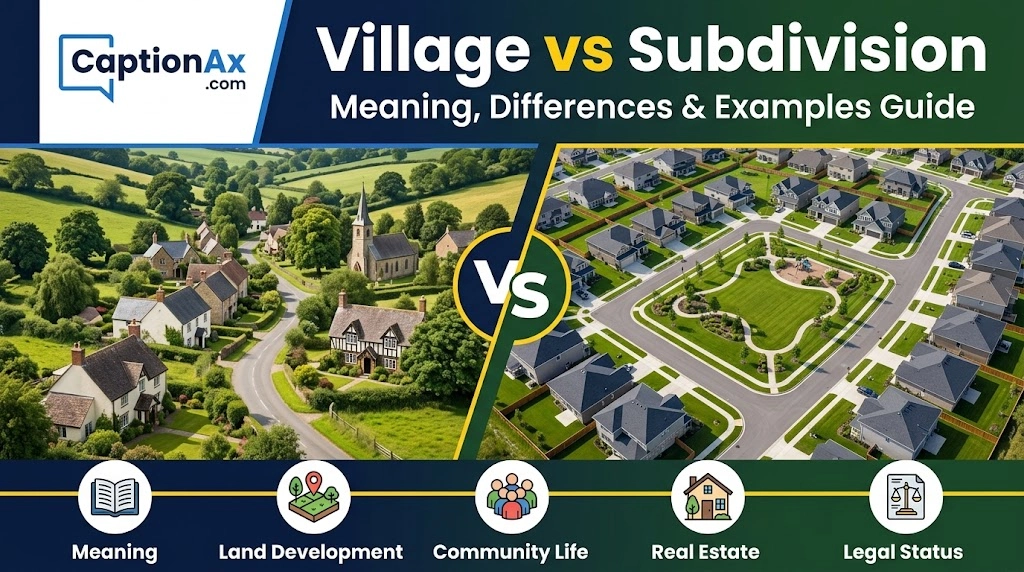
In real estate, both terms can appear in property listings, development plans, land records, and descriptions of residential areas.
A listing might describe a home as being in a village because the property belongs to a recognized settlement. Another might describe a home as being in a subdivision because it belongs to a planned development.
However, a marketing description alone does not establish a property’s legal classification.
What property buyers should check
Before purchasing land or a home, consider these questions:
- Property boundaries: What land does the individual lot include?
- Recorded plans: Is there an approved or registered subdivision plan where required?
- Access and services: Who maintains the roads and provides utilities?
- Rules and restrictions: Do zoning requirements, covenants, or HOA rules apply?
- Local jurisdiction: Is the property inside a municipality or an unincorporated area?
- Ongoing costs: Are there association fees, maintenance charges, or special assessments?
Ontario’s planning guide explains that registered subdivision plans identify individual lots and other relevant land features. Buyers can use applicable land records to verify a property’s boundaries and legal status.
Why the distinction matters to buyers
The word village in a property advertisement does not automatically mean that the property belongs to an officially recognized village. Similarly, calling a neighborhood a subdivision does not tell you everything about ownership, access, services, or restrictions.
Review the applicable records and local rules before making legal or financial decisions.
How Governance and Legal Status Differ
Governance is one of the most important areas where these terms diverge.
A village may have its own local government, but this depends on the country and jurisdiction. Elsewhere, the word may describe a settlement that falls under a town, district, county, or another authority.
A subdivision, meanwhile, does not automatically have a separate municipal government. Its properties generally remain subject to the applicable public authorities, although a private association may manage shared property or enforce valid community rules.
Public government versus private association
A municipal authority may oversee planning approvals, public services, or road maintenance within its responsibilities. An HOA, where one exists, may manage common areas and enforce applicable covenants or community rules within its authority.
These responsibilities are not interchangeable, and not every subdivision has an HOA.
Why local law matters
The word village can have a formal administrative definition in one place and a general geographic meaning in another. Legal definitions of subdivision may specify which kinds of land division require formal approval.
For example, Virginia’s Code defines subdivision for its statutory planning framework, while recognizing that local ordinances can affect the applicable definition.
For legal questions, consult the relevant local legislation, planning office, and property records.
How Infrastructure, Amenities, and Services Compare
Villages and subdivisions can both provide essential services, but their infrastructure may have developed in different ways.
Infrastructure in villages
Depending on their size and location, villages may have established roads, schools, shops, public spaces, water systems, and other services. Some offer extensive facilities, while others rely on nearby towns for healthcare, shopping, or public transportation.
Infrastructure in subdivisions
Residential subdivisions may be designed with roads, access points, drainage, utility connections, and other infrastructure under an approved plan. Some also include parks or shared recreational areas.
The presence and quality of these facilities depend on the specific location and project. A subdivision does not automatically have better infrastructure than a village.
Questions worth asking
When comparing two areas, consider:
- Are roads publicly maintained or privately managed?
- Are water, electricity, drainage, and sewer services available?
- How far away are schools, shops, and healthcare facilities?
- Are parks and other shared amenities accessible?
- Are there maintenance fees or special assessments?
The answers depend on the individual location, not simply whether the place is called a village or subdivision.
Village vs Subdivision: Lifestyle and Community
Some people compare villages and subdivisions when deciding where to live. Although the terms do not guarantee a particular lifestyle, they can provide clues about the kind of place being described.
Living in a village
A village may offer a strong local identity, established traditions, countryside surroundings, or a recognizable community center. In other cases, a village may be a busy suburban settlement with modern services and substantial development.
Potential advantages include an established sense of place and access to familiar community spaces. Possible disadvantages include fewer nearby services in some rural locations or longer travel distances.
Living in a subdivision
A residential subdivision may offer newer housing, organized streets, planned infrastructure, or shared amenities. Some developments provide easy access to schools, shops, and major roads, while others are more car-dependent.
Potential advantages include a planned layout and newer housing options. Possible disadvantages may include HOA costs where applicable, limited housing variety, or fewer nearby services.
Which is better?
Neither is universally better. A village may suit someone who values a particular community’s history or setting. A subdivision may appeal to someone seeking a home within a planned residential development.
Compare the actual property, commute, services, costs, and rules before choosing.
Can a Village Contain a Subdivision?
Yes, a subdivision can exist within a village. The terms describe different aspects of a place, so both can apply to the same location.
For example, an established village may expand by approving a new residential development on land near its existing streets. The village remains the wider community, while the new development is a subdivision.
The same principle applies to subdivisions within towns and cities. A subdivision is not automatically a separate municipality.
Example
Suppose Greenfield is an established village with a historic center, local shops, and public facilities. A developer later divides a nearby parcel into 80 housing lots and constructs a residential community.
The wider area may still be called Greenfield Village, while the new housing development may be known as Greenfield Estates Subdivision.
The development’s name alone does not establish its official administrative or legal status.
Village vs Subdivision vs Neighborhood vs Town
These four terms can overlap in everyday conversation, but each emphasizes a different concept.
| Term | General meaning | Example |
| Village | A settlement or community; sometimes an administrative unit | A historic settlement |
| Subdivision | Divided land or a development created through land division | A planned housing development |
| Neighborhood | An identifiable local area within a larger settlement | A residential area near a city park |
| Town | A settlement or administrative unit whose status varies by jurisdiction | A regional service center |
Village vs neighborhood
A village is a settlement or, in some jurisdictions, an administrative unit. A neighborhood is an identifiable area within a larger place.
A village can contain multiple neighborhoods.
Subdivision vs neighborhood
A subdivision is associated with land division. A neighborhood is defined more broadly by location, community identity, or local usage.
A subdivision may be considered a neighborhood, but not every neighborhood is a subdivision.
Village vs town
A town may be larger than a village in many common descriptions, but population size alone does not determine official status everywhere. Local laws and naming conventions matter.
Subdivision vs town
A Subdivision generally describes a land-development arrangement, whereas a town describes a settlement or administrative entity. A subdivision can exist within a town without becoming a separate town itself.
Real-Life Examples of Village and Subdivision
These examples show how to use both terms naturally.
Example 1: An established settlement
A community has existed for generations and is known for its local traditions, market, and surrounding farmland.
Correct usage: “The village holds a traditional market every Saturday.”
Why: The sentence focuses on the community and its activities.
Example 2: A new residential project
A developer divides a large property into individual lots and builds houses along newly planned streets.
Correct usage: “The developer completed the first phase of the subdivision.”
Why: The sentence focuses on the land-development project.
Example 3: A development within an established settlement
A village expands, and a developer creates a new residential area within its boundaries.
Correct usage: “The subdivision is located on the eastern edge of the village.”
Why: One term identifies the development, while the other identifies the wider settlement.
Example 4: A property listing
A real estate agent advertises a house in an area marketed as “Oak Village,” but official records identify the land as part of a residential subdivision.
Correct usage: “The property is in the Oak Village development, which is recorded as a subdivision.”
Why: The sentence distinguishes the marketing name from the documented status.
Example 5: A planning application
A landowner applies to divide one parcel into several lots for future construction.
Correct usage: “The landowner submitted a subdivision application to the local authority.”
Why: The term refers to the proposed division of land.
These examples demonstrate why context matters more than the names people give places.
Common Mistakes When Using Village and Subdivision
Readers often confuse these terms because both can refer to residential areas. Here are the most important mistakes to avoid.
Mistake 1: Treating village and subdivision as synonyms
Incorrect assumption: Every village is a subdivision, or every subdivision is a village.
Better understanding: A village is a community or settlement, while a subdivision concerns land division or the resulting development.
Mistake 2: Assuming every village is rural
Villages are often associated with rural settings, but some have become suburban or urban in character. Their official status also varies.
Mistake 3: Assuming every subdivision is residential
Although the term frequently refers to housing developments, subdivision can also concern land divided for other permitted purposes. The applicable legal definition determines its scope.
Mistake 4: Assuming every subdivision has an HOA
Some subdivisions have homeowners associations or similar arrangements, but others do not. Check the property’s documents to establish whether an association exists and what rules apply.
Mistake 5: Believing the name determines legal status
A development marketed as “Sunny Village” is not automatically an officially recognized village. Check local government information and property records where legal classification matters.
Mistake 6: Ignoring jurisdiction-specific definitions
Legal requirements for land division differ across countries and local authorities. Never assume that a definition used in one state, province, or country applies everywhere.
Best rule: Use village when you mean a settlement or community. Use subdivision when you mean land divided into parcels or a development created through that process.
People Also Ask
A:A village is a community or settlement, while a subdivision refers to land divided into smaller parcels or a development created through that process. A subdivision can be located within a village.
A:No. The terms describe different concepts. A village identifies a settlement or community, whereas a subdivision relates to land division and development. Their precise legal meanings depend on local rules.
A:Yes. A residential subdivision can be developed within an existing village. The village describes the wider settlement, while the subdivision describes the specific land development.
A:A subdivision can be considered a neighborhood, but the terms are not identical. A subdivision is associated with land division, while a neighborhood is a broader area identified by its location or community character.
A:In real estate, subdivision generally refers to dividing a larger parcel of land into smaller lots or parcels. Depending on local law, the process may require surveys, official approvals, and registered plans.
Conclusion
The difference between Village vs Subdivision becomes simple once you understand what each term describes. A village is a settlement or community, while a subdivision is a division of land into smaller parcels or a development created through that process.
A village may contain homes, businesses, public spaces, and several residential developments. A subdivision may be located within a village, town, or city without becoming a separate municipality.
When using these terms in everyday conversation, focus on whether you mean the community itself or the land-development arrangement. When reading property listings or legal documents, verify the applicable local definitions and records.
Understanding this distinction will help you choose the right word, interpret real-estate terminology, and describe residential areas more accurately. Explore more vocabulary and commonly confused word guides on CaptionAx.com to strengthen your everyday English.