
Meaning, Differences, and Examples
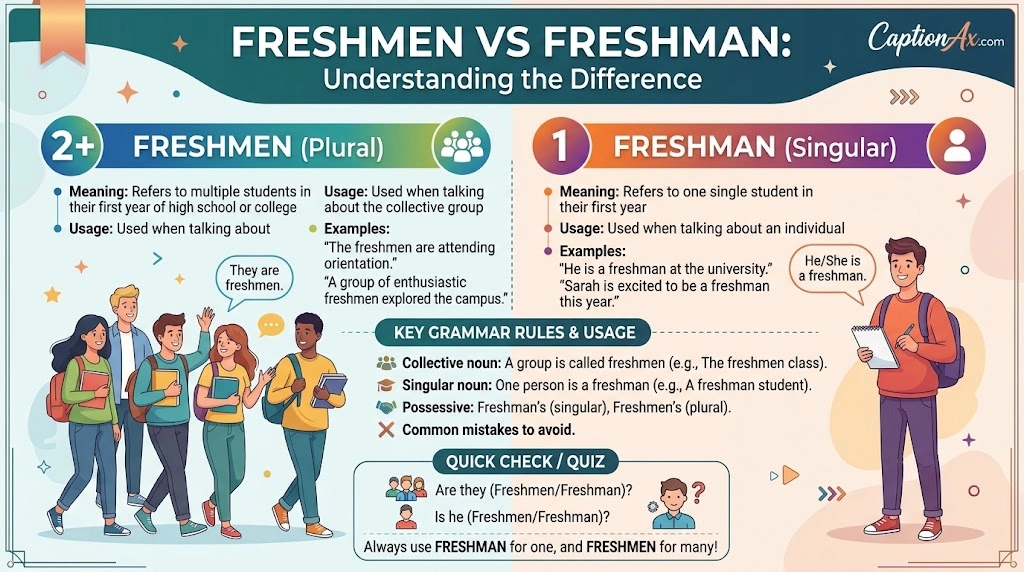
Have you ever wondered whether to write Freshman or Freshmen? Both words refer to students in their first year of school or college, but they are used differently in a sentence. The main difference is grammatical number: freshman is singular, while freshmen is plural.
For example, you would write, “My sister is a freshman,” when talking about one student. When referring to several students, you would say, “The freshmen are attending orientation.”
There is one more important detail: freshman also appears before other nouns in expressions such as freshman year, freshman class, and freshman orientation. This is why freshmen year is not the standard expression.
In this guide, you will learn the meaning of each word, when to use it, how to form possessives, and how to avoid common grammar mistakes. Whether you are writing a school assignment, a college essay, a professional email, or a social media post, these simple rules will help you choose the correct form confidently.
Freshmen vs. Freshman: What Is the Difference?
Freshman refers to one first-year student, while freshmen refers to two or more first-year students. Both are commonly used in American English for students beginning high school or college.
The basic rule is simple:
- Freshman: One student.
- Freshmen: More than one student.
- Freshman year: The first year of study.
- Incoming freshmen: A group of new first-year students.
Consider these examples:
- Correct: Emma is a freshman at college.
- Correct: Emma and Noah are freshmen at college.
- Correct: I enjoyed my freshman year.
- Incorrect in standard usage: I enjoyed my freshmen year.
The important point is that the choice depends on how the word functions in your sentence. When it refers to several people, use freshmen. When it describes another noun, freshman is generally the standard form.
What Does Freshman Mean?
A freshman is a student in the first year of high school or college, especially in American English. The word can also describe a newcomer or beginner in certain professional, political, or sports contexts.
For example, a newly elected member of Congress may be called a freshman member, and an athlete in their first year may be described as a freshman player.
Freshman examples in sentences
- My brother is a freshman at university.
- She attended freshman orientation last week.
- His freshman year taught him to manage his time.
- A freshman asked the professor an important question.
- The freshman basketball player scored the winning point.
- Every freshman received a student handbook.
- He became a freshman member of the organization.
- My cousin is excited about starting as a freshman.
In each example, Freshman refers to one person or describes something associated with a first-year student.
What Does Freshmen Mean?
Freshmen is the irregular plural form of freshman. It refers to two or more first-year students.
Unlike regular nouns that usually form their plural by adding -s or -es, freshman changes to freshmen. The same spelling pattern appears in man and men.
Freshmen examples in sentences
- The freshmen arrived on campus early.
- Several freshmen joined the science club.
- The college offers tutoring services for freshmen.
- Three freshmen received academic scholarships.
- The freshmen are preparing for their first examinations.
- Many freshmen attended the welcome event.
- New freshmen received their student identification cards.
- The freshmen were excited about campus life.
Use freshmen when the word itself refers to a group of people. Because it is plural, it generally takes plural verbs such as are, were, and have.
Freshman vs. Freshmen: Comparison Table
| Feature | Freshman | Freshmen |
| Grammatical form | Singular noun or modifier | Plural noun |
| Meaning | One first-year student | Two or more first-year students |
| Example | She is a freshman. | They are freshmen. |
| Verb agreement | The freshman is ready. | The freshmen are ready. |
| Common Phrase | Freshman year | Incoming freshmen |
| Possessive form | Freshman’s | Freshmen’s |
| Incorrect plural | Freshmans | — |
The easiest way to remember the difference is to ask yourself: Am I talking about one student, several students, or describing another noun?
When to Use Freshman
Use freshman when you are referring to one first-year student or describing a noun associated with the first year of study.
1. When referring to one student
- My sister is a freshman.
- The freshman asked for directions.
- Each freshman must attend the meeting.
- One freshman won the competition.
Words such as a, one, and each commonly signal that you need the singular noun.
2. When describing an academic year
- I remember my freshman year fondly.
- Her freshman year was challenging.
- He learned many useful skills during his freshman year.
The correct standard expression is freshman year, even when discussing an entire class of students.
3. When describing a class, event, or activity
- The university organized a freshman orientation.
- Our school introduced a freshman seminar.
- The freshman basketball player performed well.
- The freshman class gathered in the auditorium.
Here, freshman functions as a modifier before another noun.
When to Use Freshmen
Use freshmen when you are referring to multiple first-year students.
1. When talking about a group
- The freshmen gathered in the library.
- Several freshmen joined the debate club.
- The freshmen were welcomed by senior students.
2. When using numbers or plural expressions
- Five freshmen received scholarships.
- Many freshmen live in student housing.
- Two freshmen participated in the competition.
- Several freshmen asked for additional guidance.
3. When describing students as the subject of a sentence
- The freshmen are learning new study skills.
- These freshmen have different academic interests.
- Our freshmen were invited to the welcome event.
Remember that freshmen is plural, so the verb should agree with it. Write the freshmen are, not the freshmen is.
- Explore More: https://captionax.com/wtaf-meaning/
Why Is It Freshman Year, Not Freshmen Year?
The standard expression is freshman year, not freshmen year. In this phrase, freshman modifies the noun year rather than functioning as a plural noun. English commonly uses a singular noun in this position.
Compare the following expressions:
| Correct expression | Nonstandard expression |
| Freshman year | Freshmen year |
| Freshman orientation | Freshmen orientation |
| Freshman class | Freshmen class |
| Freshman seminar | Freshmen seminar |
For example:
“Hundreds of freshmen attended the freshman orientation.”
Both forms are correct in this sentence because they perform different grammatical jobs. Freshmen identifies the students, while freshman describes the orientation program.
This distinction is especially useful in academic writing, where phrases such as freshman year, freshman experience, and freshman seminar are common.
Freshman vs. Freshmen: Sentence Examples
Side-by-side examples make the difference easier to understand.
| Situation | Correct sentence |
| One student | The freshman is waiting outside. |
| Several students | The freshmen are waiting outside. |
| One student at college | My friend is a college freshman. |
| Multiple college students | My friends are college freshmen. |
| Academic year | He enjoyed his freshman year. |
| School orientation | The school arranged a freshman orientation. |
| One scholarship recipient | A freshman received a scholarship. |
| Multiple scholarship recipients | Four freshmen received scholarships. |
| One student needs help | The freshman needs help. |
| A group needs help | The freshmen need help. |
More examples of correct usage
- Singular: A freshman asked a question during the lecture.
- Plural: Several freshmen asked questions during the lecture.
- Singular modifier: The freshman class planned a charity event.
- Plural noun: The freshmen planned a charity event.
- Singular possessive: The freshman’s essay was excellent.
- Plural possessive: The freshmen’s essays were excellent.
Reading these sentences aloud and identifying the subject can help you recognize which form belongs in Freshmen vs Freshman each context.
Freshman’s vs. Freshmen’s: Possessive Forms
The difference between freshman’s and freshmen’s concerns ownership or association.
Freshman’s is the singular possessive form. Use it when something belongs to, or is associated with, one freshman.
Examples:
- The freshman’s backpack was missing.
- I read the freshman’s essay.
- The freshman’s schedule changed.
- The freshman’s adviser answered the question.
Freshmen’s is the plural possessive form. Use it when something belongs to, or is associated with, multiple freshmen.
Examples:
- The freshmen’s projects were displayed in the hall.
- The freshmen’s questions were answered by the instructor.
- The freshmen’s dormitory is near the library.
Compare these two examples:
- The freshman’s books were on the desk. — Books associated with one student.
- The freshmen’s books were on the desk. — Books associated with multiple students.
The apostrophe comes before the final s in the singular possessive and after the s in the plural possessive.
Common Mistakes to Avoid
The most frequent mistakes occur when writers confuse singular and plural nouns or use the wrong form before another noun.
| Incorrect | Correct | Reason |
| She is a freshmen. | She is a freshman. | Singular noun |
| Two freshman arrived. | Two freshmen arrived. | Plural noun |
| The freshmen is here. | The freshmen are here. | Plural subject |
| My freshmen year was fun. | My freshman year was fun. | Singular modifier |
| Each freshmen received a form. | Each freshman received a form. | Each takes a singular noun |
| The freshman are ready. | The freshmen are ready. | Plural noun required |
| Three freshmans joined. | Three freshmen joined. | Irregular plural |
| The freshmen’s essay was excellent. | The freshman’s essay was excellent. | Singular owner intended |
A useful proofreading method is to identify the subject, check whether it is singular or plural, and then verify the noun and verb.
One more point deserves attention: freshman students can be grammatical when freshman is used as a modifier. For example, “Ten freshman students joined the club” is acceptable. However, freshmen students is generally nonstandard in this construction. The simpler expression ten freshmen or the more neutral ten first-year students is often clearer.
Freshman vs. Freshmen in High School and College
In American English, both words commonly describe students in the first year of high school or college.
High school examples
- My daughter is a freshman in high school.
- The freshmen attended their first assembly.
- Every freshman received a copy of the handbook.
- Several freshmen joined the school choir.
In the United States, freshman commonly refers to a ninth-grade student in high school.
College and university examples
- He is a freshman at a public university.
- The freshmen are exploring campus clubs.
- Several freshmen registered for the introductory course.
- The college provides academic support for incoming freshmen.
Terminology varies across educational systems. British English often uses fresher informally for a new university student, while first-year student is widely understood as an alternative across different English-speaking contexts.
Is There a Gender-Neutral Alternative to Freshman?
Yes. First-year student is a clear, gender-neutral alternative to freshman.
Although freshman has traditionally been used for students of any gender in American English, some institutions and writers prefer alternatives that avoid the gendered element of the word.
| Traditional wording | Alternative |
| Freshman student | First-year student |
| Incoming freshmen | Incoming first-year students |
| Freshman orientation | First-year student orientation |
| Freshman Class | First-year class |
For example:
- Traditional: She is a freshman at the university.
- Alternative: She is a first-year student at the university.
Both communicate the same basic idea. When writing for a specific school or university, follow its preferred terminology and style guide.
How to Remember the Difference
You do not need to memorize complicated grammar rules. These five tips cover the most common situations.
- One person, one freshman. Use freshman for a single first-year student.
- Many people, many freshmen. Use freshmen for a group.
- Check the following noun. Use freshman year, freshman class, and freshman orientation.
- Match the verb. A freshman is ready; freshmen are ready.
- Remember the irregular plural. The plural of freshman is freshmen, not freshmans.
A quick mental check is to replace the word with one student or several students. If the sentence refers to one person, choose freshman. If it refers to several people, choose freshmen.
Practice Quiz: Freshman or Freshmen?
Test your understanding by choosing the correct word in each sentence.
Grammar mini quiz
0 of 8 answered
1. My sister is a _____ at college.
freshman
freshmen
2. The _____ are meeting their academic advisers.
freshman
freshmen
3. He had a memorable _____ year.
freshman
freshmen
4. Three _____ joined the student association.
freshman
freshmen
5. Every _____ must complete the registration form.
freshman
freshmen
6. The _____ are preparing for their first exams.
freshman
freshmen
7. The university organized a _____ orientation.
freshman
freshmen
8. Both students are college _____.
freshman
freshmen
Check my answers
People Also Ask
A:Freshmen is plural and refers to two or more first-year students. The singular form is freshman.
A:Both are correct words, but they have different uses. Write a freshman when referring to one student and the freshmen when referring to a group.
The plural of freshman is freshmen. It is an irregular plural, so freshmans is not the standard form.
A:Freshman year is the standard expression. In this phrase, freshman modifies the noun year, so it does not change to the plural form.
A:Freshman students can be grammatical because freshman acts as a modifier. However, freshmen students is generally nonstandard. For clarity, you can write first-year students or simply freshmen.
Conclusion
The difference between Freshmen vs. Freshman becomes easy to understand once you know the singular and plural rules. Use freshman for one first-year student and freshmen for two or more students. When describing an academic year, class, or orientation program, the standard expressions are freshman year, freshman class, and freshman orientation.
Remember to check your subject, match the verb, and use the correct possessive form when needed. With these simple rules and examples, you can write confidently in school assignments, college essays, emails, and everyday communication.
If you found this guide helpful, bookmark it for future grammar questions and explore more commonly confused words on CaptionAx.com.