
Noteable or Notable: Which Is Correct?
Have you ever paused while writing and wondered whether to use noteable or notable? These spellings look similar, so it is easy to wonder whether both are acceptable. However, when you want to describe something important, remarkable, or worthy of attention, the standard English spelling is notable.
For example, write “She made a notable contribution to the project,” not “She made a noteable contribution to the project.” The second version contains an extra letter that does not belong in the standard spelling of this word.
According to Cambridge Dictionary, notable describes something important and deserving attention because it is particularly good or interesting. The dictionary also recognizes notable as a noun for an important or famous person.
This guide explains the correct spelling, meaning, pronunciation, grammar, and sentence usage. You will also learn how notable differs from noticeable, noteworthy, and notably, so you can choose the right word for essays, emails, reports, blog posts, and everyday communication.
Noteable or Notable: Which Spelling Is Correct?
Notable is the correct standard English spelling. Noteable is generally a misspelling when you intend to use the ordinary English word meaning important, remarkable, or worthy of attention.
Although noteable may seem logical because it resembles note followed by able, the accepted spelling of the adjective is notable.
| Word | Status | Meaning or use |
| Notable | Correct | Important or deserving attention |
| Noteable | Generally incorrect | Common misspelling of notable |
| Noticeable | Correct | Easy to see, recognize, or detect |
| Noteworthy | Correct | Deserving attention or interest |
| Notably | Correct | Especially or in a way that deserves attention |
Examples:
- Correct: The student achieved a notable result.
- Incorrect: The student achieved a noteable result.
- Correct: The organization made a notable improvement.
- Incorrect: The organization made a noteable improvement.
Quick rule: When you mean important or remarkable, write notable without the extra “e.”
One exception concerns proper names. A company, application, or product may deliberately use Noteable as its official name. In that situation, preserve the verified name rather than automatically correcting it.
What Does Notable Mean?
Notable is primarily an adjective that describes a person, event, achievement, feature, or result that deserves attention because of its importance, quality, interest, or distinction.
Cambridge Dictionary gives examples such as a notable collection and a notable achievement. It also records a noun use referring to an important or famous person.
The word commonly expresses these ideas:
- Important: Something that matters in a particular situation.
- Remarkable: Something that stands out from the ordinary.
- Distinguished: Someone recognized for achievements or qualities.
- Worthy of attention: Something that deserves consideration or discussion.
Consider these examples:
- The university made a notable improvement to its research facilities.
- Her novel made a notable contribution to contemporary literature.
- The city is notable for its historic architecture.
- The team achieved notable progress during the final quarter.
- The report identified several notable changes in consumer behavior.
In each sentence, notable signals that the subject deserves particular attention. It does not always mean something is positive: a notable achievement is usually positive, while a notable problem may be serious or concerning.
Why Is Noteable Considered a Misspelling?
The spelling Noteable often appears because writers associate the word with note and assume that adding -able produces noteable. That pattern looks reasonable, but English spelling depends on established word forms rather than every apparent combination of word parts.
The correct spelling is:
- N-O-T-A-B-L-E: notable
- N-O-T-E-A-B-L-E: noteable
The incorrect version contains one extra “e” after the “t.”
There is no need to memorize a complicated grammatical formula to avoid this mistake. Learn notable as a complete word, and check a reliable dictionary whenever you are uncertain.
Compare these sentences:
- Incorrect: The report revealed a noteable difference.
- Correct: The report revealed a notable difference.
- Incorrect: She delivered a noteable performance.
- Correct: She delivered a notable performance.
Proofreading tip: Search your document for “noteable” before publishing. If you intended the ordinary adjective, replace it with “notable.” If it is a verified proper name, retain the official spelling.
Notable vs. Noteable: Key Differences
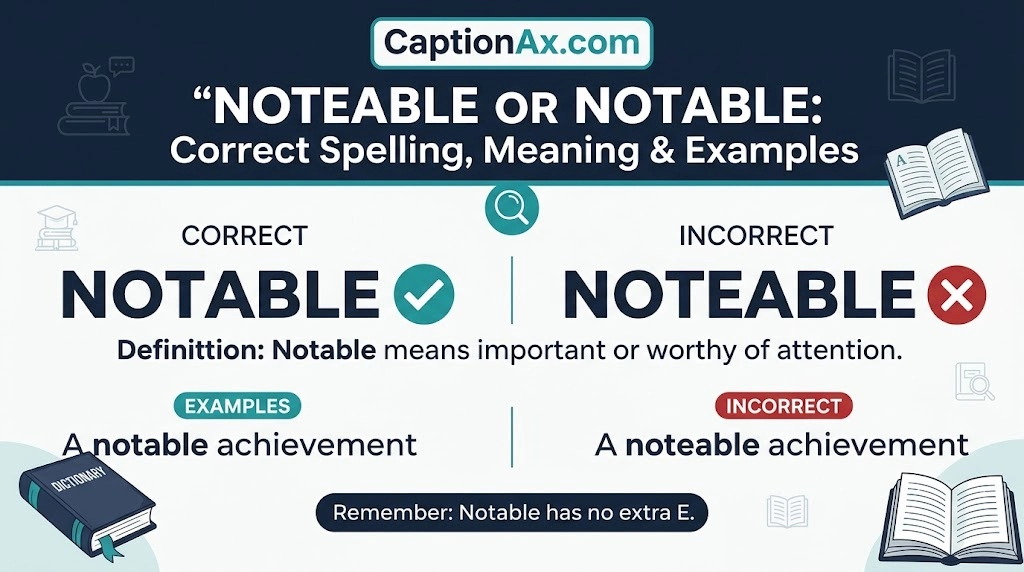
The main difference between notable and noteable is spelling, not meaning. In standard English prose, notable is the established form.
| Feature | Notable | Noteable |
| Standard spelling | Yes | No, for the ordinary adjective |
| Meaning | Important or worthy of attention | No separate standard meaning as this adjective |
| Part of speech | Primarily an adjective; also a noun | Not a standard spelling of the adjective |
| Academic writing | Appropriate | Avoid |
| Business writing | Appropriate | Avoid unless part of a proper name |
| Example | A notable achievement | A noteable achievement — incorrect |
Here are more examples:
Academic writing
- Correct: The researchers identified a notable limitation.
- Incorrect: The researchers identified a noteable limitation.
Business communication
- Correct: Our team achieved notable progress this quarter.
- Incorrect: Our team achieved noteable progress this quarter.
Everyday writing
- Correct: It was a notable moment in her career.
- Incorrect: It was a noteable moment in her career.
Remember that a spellchecker is useful, but context still matters. An unusual brand name may be intentional, whereas the same spelling in an ordinary sentence is likely an error.
How to Use Notable in a Sentence
You can use notable in academic papers, professional emails, reports, news articles, and everyday conversation. It usually appears before a noun, but it can also follow a linking verb such as is, was, or became.
Before a noun
- She received an award for her notable achievements.
- The museum houses a notable collection of historical documents.
- The company reported a notable increase in revenue.
After a linking verb
- His contribution was notable.
- The building is notable for its unusual design.
- Her research became notable for its attention to detail.
In academic writing
- The study revealed a notable difference between the two groups.
- The researcher made a notable contribution to the field.
- One notable limitation was the small sample size.
Professional communication
- Our team achieved notable progress this quarter.
- The report highlights several notable improvements.
- The project produced notable results within the planned timeframe.
In everyday conversation
- That was a notable moment in the match.
- She has made notable progress in learning English.
- The restaurant is notable for its homemade desserts.
Use notable when the subject deserves attention or recognition. If you simply mean that a difference is easy to see, noticeable may express your idea more precisely.
Correct and Incorrect Examples of Notable
The following table shows common mistakes and their corrections.
| Incorrect sentence | Correct sentence |
| She made a noteable contribution. | She made a notable contribution. |
| The company recorded a noteable increase. | The company recorded a notable increase. |
| He is a noteable expert in his field. | He is a notable expert in his field. |
| The report contains a noteable finding. | The report contains a notable finding. |
| They achieved a noteable victory. | They achieved a notable victory. |
| The museum has a noteable collection. | The museum has a notable collection. |
| It was a noteable exception. | It was a notable exception. |
| The city has a noteable history. | The city has a notable history. |
- Explore More: https://captionax.com/implicit-vs-complicit/
Here are additional examples of correct usage:
- The most notable feature of the house is its large garden.
- The conference attracted several notable speakers.
- Her most notable achievement was establishing a scholarship program.
- The report highlighted one notable exception.
- The town is notable for its traditional architecture.
- Several notable changes occurred during the final stage of the project.
When proofreading, do not replace words mechanically. Check that notable conveys the meaning you intend and that the sentence reads naturally.
How to Remember the Correct Spelling
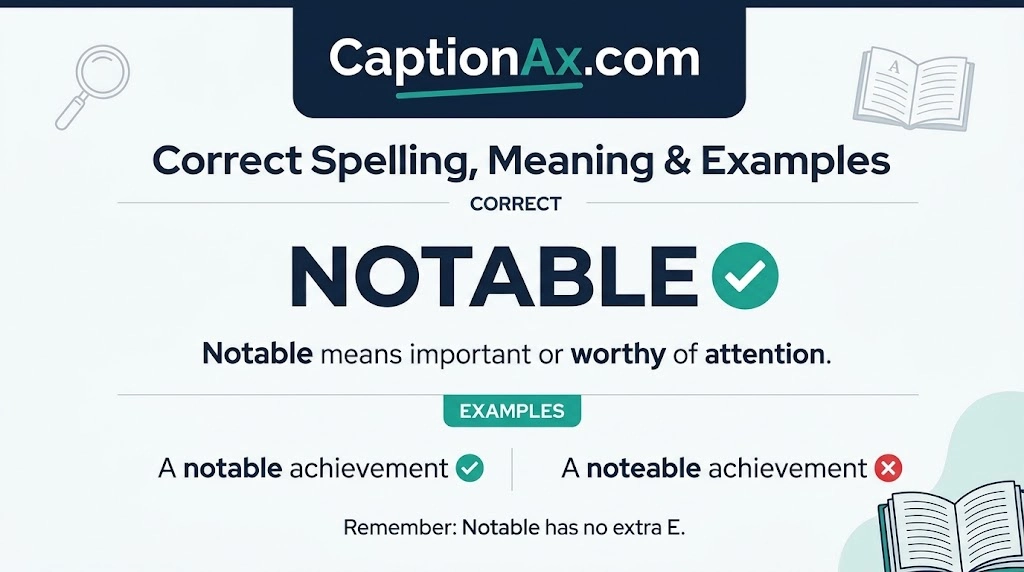
The simplest way to remember the correct spelling is to memorize notable as a complete word instead of trying to reconstruct it from note and able.
Try these five practical techniques:
- Memorize the letters: N-O-T-A-B-L-E.
- Remember an example: “She made a notable contribution.”
- Notice the extra letter: Noteable contains an additional “e” that the standard adjective does not use.
- Practice with context: Write three sentences using notable in different situations.
- Verify unfamiliar words: Consult a reputable dictionary when writing something important.
A short memory aid is:
Important or remarkable = notable.
You can also remember this contrast:
- A notable achievement deserves recognition.
- A noticeable change is easy to observe.
Practicing these words together helps you remember both their spellings and their meanings.
Is Notable Spelled the Same in British and American English?
Yes. Notable is the standard spelling in both British and American English. You do not need to change the spelling when writing for readers in the United Kingdom or the United States. Cambridge Dictionary lists the word in both British and American English entries.
Some English words do have regional spelling differences:
| British English | American English |
| Colour | Color |
| Centre | Center |
| Travelling | Traveling |
| Organise | Organize |
However, notable does not have an equivalent British-versus-American spelling variation.
Examples in both varieties include:
- The scientist made a notable discovery.
- The city is notable for its historic buildings.
- The company achieved notable growth.
- She played a notable role in the project.
Do not use noteable as an alternative British spelling. In ordinary writing, use notable in either variety.
How Do You Pronounce Notable?
Cambridge Dictionary gives the American pronunciation as approximately /ˈnoʊ.t̬ə.bəl/ and the British pronunciation as /ˈnəʊ.tə.bəl/. The main difference is the vowel sound at the beginning, which varies by accent.
A simple pronunciation guide is:
NOH-tuh-buhl
Break the word into three syllables:
- NOH
- tuh
- buhl
Example: “The report identified a notable improvement in customer satisfaction.”
The written word is notable, not noteable. Pronunciation can help you recognize the word, but learning the standard written form is the best way to avoid the spelling error.
What Is the Difference Between Notable and Noticeable?
Both words are correct, but they emphasize different qualities.
Notable means important, remarkable, or worthy of attention.
Noticeable means easy to see, recognize, or detect.
Cambridge Dictionary provides a separate entry for noticeable, emphasizing that something can be easily seen or recognized.
| Notable | Noticeable |
| Emphasizes importance or distinction | Emphasizes ease of perception |
| A notable achievement | A noticeable improvement |
| A notable historical figure | A noticeable difference in appearance |
| A notable contribution | A noticeable change in temperature |
| A notable discovery | A noticeable mark on the wall |
Compare these sentences:
- Notable: The researcher made a notable contribution to medical science. This emphasizes the contribution’s importance.
- Noticeable: There was a noticeable change in the color of the walls. This emphasizes that the change was easy to observe.
The words can sometimes overlap when describing something that stands out, but they are not interchangeable in every context. Choose notable for significance and noticeable for visibility or detectability.
Notable vs. Noteworthy: Are They the Same?
Notable and noteworthy have similar meanings. Both can describe something important or interesting enough to deserve attention.
Cambridge Dictionary defines noteworthy as deserving attention because of importance or interest.
The difference is subtle:
- Notable: Often emphasizes importance, distinction, or recognition.
- Noteworthy: Often emphasizes that something deserves mention or consideration.
Examples:
- She made a notable contribution to the organization.
- Her findings offer several noteworthy observations.
- The building is notable for its distinctive architecture.
- One noteworthy detail was missing from the final report.
In many contexts, either word may work:
- The study produced a notable result.
- The study produced a noteworthy result.
Both sentences suggest that the result deserves attention. The best choice depends on the tone and emphasis you want.
For formal writing, avoid treating synonyms as perfectly interchangeable. Read the complete sentence to decide which word communicates your point most naturally.
What Does Notably Mean?
Notably is an adverb related to notable. It can mean especially, most importantly, or in a way that deserves attention.
Use it when you want to highlight a particular point or identify an especially important example. Cambridge Dictionary also lists notably as a related adverb.
Examples:
- Several departments improved, most notably customer service.
- The company expanded into several markets, notably Europe and Asia.
- She was notably absent from the meeting.
- The two groups differed notably in their results.
- The policy affected several industries, notably manufacturing.
Compare the related words:
| Word | Part of speech | Example |
| Notable | Adjective | It was a notable achievement. |
| Notably | Adverb | She performed notably well. |
| Noteworthy | Adjective | It was a noteworthy discovery. |
| Noticeable | Adjective | There was a noticeable change. |
The key distinction is grammatical as well as semantic. Use notable to describe a noun, and use notably to modify a verb, adjective, or statement.
Can Noteable Be Correct as a Brand Name?
Although noteable is generally a misspelling of the ordinary English adjective, Noteable may be correct when it is the verified official name of a company, application, product, or project.
Proper names can use distinctive spellings chosen by their owners. Their spelling does not necessarily follow the conventions of ordinary English vocabulary.
Consider these hypothetical examples:
- Ordinary adjective: The team made a notable improvement.
- Product name: The company launched an application called Noteable.
In the first sentence, notable is the standard adjective. In the second, Noteable functions as a proper name.
Before editing a document, identify what the word refers to. If it is a brand or product, verify the official spelling on the organization’s website or documentation.
Do not assume that every occurrence of Noteable is a spelling error. However, when you mean something important or remarkable, use notable.
People Also Ask
A:Noteable is generally treated as a misspelling of notable when used as the ordinary adjective. It may appear as an intentionally chosen proper name, but it is not the standard spelling for something important or remarkable.
A:Notable is the correct standard spelling. Use it to describe an important achievement, a distinguished person, a remarkable event, or a feature that deserves attention.
A:The established spelling is notable. Although noteable may appear logical because of its resemblance to note and able, standard English uses the shorter spelling.
A:Notable is primarily an adjective, as in “a notable achievement.” It can also be a noun referring to an important or famous person, as in “local notables.”
A:Its tone depends on context. A notable achievement usually conveys recognition or praise, while a notable problem highlights an issue that deserves attention. The word itself does not always imply something positive.
A:Memorize N-O-T-A-B-L-E, practice the word in a sentence, and consult a dictionary when uncertain. Remember that noticeable is a separate, correctly spelled word.
Final Verdict
The answer is straightforward: Notable is correct, while noteable is generally incorrect in standard English when used as the ordinary adjective.
Use notable when describing an important person, a remarkable achievement, a significant event, or a feature worthy of attention. Use noticeable when something is easy to observe, noteworthy when something deserves attention or mention, and notably when you need an adverb.
Remember these examples:
- Correct: She made a notable contribution.
- Incorrect: She made a noteable contribution.
- Correct: There was a noticeable difference.
- Correct: Her discovery was noteworthy.
Before publishing an article, submitting an assignment, or sending a professional email, check both the spelling and the meaning. A few seconds of proofreading can help you avoid this common mistake and communicate more clearly.