
Kick Rocks Meaning: What It Means in Slang, Texting & Conversation
Have you ever received a message saying “Kick Rocks” and wondered whether the person was joking, angry, or telling you to leave them alone? This expression is common in informal English, especially in situations involving annoyance, disagreement, or rejection.
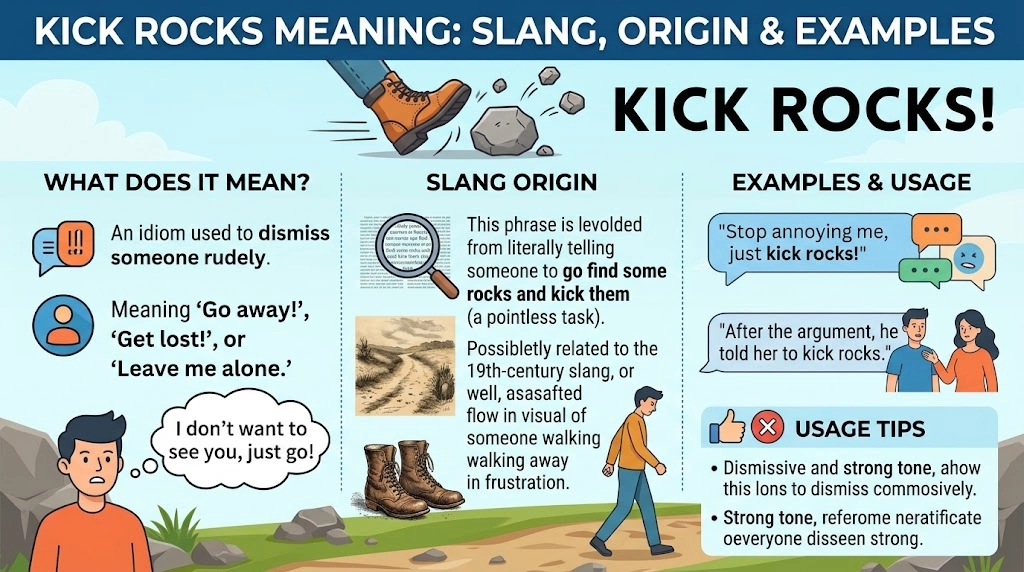
Kick rocks means “go away,” “get lost,” or “stop bothering me.” It is an informal slang expression that usually dismisses someone or rejects what they are saying. Depending on the situation, it can sound playful, sarcastic, rude, or openly hostile.
For example, if someone keeps sending unwanted messages, a person might respond, “Go kick rocks.” In a friendly conversation, however, the same phrase might be used jokingly between people who understand each other’s humor.
Understanding the context is essential because the expression does not always carry the same level of hostility. This guide explains the meaning of kick rocks, its use in texting and social media, its uncertain origins, natural examples, similar expressions, and appropriate ways to respond.
What Does Kick Rocks Mean?
Kick rocks means to go away, get lost, or leave someone alone. People use this slang phrase to dismiss someone, express irritation, or show that they do not want to continue an interaction.
The expression is usually informal and dismissive. It can communicate anything from mild annoyance to a firm rejection, depending on the speaker’s tone and relationship with the listener.
For example:
- “If you don’t like my opinion, go kick rocks.”
- “He kept bothering me, so I told him to kick rocks.”
- “She said I could kick rocks after I asked for another favor.”
In each example, the phrase communicates rejection rather than a literal request to kick stones.
The expression can be used in spoken conversation, text messages, online arguments, and casual social media discussions. It is generally unsuitable for formal or professional communication.
Quick Meaning Summary of Kick Rocks
| Detail | Meaning |
| Phrase | Kick rocks |
| Simple definition | Go away or get lost |
| Category | Slang and idiomatic expression |
| Typical tone | Dismissive, annoyed, sarcastic, or playful |
| Common use | Rejecting someone or ending an unwanted interaction |
| Common variation | Go kick rocks |
| Formality | Informal |
| Profanity | Not inherently a swear word |
Quick answer: When someone tells you to kick rocks, they usually want you to go away or stop bothering them.
What Does Kick Rocks Mean in Texting?
In texting, kick rocks usually means “leave me alone” or “I don’t want to deal with you.” Someone might send it after an argument, an unwanted request, repeated messages, or a disagreement.
Because text messages do not always communicate tone clearly, the phrase can be difficult to interpret without understanding the conversation.
Here are a few examples:
Example 1: After an argument
Person A: “You never listen to what I say.”
Person B: “Whatever. Go kick rocks.”
Meaning: Person B is dismissing the conversation and may be angry.
Example 2: Rejecting a request
Person A: “Can you lend me money again?”
Person B: “No. Go kick rocks this time.”
Meaning: Person B refuses the request in a blunt or sarcastic way.
Example 3: Friendly teasing
Person A: “Your team is terrible. Mine is much better.”
Person B: “Oh, please, go kick rocks 😂”
Meaning: The speaker may be jokingly dismissing the comment rather than expressing genuine hostility.
When interpreting this phrase in a text, consider the surrounding messages, the relationship between the people, and whether the conversation is playful or tense.
What Does Go Kick Rocks Mean?
“Go kick rocks” is a common variation of “kick rocks.” Adding “go” makes the instruction to leave or stop bothering someone more explicit.
The expression is often used when a speaker wants to reject a request, end an argument, or tell another person that their behavior is unwelcome.
Examples include:
- “You think I’m going to apologize for that? Go kick rocks.”
- “If you don’t respect my boundaries, go kick rocks.”
- “He wanted me to do all his work, so I told him to go kick rocks.”
The wording is generally dismissive. It can sound more confrontational than simply saying, “I don’t agree,” or “Please leave me alone.”
Is Kick Rocks an Insult?
Yes, Kick Rocks can be an insult, but its severity depends on context. It dismisses the other person and may imply that their presence, request, or opinion is unwanted.
It is not inherently a swear word, but that does not mean it is polite.
Consider these situations:
- Playful: Friends use the phrase while joking about a sports rivalry.
- Dismissive: Someone uses it to reject an unwanted request.
- Rude: A person says it during a heated disagreement.
- Hostile: Someone uses it to humiliate or aggressively reject another person.
The phrase is generally less explicit than strong profanity, although it can still hurt someone’s feelings. If you are unsure how it will be received, a more direct and respectful expression is usually safer.
Where Did the Phrase Kick Rocks Come From?
The exact origin of “kick rocks” is uncertain. It is commonly understood as an American English slang expression, but its precise beginnings and earliest usage have not been firmly established.
One proposed explanation connects the phrase with the image of someone walking away while idly kicking stones. Another theory links it to people passing time by kicking rocks when they have little else to do.
Some accounts also discuss possible connections with prison slang. However, these explanations should be treated as theories rather than established historical facts.
The Routledge Dictionary of Modern American Slang and Unconventional English records “kick rocks!” as a command meaning “go away” in a 2001 reference to US slang. This supports documented use by that time, but it does not establish when the phrase was first coined.
For a trustworthy explanation, it is important to distinguish a recorded example from a confirmed origin story. The expression’s general meaning is much clearer than its exact history.
How Is Kick Rocks Used in a Sentence?
The phrase usually appears as a dismissive command, often with “go” before it. It can also appear in reported speech when someone describes how they rejected another person.
Here are natural examples:
- “If you came here to argue, go kick rocks.”
- “She told the rude customer to kick rocks.”
- “He wanted me to do his homework, but I told him to kick rocks.”
- “They can kick rocks if they think I’ll change my mind.”
- “I was joking when I said you could kick rocks.”
- “After the repeated insults, she decided to tell him to kick rocks.”
- “He laughed and told his friend to kick rocks.”
- “If they don’t appreciate your effort, don’t waste your time trying to impress them.”
Notice that the phrase is usually directed at a person or group, rather than used as a neutral description of an activity.
Grammar tip: In “I told him to kick rocks,” the phrase follows the infinitive marker “to.” In “Go kick rocks,” it works as a direct informal command.
What Does Kick Rocks Mean on Social Media?
On social media, kick rocks generally carries the same dismissive meaning it has in everyday conversation. People may use it in comments, replies, memes, captions, or online arguments.
Its tone depends on the surrounding Kick Rocks Meaning post and the relationship between the people interacting.
TikTok and Instagram
Someone might comment “Go kick rocks” on a post they strongly disagree with. Friends might also use it humorously in a video or comment thread.
Snapchat and direct messages
In private messages, the phrase may indicate frustration, rejection, or a desire to end a conversation. Emojis and previous messages can help clarify whether it is meant jokingly.
Facebook, Reddit, Discord, and X
In discussion threads, the phrase can serve as a blunt response to an unwanted opinion, unreasonable request, or provocative comment.
These are examples of how the expression can be used across platforms, not a claim that every platform has a unique meaning for it.
If someone directs the phrase at you online, look at the context before assuming it is either harmless humor or a serious personal attack.
What Is the Difference Between Kick Rocks and Get Lost?
Both “kick rocks” and “get lost” can tell someone to go away. The main difference is their wording and the tone they may convey.
| Expression | Meaning | Typical tone |
| Kick rocks | Go away or stop bothering me | Dismissive, sarcastic, or rude |
| Get lost | Go away; leave me alone | Blunt, often confrontational |
| Take a hike | Go away | Informal, sometimes playful |
| Beat it | Leave immediately | Direct and forceful |
| Pound sand | Go away or stop wasting my time | Dismissive, sometimes sarcastic |
| Leave me alone | Stop bothering me | Direct; can be polite or firm |
These expressions overlap, but they are not identical in every situation. Tone, delivery, and relationship can make Kick Rocks Meaning even a relatively mild expression sound hostile.
For a polite alternative, try “Please leave me alone” or “I’m not interested in continuing this conversation.”
What Are Other Ways to Say Kick Rocks?
If you want to communicate the same general idea, choose an expression that matches your intended tone.
Casual alternatives
- Get lost.
- Take a hike.
- Beat it.
- Go away.
- Leave me alone.
Sarcastic alternatives
- Don’t let the door hit you on the way out.
- Keep walking.
- Find someone else to bother.
- That’s not my problem.
These alternatives can also sound rude, so use them carefully.
Polite alternatives
- I’m not interested, thanks.
- Please give me some space.
- I’d rather not continue this conversation.
- I can’t help with that request.
- Let’s agree to disagree.
Best tip: If your goal is to establish a boundary rather than provoke an argument, a clear and respectful statement usually works better than slang.
- Explore More: https://captionax.com/feel-or-feal/
How to Respond When Someone Says Kick Rocks
If someone tells you to kick rocks, you do not need to respond with an insult. Your best response depends on whether you want to keep the conversation friendly, set a boundary, or end the interaction.
Calm responses
- “Okay, I’ll give you some space.”
- “I understand. Let’s leave it here.”
- “There’s no need to be disrespectful.”
- “We can talk when we’re both calmer.”
Funny responses
Use these only when you know the other person is joking and the situation is friendly.
- “Only if the rocks are comfortable.”
- “I’ll bring my walking shoes.”
- “Fine, but I’m choosing the scenic route.”
- “That’s a creative way to say goodbye.”
Assertive responses
- “You can disagree without insulting me.”
- “I’m happy to talk when you’re ready to be respectful.”
- “I’ve heard you. This conversation is over.”
- “I’ll respect your space, and I expect the same in return.”
If the phrase appears in a hostile conversation
You can choose not to reply, mute the conversation, or disengage. If the interaction becomes threatening or involves repeated Kick Rocks Meaning harassment, prioritize your safety rather than trying to win the exchange.
The key is to understand what you want to achieve before responding.
Is Kick Rocks the Same as Telling Someone to Go Away?
The expressions are similar, but “Kick Rocks” usually adds a dismissive or sarcastic edge to the instruction.
“Go away” can be a neutral request for distance. For example, someone might politely ask another person to leave because they need privacy.
“Kick rocks” is more likely to communicate irritation, rejection, or contempt. It can also be playful among close friends.
Compare:
- “Please go away; I need to work.” This gives a clear reason and can be respectful.
- “Go kick rocks.” This sounds more dismissive and may provoke a negative reaction.
The intended message may be similar, but the social effect can be different.
Can You Use Kick Rocks in a Professional Setting?
Generally, it is better to avoid “kick rocks” at work. The phrase is informal and can sound disrespectful when directed at a colleague, customer, supervisor, client, or business partner.
Instead of saying:
“Go kick rocks if you think I’ll do your work.”
Try:
“I’m unable to take on that additional responsibility.”
Instead of saying:
“You can kick rocks if you don’t like my decision.”
Try:
“I understand that we disagree, but this is my final decision.”
Professional communication works best when it is direct, calm, and specific. You can establish firm boundaries without using language that escalates a disagreement.
Is Kick Rocks a Bad Word?
“Kick rocks” is slang, but it is not inherently a swear word or a profane expression. It is better described as an informal, dismissive phrase.
However, a phrase does not need to contain profanity to be rude. Telling someone to kick rocks can be insulting because it expresses rejection or contempt.
For example, a teacher, employer, or customer service representative would generally be better off using a respectful alternative. Close friends might use it jokingly if both understand the tone.
When deciding whether it is appropriate, consider the audience, relationship, setting, and likely impact.
Common Misunderstandings About Kick Rocks
It always means someone is angry
Not necessarily. It can be used humorously between friends, although it often conveys annoyance or rejection.
It is a literal instruction
Usually not. In ordinary slang usage, it is an idiomatic way to tell someone to go away rather than a request to kick actual stones.
It is always a swear word
No. It is dismissive slang, not inherently profanity. It can still be offensive depending on the context.
Its exact origin is known
No definitive origin has been established. Explanations involving idle walking, children kicking stones, or prison settings should not be presented as proven without stronger historical evidence.
It has a special meaning on every social platform
The phrase generally retains its ordinary slang meaning online. Its tone changes with context rather than automatically changing from one platform to another.
People Also Ask
A:It means “go away,” “get lost,” or “stop bothering me.” It is an informal expression people use to dismiss someone or reject a request.
A:It generally means the person wants you to leave them alone or stop pursuing a conversation or request. It does not automatically indicate romantic rejection; the surrounding situation determines what they mean.
A:It is a blunt way to tell someone to go away or stop bothering the sender. It may be angry, sarcastic, or playful, depending on the conversation.
A:It can be. The phrase is usually dismissive and may sound insulting, especially during an argument. Among close friends, it can be playful if both people understand the joke.
A:Possible alternatives include “get lost,” “take a hike,” “beat it,” and “pound sand.” For a more respectful option, use “please leave me alone” or “I’m not interested.”
Final Thoughts
The phrase Kick Rocks means “go away,” “get lost,” or “leave me alone.” It is informal slang that commonly expresses annoyance, rejection, sarcasm, or dismissal.
Although friends may use it jokingly, the phrase can sound rude or hostile in an argument, a text message, or a professional conversation. Its exact historical origin remains uncertain, so claims about its beginnings should be treated cautiously.
If someone tells you to kick rocks, consider the context before reacting. You can respond with humor when the situation is friendly, set a clear boundary when necessary, or simply disengage when the conversation is no longer productive.
Understanding both the meaning and the tone helps you interpret the expression accurately and choose the right words in return.
Explore more slang meanings and everyday English expressions on CaptionAx.com to keep building your understanding of modern informal language.