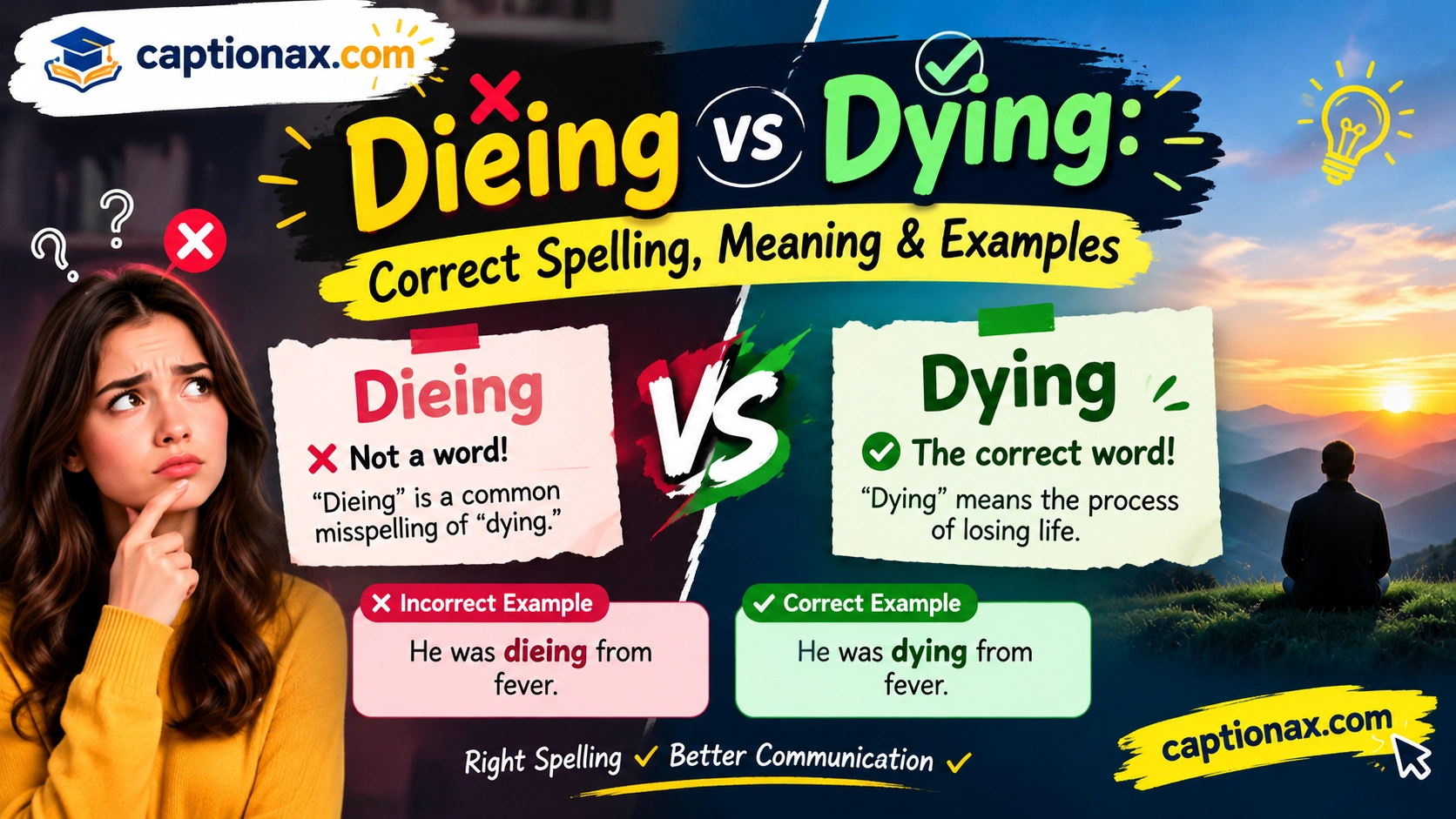
Correct Spelling, Meaning & Examples
Have you ever paused while writing and wondered whether the correct spelling is Dieing or Dying? You’re not alone. These two spellings look similar, and the confusion often arises because English verbs usually form their present participles by adding -ing to the base form. However, the verb die follows a different spelling pattern.
The correct spelling in standard English is dying when you mean losing life, fading away, weakening, or gradually coming to an end. Dieing is not the standard present participle of die and should generally be avoided in everyday writing.
Another word that creates confusion is dyeing, which means changing the color of something, such as fabric or hair. Although dying and dyeing sound alike, they have different meanings and spellings.
In this guide, you’ll learn the difference between dieing vs dying, understand the grammar rule behind the correct spelling, explore real-world examples, and discover how to distinguish dying, dyeing, died, and dyed. You’ll also find a quick comparison table, common mistakes, and a short quiz to test your knowledge.
Dieing vs Dying: Which Spelling Is Correct?
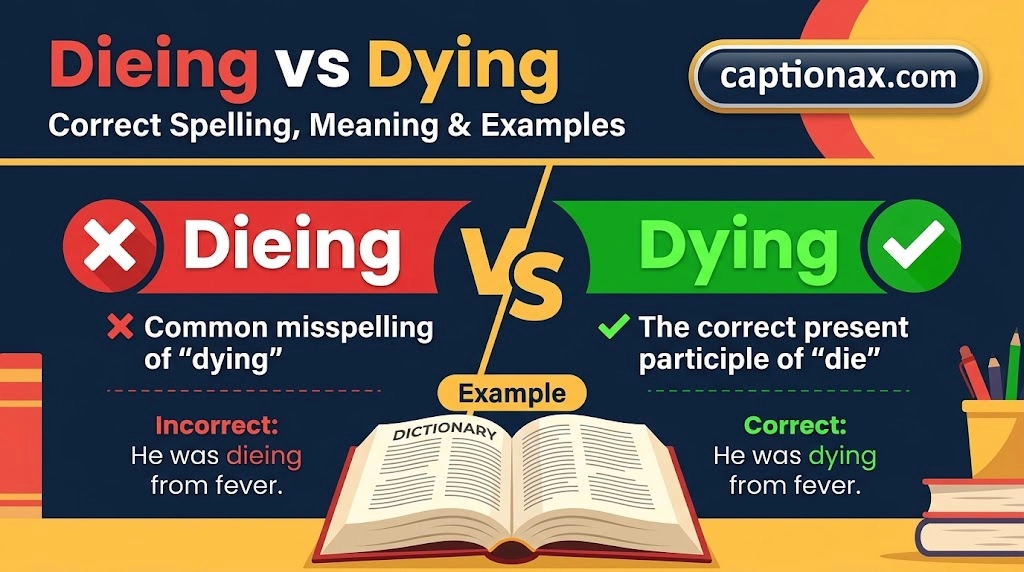
Dying is the correct standard spelling when referring to the process of losing life, gradually fading, or coming to an end. Dieing is generally considered a misspelling when used with these meanings.
The confusion comes from the assumption that you can form every present participle by adding -ing directly to its base verb. English spelling has several patterns, and die changes its final ie to y before adding -ing.
Consider these examples:
- Correct: The flowers are dying because they haven’t received enough water.
- Incorrect: The flowers are dieing because they haven’t received enough water.
- Correct: My phone battery is dying, so I need a charger.
- Incorrect: My phone battery is dieing, so I need a charger.
- Correct: I’m dying to know the results.
- Incorrect: I’m dieing to know the results.
The correct spelling remains dying whether you use it literally or figuratively.
| Word | Meaning | Correct usage |
| Dying | Losing life, fading, or coming to an end | The plant is dying. |
| Dieing | Nonstandard spelling of the ordinary verb form | Avoid in everyday writing. |
| Dyeing | Applying color to a material | She is dyeing her hair. |
| Died | Past tense of die | The tree died last winter. |
| Dyed | Past tense of dye | She dyed her shirt blue. |
Quick answer: Use dying for death, decline, or something fading away. Use dyeing when someone is coloring fabric, hair, or another material.
What Does Dying Mean?
Dying is the present participle of the verb die. It can function as part of a verb phrase or as an adjective, depending on the sentence.
Its meaning changes according to the context.
Losing life
Dying can describe a person, animal, or other living organism approaching the end of life.
Examples:
- The family stayed beside their dying pet.
- The injured bird was dying when the rescue team arrived.
- The doctor explained that the patient was critically ill and dying.
Gradually losing health or vitality
The word can describe a plant or living thing that is losing its ability to thrive.
Examples:
- The flowers are dying in the summer heat.
- The tree is dying because its roots have been damaged.
- Several crops are dying because of the prolonged drought.
Gradually disappearing
Dying can also describe something that is becoming less common, popular, active, or influential.
Examples:
- The community is trying to preserve a dying language.
- Interest in the outdated product is dying.
- The small business is struggling in a changing market.
Losing power or intensity
In everyday conversation, dying can describe a device losing power, a fire weakening, or a sound fading away.
Examples:
- My laptop is dying, so I’ll save my work.
- The fire was dying down as the rain began.
- The sound of the music was dying away in the distance.
Expressing a strong desire
The informal expression be Dying to means wanting something very much.
Examples:
- I’m dying to see your holiday photographs.
- She is dying to know the final result.
- We’re dying for a cup of coffee after the long journey.
These examples demonstrate that dying has both literal and figurative meanings. Its spelling does not change when the meaning changes.
Is Dieing a Word?
In standard everyday English, dieing is not the accepted spelling of the present participle of die. If you’re writing an essay, professional email, blog post, school assignment, or social media caption, use dying when you mean losing life or coming to an end.
You may occasionally encounter dieing in unusual historical material, specialist discussions, or writing about industrial processes involving a tool called a die. Such contexts require care because technical terminology can vary.
For example, manufacturing commonly uses established terms such as die cutting, die casting, and die forming. These terms refer to specific processes and should not be casually replaced with dying.
Compare the following sentences:
- Standard English: The old tree is dying.
- Standard English: The company is trying to save a dying business.
- Standard English: She is dyeing a cotton shirt blue.
- Technical terminology: The factory uses die cutting to shape the material.
Do not assume that every occurrence of dieing represents a recognized alternative spelling. If you encounter it in a technical document, consult an appropriate industry reference.
For ordinary English writing, the practical rule is simple: choose dying for the verb die and dyeing for the verb dye.

Why Is Dying Spelled With a Y?
The spelling rule explains why die becomes dying rather than dieing.
When a verb ends in -ie, English generally changes the final ie to y before adding -ing. This spelling pattern makes the new form easier to distinguish and follows an established convention in English verb formation.
The transformation is:
Die → Dying
The letters ie change to y, and then -ing is added.
The same pattern appears in other common verbs:
| Base verb | Present participle | Example |
| Die | Dying | The plant is dying. |
| Lie | Lying | She is lying on the sofa. |
| Tie | Tying | He is tying his shoes. |
| Vie | Vying | Several teams are vying for the prize. |
Notice that the verbs do not become dieing, lieing, or tieing.
However, not every verb ending in a similar sound follows this exact pattern. English spelling has different rules depending on the word’s ending, so it’s helpful to learn common patterns with examples rather than assume one rule applies to every verb.
Memory tip: When a verb ends in -ie, think of the familiar sequence die → dying, lie → lying, tie → tying.
Dieing vs Dying: Key Differences
The most important distinction is that dying is the standard present participle of die, while dieing is not the standard spelling for that meaning.
| Feature | Dying | Dieing |
| Standard spelling of the verb die with -ing | Yes | No |
| Used for losing life | Yes | No |
| Used for fading or decline | Yes | No |
| Appropriate in ordinary essays | Yes | Generally no |
| Appropriate in everyday emails | Yes | Generally no |
| Standard spelling for expressing strong desire | Yes | No |
Examples in context:
- The leaves are dying because the weather is too hot.
- The old tradition is dying out.
- My phone is dying, and I need to charge it.
- I’m dying to find out what happened.
All four sentences use the same standard spelling.
The word dieing may look logical to someone who expects every verb to take -ing without any spelling changes. Nevertheless, English has established spelling patterns that determine the correct form.
When proofreading, don’t rely solely on how a word looks or sounds. Check the base verb and its grammatical form.
Dying vs Dyeing: What Is the Difference?
Dying and dyeing are different words with different meanings. Although they sound alike in many varieties of English, they are not interchangeable.
Dying comes from die. It refers to losing life, fading, declining, or coming to an end.
Dyeing comes from dye. It means applying color to something, such as fabric, clothing, or hair.
| Word | Base verb | Meaning | Example |
| Dying | Die | Losing life or fading | The flowers are dying. |
| Dyeing | Dye | Applying color | She is dyeing the fabric blue. |
| Died | Die | Lost life in the past | The tree died last winter. |
| Dyed | Dye | Applied color in the past | She dyed her hair brown. |
Examples of dying
- The plant is dying without enough water.
- The fire is dying down.
- I’m dying to hear the news.
- The old custom is slowly dying out.
Examples of dyeing
- She is dyeing her hair red.
- They are dyeing white cotton fabric blue.
- The artist is dyeing the material with natural pigments.
- He is learning traditional fabric-dyeing techniques.
Compare these sentences:
Incorrect for the intended meaning: She is dying her hair brown.
Correct: She is dyeing her hair brown.
Incorrect for the intended meaning: The plant is dyeing from a lack of water.
Correct: The plant is dying from a lack of water.
Remember: Die becomes dying, but dye becomes dyeing. The extra e in dyeing helps preserve the spelling of the base verb dye.
- Explore More: https://captionax.com/deem-fit-meaning/
Die, Died, and Dying: Verb Forms Explained
Learning the different forms of die makes it easier to use the word correctly in a sentence.
| Verb form | Correct spelling | Example |
| Base form | Die | Plants die without enough water. |
| Third-person singular | Dies | The flower dies without sunlight. |
| Simple past | Died | The plant died last winter. |
| Past participle | Died | Several plants have died. |
| Present participle | Dying | The remaining plant is dying. |
Each form serves a different grammatical purpose.
Use die after certain modal verbs and in the base form:
- Plants can die without water.
- Some organisms die naturally after completing their life cycle.
Use dies with a singular third-person subject in the simple present:
- The flower dies when its roots receive too little water.
The Use died for an event in the past:
- The tree died during the winter.
Use dying in continuous verb forms or as an adjective:
- The plant is dying.
- The rescue team found a dying animal.
Be careful not to confuse died with dyed. The first is the past tense of die, while the second is the past tense of dye.
For example:
- The tree died last year.
- She dyed the curtains last week.
Both spellings are correct, but they communicate entirely different things.
How to Use Dying in a Sentence
You can use dying in literal, figurative, conversational, and descriptive contexts. The key is to make sure that the word communicates the intended meaning.
Literal use
Use dying when describing a living organism that is approaching the end of life.
- The family spent the afternoon with their dying dog.
- The rescue team helped an injured bird that was dying.
- The documentary examined the final days of a dying forest.
Describing decline
Dying can describe a custom, business, tradition, or activity that is gradually disappearing.
- The town is working to protect a dying tradition.
- The company introduced new products to save its dying brand.
- The use of the old technology is dying out.
Everyday conversation
In informal English, dying can describe a device losing power or someone strongly wanting something.
- My phone is dying, so please send the address quickly.
- I’m dying to try that new restaurant.
- We were dying to know who had won the competition.
Descriptive writing
Writers sometimes use dying to create a vivid image of something fading or losing intensity.
- The dying embers glowed softly in the fireplace.
- A dying breeze moved through the trees.
- The last rays of sunlight faded across the dying light of evening.
These examples illustrate the flexibility of the word. Its meaning changes with context, but the spelling remains dying.
Correct and Incorrect Examples of Dying
Use this table to identify common spelling mistakes and learn the correct alternatives.
| Incorrect sentence | Correct sentence |
| The leaves are dieing. | The leaves are dying. |
| My phone is dieing. | My phone is dying. |
| He is dieing to meet you. | He is dying to meet you. |
| The fire is dieing down. | The fire is dying down. |
| The old language is dieing out. | The old language is dying out. |
| She is dieing her hair red. | She is dyeing her hair red. |
| The tree dyed last winter. | The tree died last winter. |
| She is dying a white shirt blue. | She is dyeing a white shirt blue. |
The final three examples are particularly useful because they involve different words rather than just a misspelling.
- Use dying when something is losing life or fading.
- Use dyeing when someone is applying color.
- Use died when describing the past event of losing life.
- Use dyed when describing a past coloring action.
Remember that spell-check software may identify dieing as an error, but it might not catch a sentence that uses dying where dyeing is required. Always review the meaning as well as the spelling.
Common Expressions That Use Dying
Dying appears in several familiar English expressions. Some are informal, while others describe serious situations or gradual change.
| Expression | Meaning | Example |
| Dying to know | Wanting to know very much | I’m dying to know what happened. |
| Dying for | Strongly wanting something | I’m dying for a glass of water. |
| Dying down | Becoming less intense | The noise is dying down. |
| Dying out | Gradually disappearing | Some traditions are dying out. |
| Dying breed | A type of person or thing becoming rare | Independent bookshops can seem like a dying breed. |
| Dying wish | A wish expressed near the end of life | His dying wish was to reunite the family. |
| Dying embers | The last glowing pieces of a fading fire | The dying embers lit the room. |
What does dying down mean?
The expression dying down means becoming less intense, loud, active, or noticeable.
Example: The crowd’s excitement was dying down after the announcement.
What does dying out mean?
The phrase dying out describes something that is gradually disappearing or becoming less common.
Example: The community is preserving a language that is dying out.
What does dying to know mean?
This informal expression means being extremely curious about something.
Example: I’m dying to know how you solved the problem.
These expressions are useful in everyday speech, creative writing, and social media captions. Use them according to Dieing vs Dying their intended meaning and tone.
British English vs American English: Is There a Difference?
No. Both British and American English use dying as the standard present participle of die. Neither variety uses dieing as the ordinary Dieing vs Dying spelling of this verb form.
Some words have recognized regional spelling differences. For example, British English generally uses colour, while American English uses color. The spelling of dying does not change in this way.
| Context | British English | American English |
| A plant losing life | The plant is dying. | The plant is dying. |
| A battery losing power | My battery is dying. | My battery is dying. |
| A tradition disappearing | The tradition is dying out. | The tradition is dying out. |
| Coloring hair | She is dyeing her hair. | She is dyeing her hair. |
| A tree that lost its life | The tree died last year. | The tree died last year. |
If you’re writing for readers in the United Kingdom, the United States, Canada, Australia, or other English-speaking regions, you can confidently use dying when referring to the verb die.
Always follow the spelling conventions of Dieing vs Dying your publication, but there is no regional spelling choice between dieing and dying in standard English.
Common Mistakes to Avoid
Even experienced writers sometimes confuse these words when typing quickly. Understanding the most common errors can help you proofread more effectively.
Mistake 1: Adding -ing without changing ie to y
Incorrect: The flowers are dieing.
Correct: The flowers are dying.
The verb die changes its final ie to y before taking -ing.
Mistake 2: Confusing dying with dyeing
Incorrect: She is dying her hair blonde.
Correct: She is dyeing her hair blonde.
The second sentence describes a coloring process, so dyeing is the correct word.
Mistake 3: Confusing died with dyed
Incorrect: The tree dyed during the drought.
Correct: The tree died during the drought.
The sentence refers to the tree losing its life, so the past tense of die is required.
Mistake 4: Assuming pronunciation determines spelling
Dying and Dyeing sound alike in many accents, but their meanings and spellings differ. Use the context of the sentence to determine which word you need.
Mistake 5: Trusting spell-check without reviewing meaning
A spelling checker may flag an obvious typo, but it cannot always determine whether you intended to describe death or a coloring process.
Read your sentence again and ask yourself: What exactly am I trying to say?
Mistake 6: Overlooking figurative meanings
Dying does not always refer to literal death. It can describe a declining tradition, a weakening fire, a fading sound, or a strong desire.
For example, “I’m dying to see the results” expresses excitement or curiosity rather than literal danger.
How to Remember the Correct Spelling
You can remember the difference between dieing and dying with three simple techniques.
Trick 1: Learn the ie-to-y pattern
Remember these three verbs:
- Die → Dying
- Lie → Lying
- Tie → Tying
The shared pattern makes the spelling easier to recall.
Trick 2: Connect the spelling to the meaning
Ask yourself what the sentence describes.
- Losing life or fading? Use dying.
- Coloring fabric or hair? Use dyeing.
- Losing life in the past? Use died.
- Coloring something in the past? Use dyed.
Trick 3: Memorize two example sentences
The plant is dying.
This sentence describes a plant losing its health or life.
She is dyeing the fabric blue.
This sentence describes someone applying color to fabric.
The contrast makes the spelling difference easier to remember.
Trick 4: Check the base verb
When you’re unsure, return to the original verb.
If the verb is die, the present participle is dying. If the verb is dye, the present participle is dyeing.
The easiest rule to remember is die → dying, but dye → dyeing.
Practice Quiz: Dieing vs Dying
Test your knowledge with these five Dieing vs Dying questions. Choose the correct word for each sentence before checking the answers.
Question 1: The flowers are _____ because the soil is dry.
- A. Dieing
- B. Dying
- C. Dyeing
For Question 2: She is _____ her hair blonde for the celebration.
- A. Dieing
- B. Dying
- C. Dyeing
Question 3: I’m _____ to find out the competition results.
- A. Dieing
- B. Dying
- C. Dyeing
For Question 4: The old custom is slowly _____ out.
- A. Dieing
- B. Dying
- C. Dyeing
Question 5: The tree _____ during the winter.
- A. Died
- B. Dyed
- C. Dieing
Quiz answers and explanations
- B. Dying — The flowers are losing their health because the soil is dry.
- C. Dyeing — The sentence describes applying color to hair.
- B. Dying — The phrase dying to find out means being very curious.
- B. Dying — Dying out means gradually disappearing.
- A. Died — Died is the simple past tense of die.
If you answered all five correctly, you’ve mastered the basic distinction between these words. If you missed one, review the spelling rule and comparison table above.
People Also Ask
A:Dying is correct when you mean losing life, fading, or coming to an end. Dieing is not the standard spelling of this verb form in ordinary English.
A:The verb die changes its final ie to y before adding -ing. This produces dying, following the same pattern as lie → lying and tie → tying.
A:Dieing is not the standard present participle of die. If you encounter it in an unusual technical or historical context, check the specific terminology. For everyday English, use dying.
A:Dying refers to losing life, fading, or gradually coming to an end. Dyeing means applying color to fabric, hair, or another material.
A:The simple past tense is dead. For example, “The tree died last winter.” Do not confuse died with dyed, which is the past tense of dye.
Conclusion
Understanding Dieing vs Dying becomes much easier once you learn the spelling rule. Dying is the standard present participle of die and describes losing life, fading, weakening, or coming to an end. Dieing should generally be avoided in ordinary English writing.
The related word dyeing has a different meaning: it describes applying color to something, such as clothing or hair. Meanwhile, died is the past tense of die, and dyed is the past tense of dye.
Keep these four forms in mind:
- Die → Dying: The plant is dying.
- Die → Died: The tree died last winter.
- Dye → Dyeing: She is dyeing her hair.
- Dye → Dyed: She dyed her shirt blue.
Whether you’re writing a school assignment, professional email, blog post, or social media caption, choosing the correct spelling makes your writing clearer and more accurate.
Save this guide for future reference, share it with Dieing vs Dying someone learning English, and explore more spelling and grammar guides on CaptionAx.com to strengthen your everyday writing skills.