Lay vs. Lie: Which Is Correct? Simple Guide
Have you ever paused while writing a sentence because you could not decide whether to use Lay or Lie? You are not alone. These two English verbs are easy to confuse because they have similar meanings in some situations, but their grammar and verb forms are different.
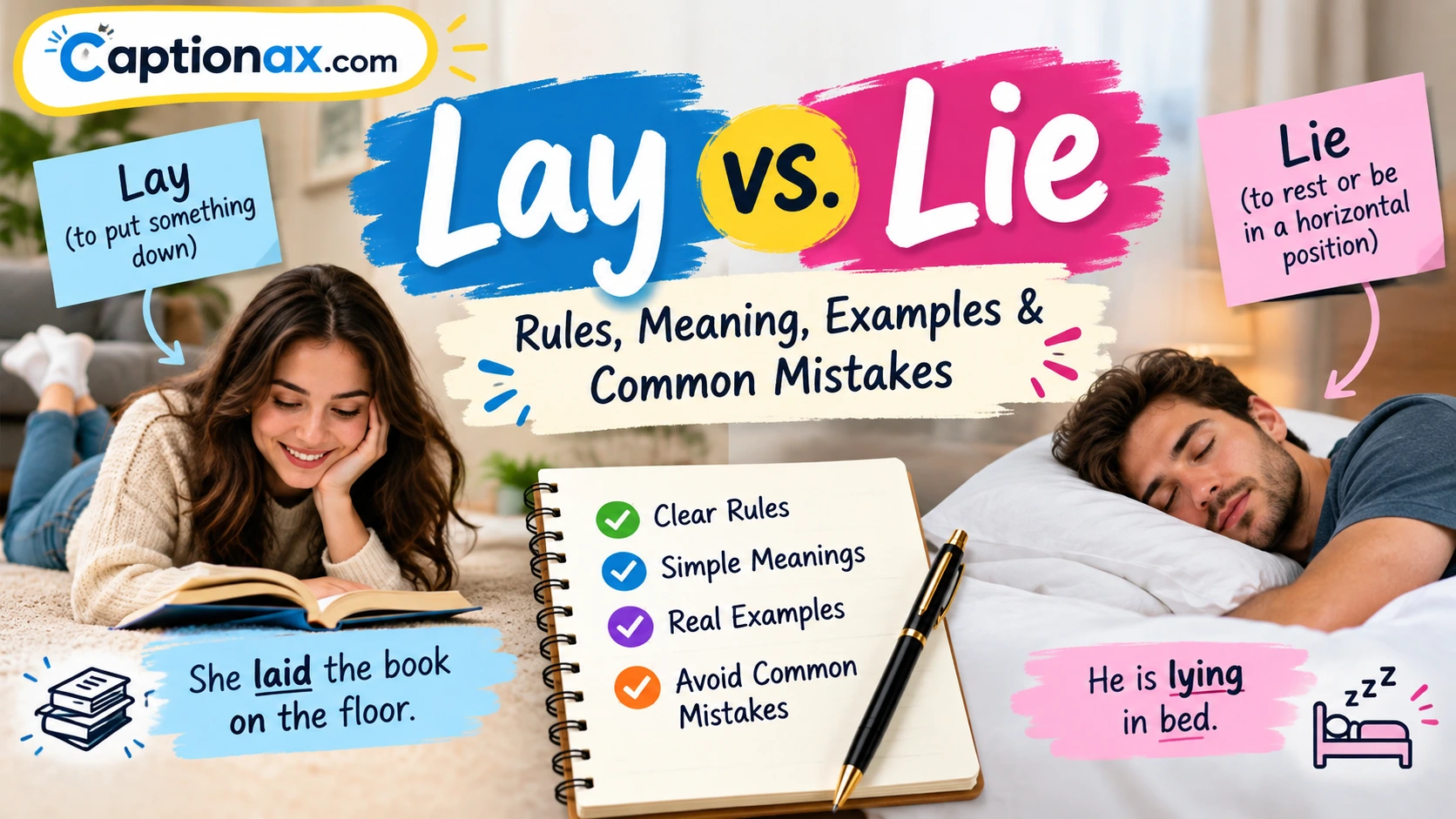
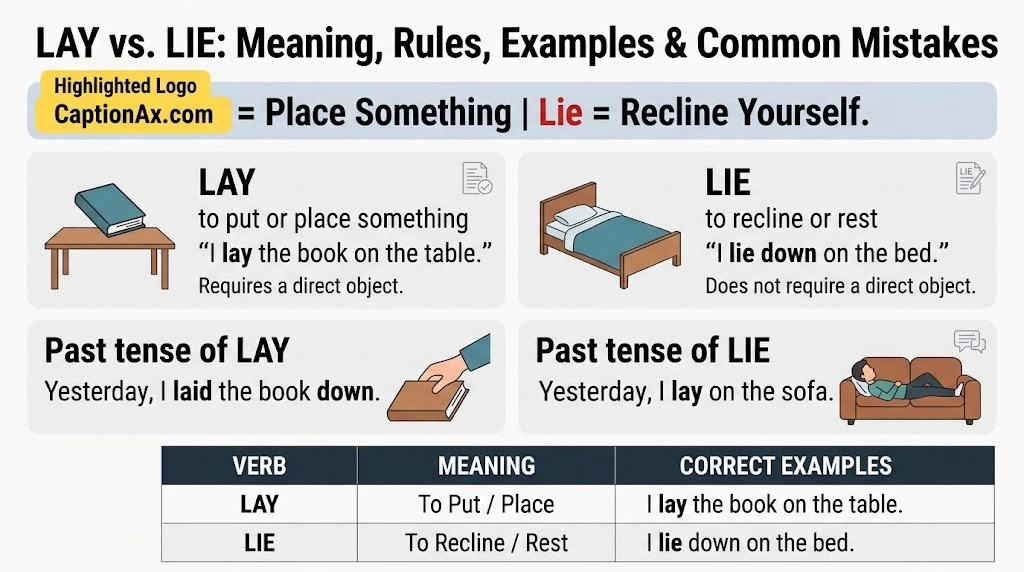
The basic rule is simple: lay means to put or place something somewhere, while lie means to recline, rest, or remain in a position. For example, you lay a book on a desk, but you lie down on a sofa. The tricky part is the past tense: lay is also the past tense of lie when it means to recline.
Understanding this distinction will help you write more accurately in everyday conversations, school assignments, emails, blog posts, and professional documents. This guide explains the meanings of lay and lie, their verb forms, practical examples, common mistakes, easy memory tricks, and a quiz with answers.
Lay vs. Lie: What Is the Difference?
The main difference between lay vs. lie is whether the verb describes placing something or describes a person or thing resting in a position.
- Lay: To put or place someone or something somewhere.
- Lie: To recline, rest, or remain in a position.
- Lie: To tell an untruth, which is a separate verb with different past-tense forms.
Consider these examples:
- Please lay the book on the table.
- I need to lie down for a few minutes.
- Yesterday, I lay on the sofa.
- Yesterday, I laid the book on the table.
- He lied about what happened.
The first and fourth sentences describe placing an object. The second and third describe reclining. The fifth uses lie in the sense of telling an untruth.
Lay vs. lie comparison table
| Feature | Lay (place) | Lie (recline) |
| Meaning | Put or place something | Rest or recline |
| Direct object | Normally required | Not required |
| Present form | Lay | Lie |
| Third-person singular | Lays | Lies |
| Past tense | Laid | Lay |
| Past participle | Laid | Lain |
| Present participle | Laying | Lying |
| Example | Lay the book here. | Lie on the sofa. |
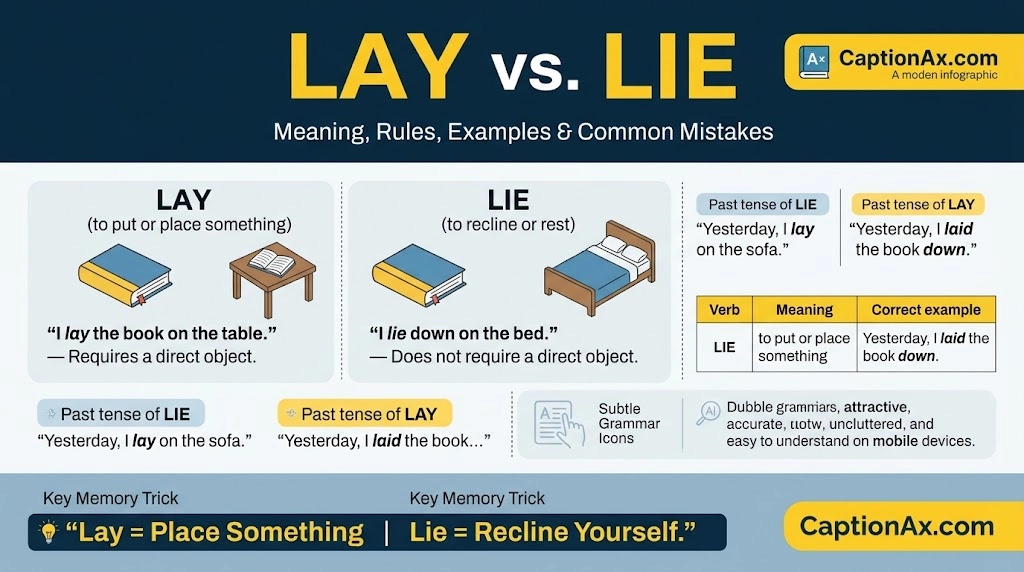
Quick rule: You lay something down, but you lie down yourself. When discussing the past, remember that lay can also mean that someone reclined.
What Does Lay Mean in Grammar?
The verb lay means to put, place, or position something somewhere. In this meaning, it is a transitive verb, which means it normally takes a direct object.
For example, in the sentence “Mia laid her phone on the desk,” the phone is the object being placed. The verb laid is correct because the sentence describes an action performed on something.
Examples of lay in sentences
- Please lay your notebook beside the computer.
- She lays the baby gently in the crib.
- He laid his jacket on the chair.
- We are laying new tiles in the kitchen.
- The workers have laid the foundation.
- Lay the cards face up on the table.
- The hen lays an egg almost every day.
The meaning can extend beyond physical placement. English speakers also use Lay in expressions such as “lay the groundwork,” “lay down the rules,” and “lay a foundation.”
How to recognize lay
Ask yourself: What is being placed?
Example: “I laid the keys on the counter.”
What did I lay? The keys.
Because the keys receive the action, laid is the appropriate form.
Remember the verb pattern:
- Present: I lay the keys on the counter.
- Past: I laid the keys on the counter.
- Present perfect: I have laid the keys on the counter.
- Present continuous: I am laying the keys on the counter.
The standard past-tense spelling is laid, not layed.
What Does Lie Mean in Grammar?
The verb lie means to recline, rest, or remain in a particular position. In this meaning, it is an intransitive verb and does not take a direct object.
You can lie on a bed, lie on the grass, or lie down for a rest. You are not placing a separate object somewhere; you are describing the position of the subject.
Examples of lie in sentences
- I like to lie on the beach and read.
- Please lie down and relax.
- The dog lies beside the fireplace.
- She is lying on the couch.
- The keys lie on the kitchen counter.
- The patient needs to lie still.
- The village lies beside the river.
Notice that lie can describe both a physical position and the location of something.
Verb forms of lie
When lie means to recline, its forms are:
- Present: I lie down after work.
- Third-person singular: He lies down after work.
- Past tense: I lay down yesterday.
- Past participle: I have lain down.
- Present participle: I am lying down now.
The past tense is the most confusing part. “I lay down yesterday” is correct because lay is the past tense of reclining lie.
Do not confuse this with the separate verb lie, meaning to tell an untruth. That verb follows the pattern lie, lied, lied.
Lay vs. Lie Verb Forms: Lay, Laid, and Lain
Learning the verb forms together is one of the easiest ways to master this grammar rule. The forms overlap, so you need to consider both the meaning and the tense.
Forms of lay, meaning to place
| Verb form | Word | Example |
| Present | Lay | I lay the book on the desk. |
| Third-person singular | Lays | She lays the book on the desk. |
| Past tense | Laid | She laid the book on the desk. |
| Past participle | Laid | She has laid the book on the desk. |
| Present participle | Laying | She is laying the book on the desk. |
Forms of lie, meaning to recline
| Verb form | Word | Example |
| Present | Lie | I lie on the bed. |
| Third-person singular | Lies | He lies on the bed. |
| Past tense | Lay | He lay on the bed yesterday. |
| Past participle | Lain | He has lain on the bed. |
| Present participle | Lying | He is lying on the bed. |
To Forms of lie, meaning to tell an untruth
| Verb form | Word | Example |
| Present | Lie | I never lie about my work. |
| Third-person singular | Lies | He lies about his age. |
| Past tense | Lied | She lied to her teacher. |
| Past participle | Lied | He has lied before. |
| Present participle | Lying | She is lying about the incident. |
The three patterns to memorize
Lay → laid → laid → laying means putting or placing something.
Lie → lay → lain → lying means reclining or resting.
Lie → lied → lied → lying means telling an untruth.
Once you separate these three patterns, the apparent confusion becomes much easier to manage.
When Should You Use Lay?
Use lay when a person, animal, or thing places someone or something in a particular position. In this use, the verb normally has a direct object.
Placing everyday objects
- Lay the newspaper on the desk.
- She laid the keys beside the door.
- He is laying the tools on the shelf.
- Please lay your phone face down.
Positioning a person or animal
- The nurse laid the patient on the bed.
- She laid the sleeping baby in the crib.
- Lay your head on my shoulder.
- The owner laid the injured dog on a blanket.
Construction and other expressions
- The crew laid the bricks yesterday.
- Workers are laying a new carpet.
- The company has laid the groundwork for expansion.
- The manager laid down the rules for the project.
In each example, lay describes placing something, positioning someone, or performing an action that has an object.
A simple test for lay
Ask “Lay what?” If the sentence identifies an object receiving the action, a form of lay is generally appropriate.
For example:
“I laid the folder on the desk.”
What did I lay? The folder.
Therefore, laid is correct.
- Explore More: https://captionax.com/afterward-vs-afterword/
When Should You Use Lie?
Use lie when the subject reclines, rests, or remains in a position without placing a direct object.
Everyday situations
- I need to lie down for a few minutes.
- She likes to lie in the sun.
- The cat lies near the window.
- He is lying on the floor.
- The responsibility lies with the manager.
- The documents lie on the table.
The verb can describe physical rest, location, or an abstract situation.
Lie in different tenses
Present: I lie down after lunch.
Present continuous: I am lying down now.
Past: I lay down after lunch yesterday.
Present perfect: I have lain down for a short rest.
Past perfect: I had lain down before the phone rang.
The sentence “I lay down yesterday” is correct because lay is the simple past of lie meaning to recline.
The key is to identify the intended meaning before choosing the tense.
Lay Down vs. Lie Down: Which Is Correct?
Both expressions are correct, but they mean different things in standard edited English.
Use lie down when you mean to recline or rest. Use lay something down when you mean to put an object somewhere.
| Sentence | Correct usage | Why |
| I need to lie down. | Lie | The speaker wants to rest. |
| Please lay the book down. | Lay | The book is being placed. |
| I want to lie down for a nap. | Lie | No direct object is being placed. |
| Lay your bag down here. | Lay | The bag is the direct object. |
| I lay down for a nap yesterday. | Lay | This is the past tense of reclining lie. |
| I laid the bag down yesterday. | Laid | This is the past tense of placing lay. |
What about “lay down the law”?
This expression is correct because the law is the object. The phrase means to establish or enforce rules firmly.
Similarly, “lay down your weapons” is correct because the weapons are the things being placed down.
Remember: The word down does not determine which verb to use. The meaning, direct object, and tense determine the correct form.
Laying vs. Lying: What’s the Difference?
The difference between laying and lying follows the same grammatical rule.
- Laying: Placing something somewhere.
- Lying: Resting or remaining in a position, or telling an untruth.
Examples of laying
- I am laying the documents on the desk.
- She is laying a blanket over the baby.
- They are laying floor tiles.
- The hen is laying an egg.
Examples of lying
- I am lying on the sofa.
- The dog is lying under the table.
- She was lying in bed when I called.
- The book is lying on the floor.
- He is lying about what happened.
The final example uses lying to mean telling an untruth rather than resting.
Compare laying and lying in context
- I am laying the book on the floor.
- The book is lying on the floor.
The first sentence describes the action of placing the book. The second describes the book’s position.
Similarly:
- She is laying the baby in the crib.
- The baby is lying in the crib.
The person doing the placing uses laying. The baby already in the crib is described with lying.
Laid vs. Lay vs. Lain: Explained With Examples
These words are related, but they have different grammatical functions.
Laid
Laid is the past tense and past participle of lay, meaning to put or place something.
Examples:
- She laid the coat on the chair.
- I laid my phone beside the laptop.
- They have laid the new flooring.
Lay
Lay can be the present form of the verb meaning to place, or the past tense of lie meaning to recline.
Examples:
- I lay the book on the table every morning. (Present)
- Yesterday, I lay on the beach. (Past)
- She lays the keys beside the door. (Present, third-person singular)
The surrounding sentence determines which meaning applies.
Lain
Lain is the past participle of lie when it means to recline or remain in a position. It commonly appears with have, has, or had.
Examples:
- I have lain awake all night.
- She had lain on the couch before the guests arrived.
- The documents have lain untouched for weeks.
Although lain is less common in everyday conversation, it remains part of standard English grammar.
Quick comparison
| Word | Grammatical role | Example |
| Lay | Present form of placing verb | I lay the book down. |
| Laid | Past form of placing verb | I laid the book down. |
| Laid | Past participle of placing verb | I have laid the book down. |
| Lay | Past tense of reclining lie | I lay down yesterday. |
| Lain | Past participle of reclining lie | I have lain down before. |
Lay vs. Lie Examples in Everyday English
Everyday examples help you recognize which form sounds correct and why.
At home
- Correct: I want to lie on the couch.
- Correct: Please lay the cushions on the couch.
- Correct: The cat is lying beside the sofa.
- Correct: I laid the remote on the coffee table.
At work or school
- Correct: Lay the report on my desk.
- Correct: She laid her notebook beside the computer.
- Correct: The documents are lying on the conference table.
- Correct: I lay awake last night worrying about the exam.
In the past tense
- Correct: Yesterday, I lay in bed until nine.
- Correct: Yesterday, I laid my clothes on the bed.
- Correct: He has lain in that position for an hour.
- Correct: He has laid the equipment on the floor.
Questions
- Correct: Should I lay the folder here?
- Correct: Should I lie down for a while?
- Correct: Have you laid the documents on the desk?
- Correct: Have you lain awake all night?
In short conversations
Person A: I’m exhausted. I need to lie down.
Person B: Sure. I’ll lay your blanket on the sofa.
Person A: Thanks. Yesterday, I lay awake until midnight.
These examples demonstrate that the right word depends on meaning, object, and tense rather than the surrounding words alone.
Common Lay vs. Lie Mistakes to Avoid
Even experienced English speakers sometimes confuse these verbs, particularly when describing rest in the present or past tense.
Mistake 1: “I am laying in bed.”
In standard formal English, use “I am lying in bed” when you mean that you are resting.
Why: You are describing your position, not placing a direct object.
Mistake 2: “I laid on the beach yesterday.”
If you mean that you were resting on the beach, write “I lay on the beach yesterday.”
Why: Lay is the past tense of reclining lie.
Mistake 3: “She has lay on the sofa.”
Write “She has lain on the sofa.”
Why: The present perfect uses the past participle lain for reclining lie.
Mistake 4: “He lay the keys on the counter yesterday.”
Write “He laid the keys on the counter yesterday.”
Why: The sentence describes placing the keys, so the past form of lay is required.
Mistake 5: “The dog is laying under the table.”
In careful standard writing, use “The dog is lying under the table” if the dog is resting there.
Why: The dog is in a position rather than placing an object.
Mistake 6: Confusing “lied” and “laid”
These words have different meanings.
- He lied about the broken window. (He told an untruth.)
- He laid the book on the windowsill. (He placed the book.)
Mistake 7: Writing “layed”
When the verb means to place something, the standard past-tense spelling is laid, not layed.
Correct: “She laid the papers on the desk.”
Mistake 8: Assuming “down” always requires lay
Both verbs can appear with down.
- I need to lie down.
- Please lay the book down.
- Yesterday, I lay down for an hour.
The object and tense matter more than the presence of down.
How to Remember Lay vs. Lie Easily
You do not need to memorize dozens of isolated sentences. Use these simple techniques and apply them whenever you are unsure.
Trick 1: Lay means place
Think of lay as a verb for putting something somewhere.
- Lay the phone down.
- Lay the blanket on the bed.
- Lay the cards on the table.
Each sentence identifies something being placed.
Trick 2: Lie means recline
Think of lie as describing a person, animal, or thing resting or remaining in a position.
- Lie down.
- Lie on the grass.
- Lie still.
No direct object is required.
Trick 3: Memorize the verb patterns
Repeat these patterns:
- Lay, laid, laid: place, placed, placed.
- Lie, lay, lain: recline, reclined, reclined.
- Lie, lied, lied: tell an untruth, told an untruth, told an untruth.
The second pattern is unusual because the past tense of reclining Lie is Lay. That overlap explains much of the confusion.
Trick 4: Ask “What?”
Consider this sentence: “I laid the keys on the counter.”
Ask, “Laid what?” The answer is the keys, so the placing verb is correct.
Now consider: “I lay on the couch yesterday.”
Ask, “Lay what?” There is no direct object; the subject is reclining. Here, lay is the past tense of lie.
Trick 5: Replace the verb
If you are still unsure, try replacing the verb with put or recline.
- “Please lay the book on the table” → “Please put the book on the table.”
- “I need to lie down” → “I need to recline.”
This is a useful check for everyday sentences, although you should still consider tense and the intended meaning.
Is Lay vs. Lie Different in American and British English?
The central grammatical distinction is the same in standard American and British English.
In both varieties:
- Lay means to put or place something.
- Lie means to recline or remain in a position.
- The past tense of reclining lie is lay.
- The past tense of placing lay is laid.
- The past participle of reclining lie is lain.
In informal conversation, you may hear people say “I’m laying down” when they mean “I’m lying down.” Usage varies, and the distinction is often blurred in everyday speech.
However, lie down remains the safest choice in formal writing when describing rest without a direct object. Use lay when the sentence describes placing someone or something.
If you are writing an academic essay, professional email, article, or business document, following the standard distinction helps make your writing clear and grammatically precise.
Lay vs. Lie Quiz: Test Your Grammar Skills
Test your understanding by selecting the correct answer in each sentence. Try the questions before reading the explanations.
Question 1: I need to _____ down for a few minutes.
A. Lay
B. Lie
Question 2: Please _____ the newspaper on the table.
A. Lay
B. Lie
Question 3: Yesterday, she _____ on the beach for two hours.
A. Lay
B. Laid
Question 4: He has _____ awake since midnight.
A. Laid
B. Lain
Question 5: The workers are _____ new tiles in the kitchen.
A. Laying
B. Lying
Question 6: The cat is _____ under the chair.
A. Laying
B. Lying
Question 7: I have _____ the documents on your desk.
A. Laid
B. Lain
Question 8: She _____ the baby in the crib last night.
A. Laid
B. Lay
Question 9: He _____ about the broken window yesterday.
A. Laid
B. Lied
Question 10: The book has _____ on the floor all morning.
A. Laid
B. Lain
Answers and explanations
- B — Lie. The speaker intends to rest, and no direct object is being placed.
- A — Lay. The newspaper is the direct object receiving the action.
- A — Lay. This is the past tense of reclining lie.
- B — Lain. Lain is the past participle of reclining lie.
- A — Laying. The workers are placing tiles.
- B — Lying. The cat is resting under the chair.
- A — Laid. Laid is the past participle of placing lay.
- A — Laid. The sentence describes placing the baby in the crib.
- B — Lied. The sentence means that he told an untruth.
- B — Lain. The book has remained in that position; the present perfect of reclining lie uses lain.
If you missed a question, revisit the verb-form tables and ask whether the sentence describes placing something, reclining, or telling an untruth.
People Also Ask
A:Use lie down when you mean to recline or rest. Use lay something down when you mean to place an object somewhere. For example, “I need to lie down” and “Please lay your bag down.”
A:When lie means “recline,” its past tense is lay. For example, “I lie down every afternoon” becomes “I lay down yesterday.” When lie means “tell an untruth,” its past tense is lied.
A:The past tense of lay, meaning “put or place,” is laid. For example, “She lays the book on the table” becomes “She laid the book on the table.”
A:In standard formal English, use “lying in bed” to describe someone resting. Use “laying” when someone places something, as in “She is laying a blanket on the bed.”
A:If you mean that you reclined, the traditional standard form is “I lay down yesterday.” If you mean that you placed an object down, use a sentence such as “I laid the bag down yesterday.”
Conclusion
The difference between Lay vs. Lie becomes much easier when you understand the meaning, direct object, and tense of each verb. Use lay when placing something, and use lie when reclining or remaining in a position without a direct object.
Remember the two main patterns: lay–laid–laid for placing something and lie–lay–lain for reclining. Also keep in mind that lie–lied–lied applies when the verb means telling an untruth.
When you are unsure, ask yourself one question: Am I putting something somewhere, or am I describing something resting? Then check the tense. With these rules, examples, and practice questions, you can choose the correct form more confidently in everyday conversation and professional writing.