
Busing or Bussing: Meaning, Rules & Examples
Have you ever paused while writing because you were unsure whether to use Busing or Bussing? The difference is just one letter, but the correct-looking form can depend on your audience, context, and preferred spelling convention.
The good news is that both busing and bussing are accepted spellings of the -ing form of the verb bus. Both can refer to transporting people by bus. The spelling bussing is also especially familiar in restaurant expressions such as bussing tables, which means clearing used dishes and preparing tables for the next customers.
In American English, busing is a common choice for transportation, particularly in school and public-policy contexts. Bussing is another established form, and some English varieties and style guides favor it in particular contexts.
This guide explains the meaning of each spelling, the difference between transportation and restaurant usage, the relevant grammar rules, and how to choose the right form in everyday and formal writing.
Busing or Bussing: Which Spelling Is Correct?
Both busing and bussing are correct. The preferred spelling depends on the context, regional usage, and the style guide you follow.
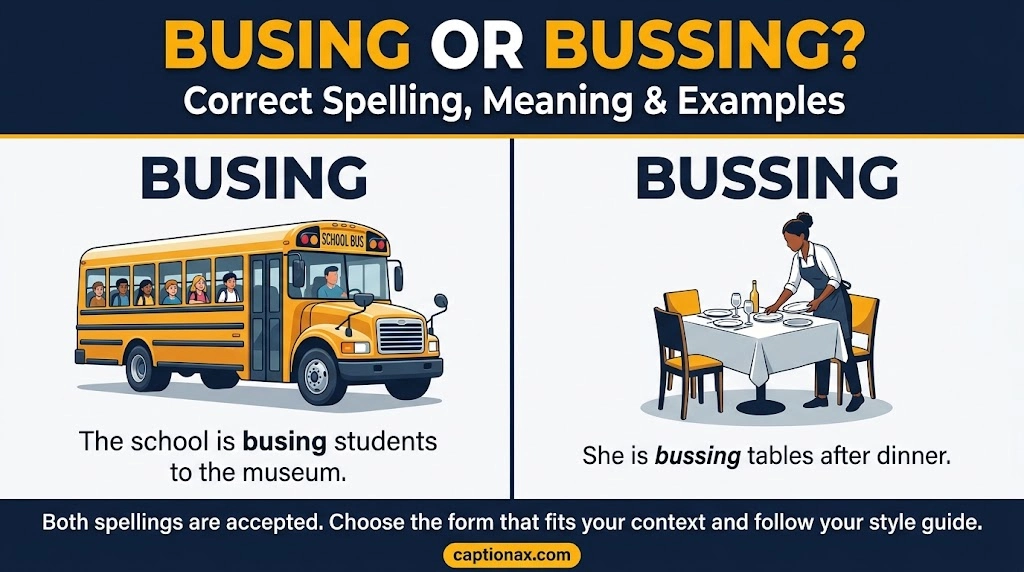
- Busing: A common American English spelling when referring to transportation by bus, including school transportation.
- Bussing: An accepted alternative that is particularly familiar in restaurant expressions such as bussing tables. It can also refer to transportation.
For example:
- The school district is busing students to a new campus.
- The school district is bussing students to a new campus.
- The restaurant employee is bussing tables after dinner.
The first two sentences have the same transportation meaning. In the third sentence, the restaurant context makes the intended meaning clear.
Quick rule: If you are writing for an American audience about transportation, busing is a practical default. For restaurant table service, bussing tables is a familiar expression. Neither spelling should automatically be labeled incorrect.
What Does Busing Mean?
Busing is the -ing form of the verb bus. It commonly describes transporting people from one place to another by bus. It can also function as a noun referring to the activity or system of transportation.
The term is frequently used in school, travel, business, and public transportation contexts.
Examples include:
- The district is busing students to a temporary school.
- The hotel is busing guests to the airport.
- The company arranged busing for conference attendees.
- The tour operator is busing visitors between attractions.
- The city introduced busing during the road closure.
In American educational and historical discussions, school busing can refer specifically to transporting students to schools outside their local neighborhoods, including as part of school integration policies.
For example: “The school board reviewed its busing program during the meeting.”
In that sentence, busing names an activity rather than describing an action currently in progress.
What Does Bussing Mean?
Bussing is an accepted spelling of the -ing form of bus. Like busing, it can describe transporting people by bus. It is also especially familiar in restaurant work, where it means removing used dishes and clearing tables.
Restaurant bussing may include:
- Collecting used plates, glasses, and cutlery.
- Removing napkins and other items left by customers.
- Wiping tables after guests leave.
- Resetting tables for the next customers.
- Keeping the dining area clean and ready for service.
Examples:
- She is bussing tables during the dinner shift.
- The restaurant hired another employee for bussing.
- He spent the evening bussing dishes and resetting tables.
- The staff are bussing tables after the lunch rush.
- The school is bussing students to another building.
The final example illustrates why bussing should not be defined exclusively as restaurant work. It can also express the meaning of transportation.
A restaurant employee who performs this work is commonly called a busser in American restaurant terminology.
Busing vs. Bussing: Key Differences
The main difference is spelling preference, not an absolute difference in meaning.
| Feature | Busing | Bussing |
| Base verb | Bus | Bus |
| Transportation by bus | Accepted | Accepted |
| Restaurant table service | Also used | Especially familiar |
| American English | Common for transportation | Also used |
| British English | Recognized | Also recognized |
| Pronunciation | /ˈbʌsɪŋ/ | /ˈbʌsɪŋ/ |
| Correct spelling? | Yes | Yes |
Both forms are pronounced the same in ordinary English. The extra s does not create a meaningful pronunciation difference.
Context helps readers understand the intended meaning. Words such as students, passengers, airport, and shuttle often indicate transportation. Words such as plates, dishes, restaurant, and dining room often indicate table service.
Busing or Bussing in American English
In American English, Busing is a common spelling for transportation by bus. It appears in school announcements, business communications, travel information, and discussions of public transportation.
Examples:
- The district is busing students to the new campus.
- The hotel provides busing to the airport.
- The company arranged busing for its employees.
- The school board discussed the cost of student busing.
However, bussing is also an accepted form in American English.
For restaurant work, bussing tables is particularly familiar:
- The employee is bussing tables after lunch.
- She gained hospitality experience by bussing tables.
- The restaurant needs additional staff for bussing and cleaning.
These are practical usage preferences rather than rigid rules. If your employer, editor, or publication follows a specific dictionary or style guide, use its preferred form consistently.
Busing or Bussing in British English
Both spellings are recognized in English-language usage, and the distinction between American and British English should not be oversimplified.
Oxford Learner’s Dictionaries identifies busing as a North American form in its relevant school-transportation definition and records bussing as an alternative used in British and North American English.
Examples:
- The school is bussing students to another campus.
- The school is busing students to another campus.
- The organization arranged bussing for the visitors.
Both spellings can communicate the transportation meaning. The form that feels most natural may vary by publication and context.
For British English, consult the dictionary or house style preferred by your publication rather than assuming that every British writer must use two s letters.
Busing or Bussing Tables: Which Is Correct?
Bussing tables is a familiar expression in restaurant English. It describes clearing used dishes and preparing tables for the next customers.
Examples:
- He works evenings bussing tables at a local restaurant.
- Bussing tables is part of the employee’s daily duties.
- The manager thanked the team for bussing tables quickly.
- She included restaurant bussing experience on her résumé.
You may also encounter busing tables. The single-s form is recognized in dictionary usage, so it should not automatically be treated as a spelling error.
For restaurant job descriptions, résumés, and hospitality articles, bussing tables is a natural choice because readers readily associate it with restaurant service.
A résumé bullet could read:
“Supported front-of-house operations by bussing tables, resetting dining areas, and maintaining cleanliness during busy shifts.”
If you are applying for a job, match the wording used in the employer’s listing when appropriate.
Busing or Bussing in Sentences
The following examples show how each spelling works in different contexts.
Transportation examples
- The school district is busing students to a temporary campus.
- The school district is bussing students to a temporary campus.
- The hotel arranged busing for guests attending the event.
- The company is bussing employees between its two offices.
Both spellings can express transportation.
Restaurant examples
- The employee is bussing tables after dinner.
- Bussing tables is part of her evening shift.
- The restaurant hired additional staff to help with bussing.
- The manager asked the team to finish bussing the dining room before closing.
These sentences use bussing in its familiar restaurant sense.
Formal writing examples
- The district’s busing program requires careful transportation planning.
- The organization arranged bus transportation for conference attendees.
- The restaurant’s bussing staff prepare tables between customer visits.
- The company provides shuttle service between its offices.
The last two examples also show how you can rewrite a sentence if you want to avoid a spelling choice that feels awkward.
Gerund and present participle examples
The -ing form can have different grammatical functions.
Present participle: “The district is busing students to another campus.”
Here, busing forms part of the progressive verb phrase is busing.
Gerund: “Busing students requires careful planning.”
Here, busing functions as a noun naming an activity.
The same distinction applies to bussing:
- Present participle: “The restaurant is bussing tables.”
- Gerund: “Bussing tables can be physically demanding.”
- Explore More: https://captionax.com/bearer-vs-barer/
Busing, Bussing, Bused, or Bussed?
The confusion also affects the past tense, past participle, and other forms of bus. Merriam-Webster recognizes busing/bussing and bused/bussed as alternative forms.
| Grammatical form | Spelling | Example |
| Base verb | Bus | They bus students to school. |
| Third-person singular | Buses | The company buses employees to the site. |
| Alternative third-person form | Busses | The company busses employees to the site. |
| Present participle | Busing | The school is busing students. |
| Alternative present participle | Bussing | The school is bussing students. |
| Past tense | Bused | The district bused students yesterday. |
| Alternative past tense | Bussed | The district bussed students yesterday. |
| Past Participle | Bused or bussed | Students were bused to the event. |
The plural noun buses refers to more than one bus. Busses can also be used as a plural spelling, although buses is the usual choice for vehicles in contemporary writing.
Do not assume that doubling the s automatically changes a word’s grammatical function. Check the sentence and the spelling convention you intend to follow.

Why Is Busing Spelled With One S?
The spelling can seem unusual because English often doubles a final consonant before adding -ing.
Consider these examples:
- Run → running
- Sit → sitting
- Plan → planning
By analogy, bussing may look like the expected form of bus. However, English spelling contains established variations, and busing is also a recognized form.
Both busing and bussing have become accepted spellings of the verb. The choice reflects established usage rather than a universal rule that every short verb ending in a consonant must double that consonant.
Dictionary.com discusses the spelling of busing and the related form busses, including the possibility of confusion with buss, a separate word associated with a kiss.
The most useful lesson is simple: general spelling patterns are helpful, but they do not always settle the spelling of an individual word.
When you are uncertain, consult a reliable dictionary and follow the conventions of your intended audience.
Common Mistakes to Avoid
1. Assuming bussing is always wrong
This is incorrect. Bussing is an accepted form of the verb bus.
2. Assuming busing only refers to schools
Busing can describe transporting students, passengers, employees, tourists, and other groups by bus. It is not limited to school transportation.
3. Assuming bussing only refers to restaurant work
Although bussing tables is a familiar expression, bussing can also refer to transportation.
4. Confusing buses with bused
Buses usually refers to multiple vehicles or describes a regular transportation action in the third-person singular.
For example: “Three buses arrived at the station.”
Bused is a past-tense or past-participle form of the verb.
For example: “The company bused its employees to the conference.”
5. Treating regional preferences as absolute rules
American and British English do not always follow perfectly separate spelling patterns. Check the conventions used by your audience instead of assuming that one form is exclusively American and the other exclusively British.
6. Switching spellings without a reason
Using both forms in one document may distract readers if the change is inconsistent. Choose the form that suits your context and style guide, then proofread for consistency.
How to Remember Busing vs. Bussing
A practical memory aid is:
- Busing: A useful default for transportation in American English.
- Bussing: A familiar choice for clearing restaurant tables.
This shortcut can help with everyday writing, but it is not an absolute grammar rule. Both spellings can describe transportation, and busing tables are also recognized.
Before publishing, ask yourself:
- Am I describing transportation or restaurant table service?
- Which dictionary or style guide am I following?
- Have I used the chosen spelling consistently?
- Would a simpler expression, such as bus transportation or clearing tables, make the sentence clearer?
These questions help you make a practical and defensible choice.
People Also Ask
A:Both are correct spellings of the -ing form of bus. Busing is common in American transportation contexts, while bussing is especially familiar in restaurant language. Both can describe transportation.
A:Yes. Bussing is an accepted English spelling. It can mean transporting people by bus or clearing tables in a restaurant, depending on context.
A:Busing has one s after the u, while bussing has two. Both are accepted forms, so the best choice depends on your context and preferred spelling convention.
A:Bussing tables is a familiar restaurant expression, but busing tables is also recognized. Follow the terminology used by your employer, editor, or preferred dictionary.
A:Both bused and bussed are accepted past-tense and past-participle forms of bus. Choose a consistent spelling that suits your audience and style guide.
Conclusion
The answer to Busing or Bussing is straightforward: both spellings are accepted, and context helps determine which one to use.
Choose busing as a practical default for transportation in American English. Choose bussing when it is the natural wording for restaurant table service or when it matches your publication’s preferred spelling. Remember that both forms can refer to transportation, so neither should automatically be marked as a mistake.
When in doubt, consult a trusted dictionary, follow your style guide, and keep your spelling consistent. Understanding these distinctions will help you write more confidently in school assignments, workplace documents, résumés, articles, and everyday communication.