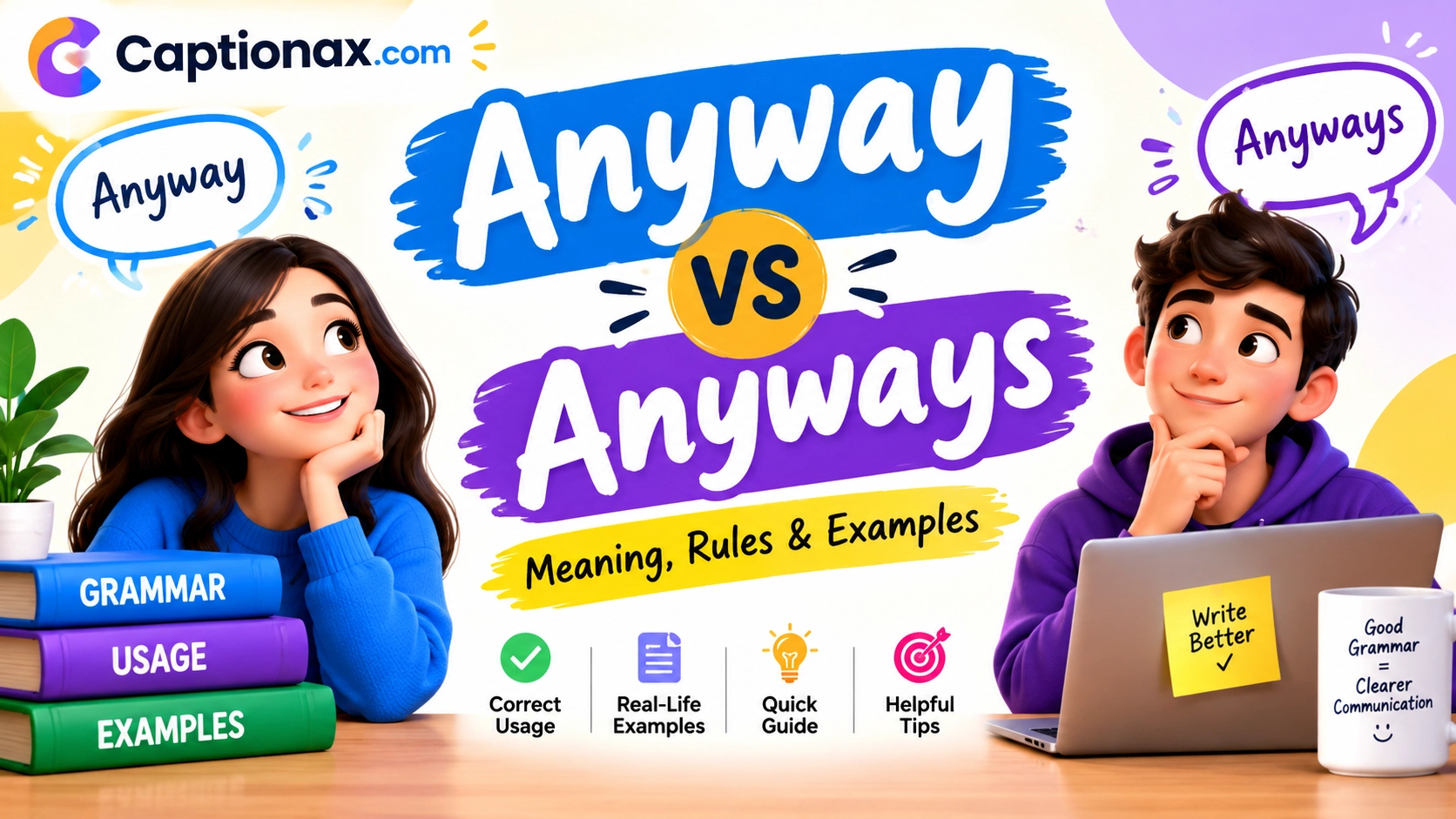
Meaning, Rules & Examples
Have you ever wondered whether to write Anyway or Anyways? You may have seen both words in text messages, online conversations, books, and everyday speech. Although they look almost identical, they differ in tone and how they are treated in standard written English.
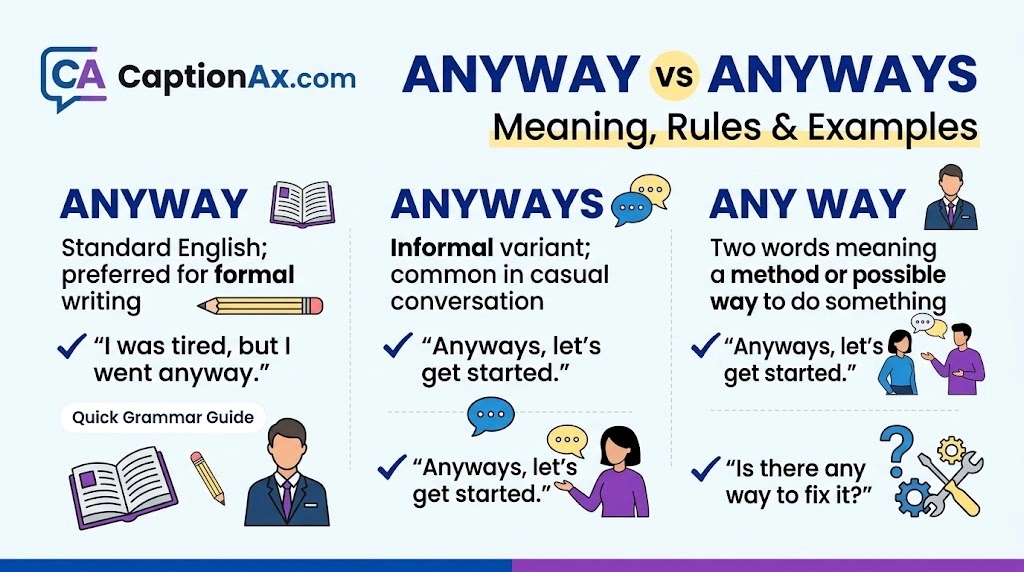
Anyway is the standard form and the best choice for formal, academic, and professional writing. Anyways is an informal variant that people commonly use in casual conversation. Both can express the idea of “in any case” or “regardless.” However, if you want your writing to sound polished and appropriate for almost any audience, anyway is the safer option.
There is also a third expression worth understanding: any way. Unlike anyway and anyways, this two-word phrase refers to a method, manner, or possible means of doing something.
In this guide, you will learn the difference between anyway and anyways, discover when each word is appropriate, explore practical sentence examples, and understand how to avoid common grammar mistakes. Whether you are writing a school assignment, composing a professional email, or chatting with friends, these simple rules will help you choose the right expression with confidence.
What Is the Difference Between Anyway and Anyways?
The main difference between anyway and anyways is their level of formality. Anyway is the standard adverb used in everyday and formal English, while anyways is an informal or nonstandard variant that generally carries the same basic meaning.
For example:
- Anyway: I was tired, but I finished the assignment anyway.
- Anyways: I was tired, but I finished the assignment anyways.
Both sentences communicate the same idea: the person finished the assignment despite feeling tired. The first version, however, is the more suitable choice for formal writing.
The distinction becomes especially important when writing essays, business documents, reports, and professional messages. In casual conversations, either form may sound natural, depending on the speaker and audience.
A simple rule makes the decision easy: use anyway when you are unsure. It is widely accepted, works in almost every context, and avoids the informal tone that some readers associate with anyways.
Anyway vs Anyways: Quick Comparison Table
This table summarizes the most important differences between the two expressions.
| Feature | Anyway | Anyways |
| Meaning | In any case; regardless | Usually the same |
| Standard written English | Standard form | Informal or nonstandard variant |
| Formal essays | Recommended | Generally avoid |
| Professional emails | Preferred | Usually avoid |
| Casual conversations | Natural | Natural for some speakers |
| Text messages | Common | Common in informal speech and texting |
| Sentence transitions | Yes | Yes, informally |
| Safest Choice | Yes | Depends on context |
Both words are understandable in ordinary conversation, but they are not equally suitable for every writing situation. Dictionaries and grammar references commonly distinguish the standard form from the informal variant. Dictionary.com labels anyways nonstandard, while Grammarist explains that it is a colloquial form of anyway.
The practical lesson is to choose your wording according to your audience, purpose, and desired tone.
What Does Anyway Mean?
Anyway is an adverb that commonly means “in any case,” “regardless,” or “despite the circumstances.” It can also help a speaker return to a previous topic or introduce a new thought.
The word has several useful applications in English.
1. To express something happening regardless of a situation
Example: It was raining heavily, but we went hiking anyway.
The sentence means that the rain did not prevent the speaker from going hiking.
2. To continue or return to a conversation
Example: Anyway, where were we before the interruption?
Here, anyway helps the speaker return to the earlier discussion.
3. To introduce a new subject
Example: Anyway, have you finished reading the book?
In this example, the speaker shifts the conversation toward another question.
4. To emphasize that something makes little difference
Example: I probably wouldn’t have used that old phone anyway.
The sentence suggests that the phone was unlikely to be used regardless of the circumstances.
Understanding these meanings helps you use anyway naturally instead of inserting it into every sentence as a filler word.
What Does Anyways Mean?
Anyways is an informal variant of anyway. It is commonly used in casual conversation and may appear in text messages, social media posts, and informal dialogue.
Its meaning usually remains the same as anyway, but its tone can sound more conversational.
Consider these examples:
- Anyways, let’s get back to the movie.
- I wasn’t planning to attend anyways.
- Anyways, what happened after that?
- It was probably too late to call anyways.
In each example, replacing anyways with anyway preserves the basic meaning.
However, some readers consider anyways less polished in edited writing. Its acceptability can also vary with regional speech habits and individual preferences.
If you are writing dialogue for a fictional character, using anyways may help preserve a natural speaking style. If you are writing an academic paper or formal business report, anyway is generally the better choice.
Remember that an informal word is not necessarily meaningless or incomprehensible. The important distinction is whether it suits the context in which you are using it.
Is Anyways a Real Word?
Yes, anyways is a recognized English word, but it is generally classified as informal or nonstandard compared with anyway.
Dictionary.com lists anyways as a nonstandard variant of anyway, while other language references discuss its use in colloquial English. This difference in labeling reflects an important distinction between a word being used and recognized in English and being the preferred form in formal writing.
For example:
- Informal: Anyways, I’ll see you tomorrow.
- Standard: Anyway, I’ll see you tomorrow.
Both are easy to understand, but the second is the safer choice in a formal document.
It is therefore misleading to claim that nobody should ever say anyways or that it cannot appear in legitimate English usage. Speakers use it naturally in some contexts, particularly informal conversation.
The better rule is straightforward: recognize anyways when you encounter it, but use anyway when you want to follow standard written English.
When Should You Use Anyway?
Use anyway whenever you need a standard expression meaning “regardless,” “in any case,” or a conversational transition.
It is appropriate for casual communication as well as most formal writing.
Here are the most common situations.
In academic writing
The experiment produced unexpected results, but the researchers continued anyway.
In professional communication
Anyway, I have attached the updated document for your review.
For a particularly formal email, “In any case” or another precise transition may sound more polished.
In everyday conversation
I know it’s getting late, but let’s finish the game anyway.
When returning to an earlier subject
Anyway, as I was saying, we need to finalize the schedule.
When something happens despite an obstacle
She wasn’t feeling well, but she attended the meeting anyway.
The versatility of anyway makes it a reliable word for almost any writing situation. You do not need to avoid it simply because it also appears in casual conversation.
When Is Anyways Appropriate?
Use anyways when an informal, conversational tone is appropriate and the expression feels natural for your audience.
It is particularly common in casual speech and may be used in informal writing to reproduce a person’s natural voice.
For example:
Text messages
“Anyways, are we still meeting tonight?”
Conversations with friends
“Anyways, let’s order something to eat.”
Informal social media posts
“Anyways, that was the best weekend ever.”
Fictional dialogue
“Anyways, I told him I wasn’t interested.”
Casual storytelling
“Anyways, we eventually found the place after getting lost twice.”
These examples show how the word can help create a relaxed tone. However, informal usage is not universal: some people use anyways frequently, while others prefer anyway even in casual conversation.
Avoid using anyways in formal assignments, professional reports, and important business correspondence unless you have a specific stylistic reason to retain it.
- Explore More: https://captionax.com/scarey-or-scary/
Anyway vs Anyways in Formal Writing
When writing for teachers, employers, clients, editors, or professional audiences, anyway is generally preferable to anyways.
The reason is not that the meaning necessarily changes. Instead, anyway is the standard form and is less likely to distract readers who consider anyways overly casual.
Compare these sentences:
Preferred for formal writing:
The team encountered several difficulties but completed the project anyway.
Less suitable for a formal report:
The team encountered several difficulties but completed the project anyways.
The first sentence follows standard written usage without changing the intended message.
In academic work, you should also consider whether anyway is the most precise transition. Depending on the relationship between your ideas, words such as nevertheless, nonetheless, therefore, or in any case may express your intended meaning more clearly.
For example:
“The initial results were inconclusive. Nevertheless, the researchers continued the investigation.”
This sounds more formal than a conversational transition beginning with anyway.
The goal is not to make every sentence complicated. It is to select wording that communicates your meaning accurately and suits the expectations of your readers.
Anyway vs Anyways in Text Messages and Social Media
In texting and social media, language tends to be more conversational than in academic or professional writing. As a result, you may encounter both anyway and anyways in informal online communication.
For example:
- “Anyway, what are we doing tomorrow?”
- “Anyways, I have to go now.”
- “I was going to call you anyway.”
- “Anyways, that was unexpected.”
Both forms can work in casual messages, although personal and regional preferences influence which sounds more natural.
On platforms such as Instagram, TikTok, Facebook, Snapchat, Reddit, and Discord, people often write the way they speak. This makes informal expressions more visible, but it does not change the standard spelling recommendation.
If you are writing a caption, a comment, or a message to friends, choose the version that matches your voice. If you are publishing Anyway vs Anyways educational content, a professional post, or a formal announcement, anyway is usually the safer option.
Online popularity should not be confused with universal grammatical preference. A word can be common in informal communication without being the preferred form for formal editing.
Any Way vs Anyway vs Anyways
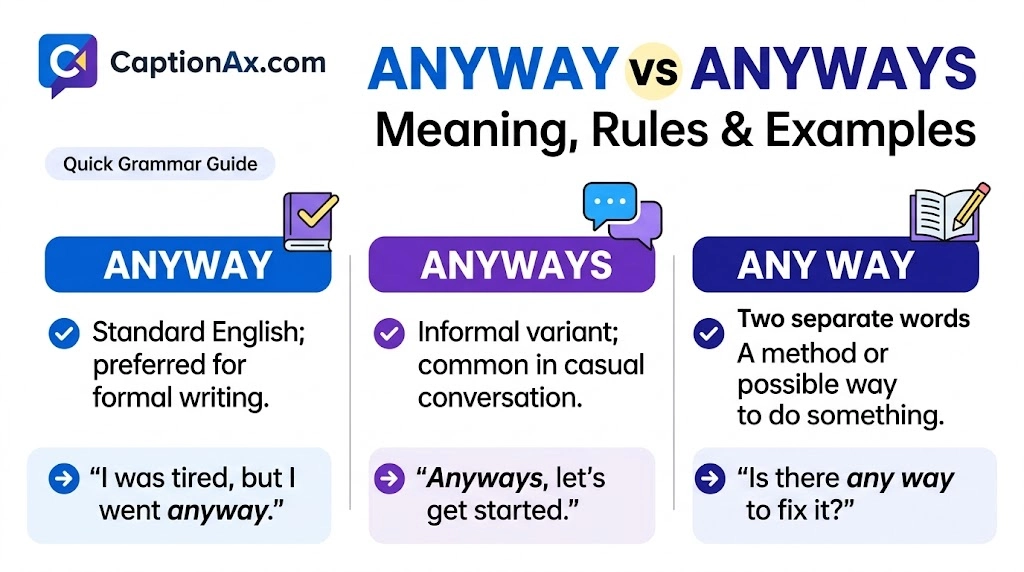
One of the most important distinctions is between any way, written as two words, and anyway, written as one word.
Although they look similar, their grammatical functions differ.
Any way refers to a method, manner, or means of doing something. It usually appears in expressions such as “in any way” or “is there any way?”
Anyway is an adverb that means “regardless” or “in any case.” It can also serve as a transition between thoughts.
Anyways is an informal variant of anyway.
Compare these examples:
| Expression | Example | Meaning |
| Any way | Is there any way to repair this laptop? | Any possible method |
| Anyway | The laptop is old, but it works anyway. | Despite the circumstances |
| Anyways | Anyways, let’s discuss the next problem. | Informal conversational transition |
Here is another useful comparison:
- “I’ll help in any way I can.” This means the speaker will help by whatever method is possible.
- “I’ll help anyway.” This means the speaker will help regardless of the circumstances.
- “Anyways, I’ll help.” This uses the informal version of anyway as a conversational transition.
A practical test is to ask whether you mean “any method” or “regardless.” If you mean any method, use two words. If you mean Anyway vs Anyways regardless or in any case, use anyway.
Common Mistakes When Using Anyway and Anyways
Writers often confuse these expressions because their meanings overlap. Fortunately, a few simple rules prevent most mistakes.
Mistake 1: Treating anyways as the best choice in every context
Incorrect for standard formal style: “Anyways, the report is ready.”
Preferred: “Anyway, the report is ready.”
The first version may be acceptable in Anyway vs Anyways casual dialogue, but the second is more suitable for professional writing.
Mistake 2: Writing any way when you mean regardless
Incorrect: “I was tired, but I went any way.”
Correct: “I was tired, but I went anyway.”
The one-word form expresses the idea of doing something despite a circumstance.
Mistake 3: Writing anyway when you mean a method
Incorrect: “Is there anyway to solve this problem?”
Correct: “Is there any way to solve this problem?”
The question asks whether a possible method exists, so any way should be written as two words.
Mistake 4: Assuming every informal expression is a spelling error
Anyways is used in real conversations and informal writing. It is more accurate to describe it as an informal or nonstandard variant than to claim it is never used in English.
Mistake 5: Adding unnecessary transitions
Starting every paragraph with anyway can make writing repetitive. Choose a transition that reflects the relationship Anyway vs Anyways between ideas, or remove the transition if it adds no useful meaning.
Punctuation Rules for Anyway and Anyways
Punctuation depends on how the word functions in the sentence. The same basic principles apply to anyway and its informal variant anyways.
At the beginning of a sentence
When anyway introduces a transition, a comma is commonly used.
Example: Anyway, let’s review the final results.
Informal version: Anyways, let’s review the final results.
At the end of a sentence
A comma is not normally required before anyway when it simply means “regardless.”
Example: We decided to continue anyway.
In the middle of a sentence
Use commas when they help mark anyway as an interrupting or transitional expression.
Example: The plan, anyway, was never intended to be permanent.
This punctuation emphasizes the inserted expression. Not every middle-position use requires commas, so consider the sentence’s structure and intended rhythm.
In dialogue
Punctuation should support natural speech without becoming excessive.
Example: “Anyways, what happened next?” she asked.
If the dialogue is intended to reflect a character’s informal voice, anyways can be appropriate. In formal narration, anyway is Anyway vs Anyways generally the safer choice.
Examples of Anyway vs Anyways in Sentences
The following examples show how both forms work in common situations.
| Situation | Anyway | Anyways |
| Continuing a discussion | Anyway, let’s continue. | Anyways, let’s continue. |
| Expressing determination | I’ll finish it anyway. | I’ll finish it anyways. |
| Changing the subject | Anyway, how was your trip? | Anyways, how was your trip? |
| Describing an unavoidable result | We were going anyway. | We were going anyways. |
| Ending a casual conversation | Anyway, I should leave. | Anyways, I should leave. |
The examples with anyways are Anyway vs Anyways conversational alternatives rather than recommendations for formal writing.
Here are more examples using anyway:
- I didn’t enjoy the movie, but I watched it anyway.
- Anyway, we need to make a decision.
- She knew it would be difficult, but she tried anyway.
- Anyway, I wanted to ask you something.
- We had already booked the tickets, so we went anyway.
- Anyway, let’s talk about your new project.
- I wasn’t hungry, but I ate a little anyway.
- Anyway, the important thing is that everyone arrived safely.
- He had warned us, but we ignored him anyway.
- Anyway, I’ll send you the details later.
These sentences illustrate the word’s main Anyway vs Anyways uses without relying on repetitive definitions.
What Are the Best Alternatives to Anyway?
Sometimes a different word communicates your meaning more precisely. The best alternative depends on whether you are expressing contrast, returning to a topic, or emphasizing that something happened regardless of the circumstances.
| Alternative | Typical use | Example |
| In any case | Moving forward despite uncertainty | In any case, we should confirm the booking. |
| Regardless | Emphasizing that something makes no difference | Regardless, the team continued. |
| Nevertheless | Introducing a contrast | The task was difficult; nevertheless, she succeeded. |
| Nonetheless | Expressing contrast in a slightly formal tone | The evidence was limited; nonetheless, it was useful. |
| At any rate | Returning to the main point or qualifying a statement | At any rate, we need a decision today. |
| Anyhow | Similar to anyway; sometimes informal | Anyhow, let’s get started. |
These expressions are not interchangeable in every sentence. For instance, nevertheless and nonetheless typically emphasize a contrast, while anyway can also be used simply to resume a conversation.
Choose the alternative that best Anyway vs Anyways expresses your intended relationship between ideas rather than replacing words mechanically.
Anyway vs Anyways: Origin and Language History
The history of anyway is connected to the older English Expression any way. Over time, the one-word form developed as an adverb meaning “in any case” or “regardless.”
Dictionary.com traces anyway to Middle English forms of “any way.” Its modern spelling reflects the development of the expression into a single word.
Anyways is a later variant associated with colloquial usage. English has other adverbs ending in -s, such as always and sometimes, but that pattern does not mean every adverb can freely take an -s ending in standard modern English.
The historical development helps explain why anyways exists, but history alone does not determine whether a word is suitable for a particular writing context.
For practical purposes, remember the Anyway vs Anyways modern distinction: anyway is the standard form, while anyways is generally informal or nonstandard in edited writing.
Quick Quiz: Anyway or Anyways?
Test your understanding by choosing the most appropriate word or phrase for each sentence.
1. It was expensive, but I bought it ______.
- A. anyway
- B. any way
2. Is there ______ to contact the manager?
- A. anyway
- B. any way
3. ______, let’s return to the original question. Choose the standard written form.
- A. Anyway
- B. Anyways
4. I was going to call you ______.
- A. anyway
- B. any way
5. Which expression is generally preferred in formal writing?
- A. Anyway
- B. Anyways
Quiz Answers
- Anyway — It means the purchase happened regardless of the expense.
- Any way — The sentence asks whether a method of contacting the manager exists.
- Anyway — It is the standard choice for a written transition.
- Anyway — It expresses that the call was going to happen regardless.
- Anyway — It is the safer standard form for formal and professional writing.
If you answered all five correctly, you understand the essential difference between these commonly confused expressions.
People Also Ask
A:Anyway is the standard form and is appropriate in both formal and informal writing. Anyways is a recognized informal variant that generally carries the same meaning but is usually avoided in formal documents.
A:Yes. Anyways appears in English usage and is recorded in dictionaries, although it is commonly labeled informal or nonstandard. Its recognition does not make it the preferred form for every situation.
A:They often mean the same thing: “in any case,” “regardless,” or “despite the circumstances.” The primary distinction is tone and standard written usage rather than a major difference in meaning.
A:It is generally better to use anyway in an academic essay. Although readers will probably understand anyways, it can sound too conversational for formal academic writing.
A:Generally, yes. Anyway is the standard form and works well in professional emails, reports, business documents, and presentations. Anyways may sound informal or less polished to some readers.
Conclusion
The difference between Anyway and Anyways is mainly a matter of standard usage and tone. Anyway is the standard form and the safest choice for formal writing, academic assignments, professional communication, and everyday English. Anyways is an informal variant that many speakers use naturally in casual conversation.
Remember the related expression any way, too. When you mean a method or manner, write two words, as in “Is there any way to solve this problem?” When you mean “regardless” or “in any case,” use anyway.
Once you understand these three forms, choosing the right expression becomes much easier. When in doubt, choose anyway for clear, polished, and widely accepted writing.