Definition, Text Examples & Usage
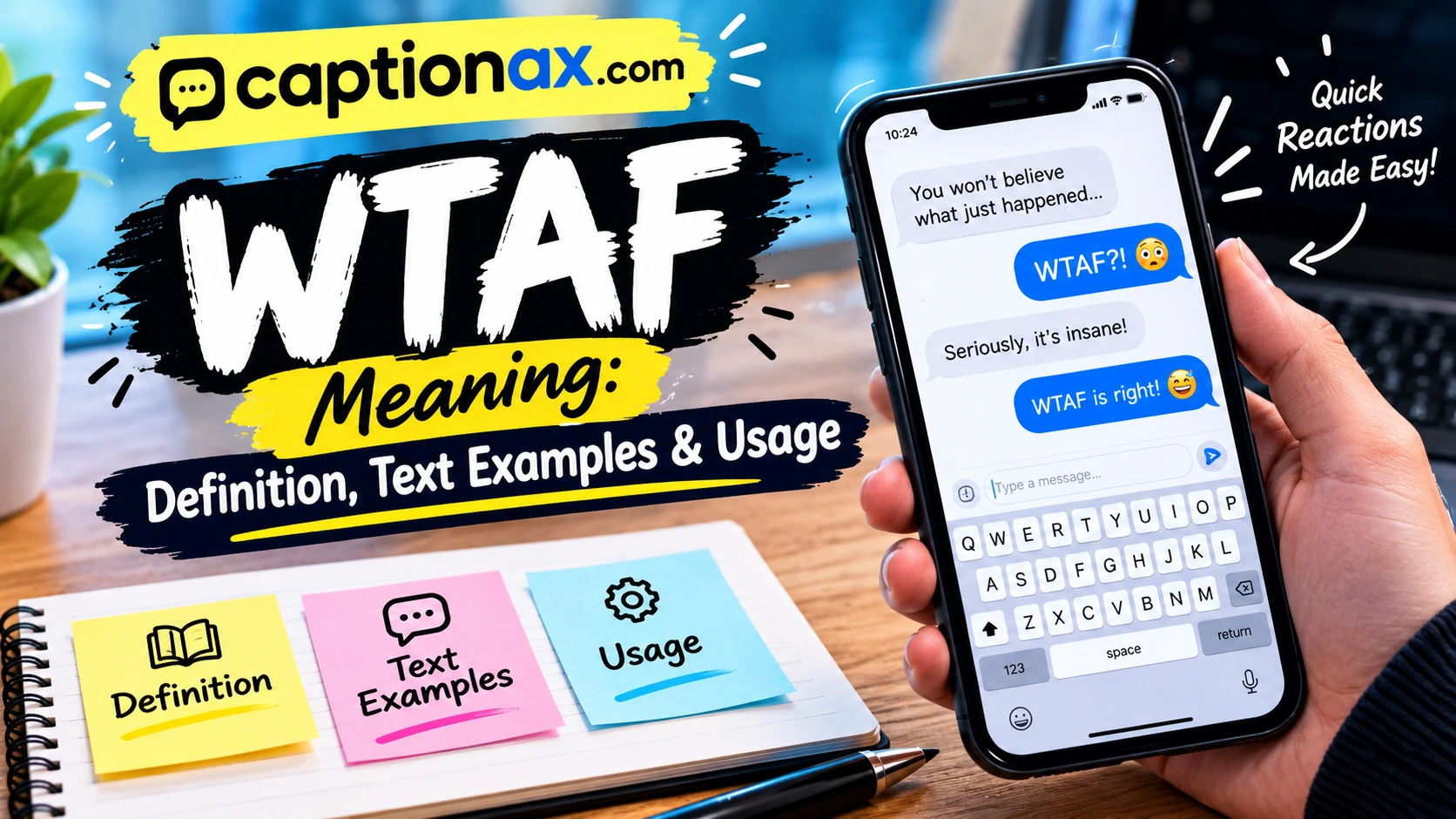
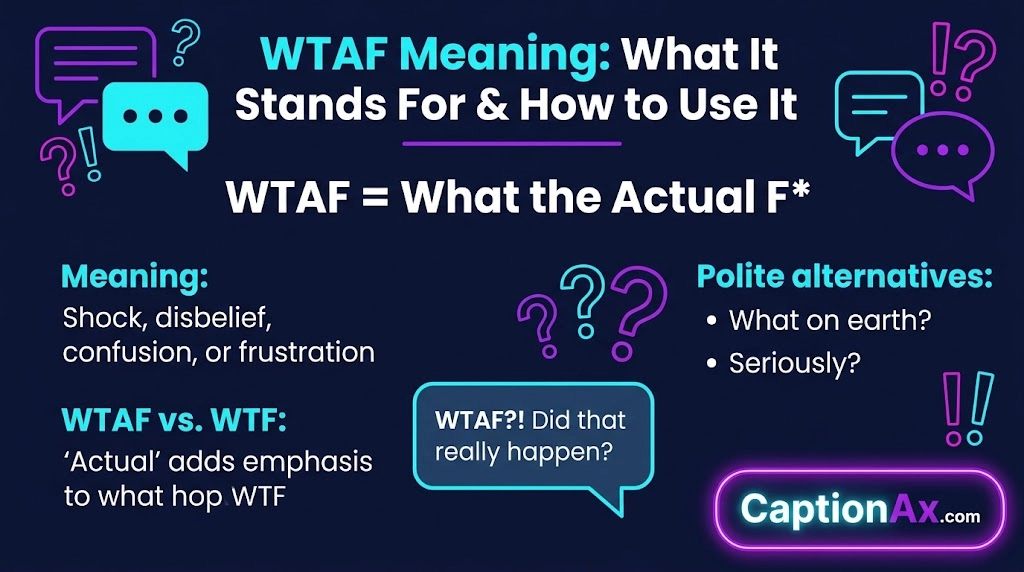
Have you seen someone type “WTAF?!” in a text message, group chat, or social media comment and wondered what it means? WTAF stands for “What the actual fuck.” It is an informal, profanity-based expression used to show shock, disbelief, confusion, or frustration.
The word “actual” adds emphasis to the reaction. Someone might use WTAF after hearing unbelievable news, seeing something ridiculous, or encountering a situation they cannot understand. Depending on the context, it can sound funny, surprised, annoyed, or confrontational.
WTAF is commonly used in digital conversations, including text messages, direct messages, and online comments. Although abbreviations can make messages shorter, they do not necessarily make strong language more polite.
In this guide, you will learn the meaning of WTAF, how people use it in everyday conversations, how it differs from WTF, and what to say when you want to express surprise without profanity.
What Does WTAF Mean in Text?
WTAF means “What the actual fuck” in texting and online communication. People use it when something seems shocking, unbelievable, confusing, or frustrating.
For example:
- “WTAF?! Did that really happen?”
- “WTAF is going on here?”
- “You paid $500 for that? WTAF 😂”
The first message expresses surprise, the second shows confusion, and the third communicates disbelief, possibly in a joking way.
WTAF is informal slang, not a suitable choice for every audience. It is generally best reserved for casual conversations with people who are comfortable with profanity.
Quick Meaning Summary
| Feature | Explanation |
| Full form | What the actual fuck |
| Main meaning | Shock, disbelief, confusion, or frustration |
| Language type | Informal internet slang |
| Common places | Text messages, DMs, group chats, comments |
| Tone | Depends on context |
| Is it profane? | Yes |
| Cleaner alternatives | What on earth? Seriously? What the heck? |
What Does WTAF Stand For?
WTAF stands for “What the actual fuck.” Each letter represents a word in the expression.
| Letter | Word |
| W | What |
| T | The |
| A | Actual |
| F | Fuck |
The abbreviation is closely related to WTF, which stands for “What the fuck.” Adding “actual” generally increases the emphasis, making the reaction sound more intense.
For example, “WTF?” might express ordinary surprise, while “WTAF?!” can communicate stronger disbelief. However, this difference is not a strict rule; both expressions can be used in similar situations.
How Is WTAF Used in Text Messages?
WTAF is useful as a short reaction when a situation is too surprising, confusing, or frustrating for an ordinary response.
Common uses include:
- Shock: “WTAF?! They canceled the concert at the last minute.”
- Confusion: “WTAF is happening in this group chat?”
- Frustration: “WTAF, my internet stopped working again.”
- Humor: “WTAF 😂 Why is the cat sitting in the sink?”
- Disbelief: “WTAF, you actually won?”
Punctuation and emojis can influence how a message comes across, but they do not establish the sender’s intent with certainty. When in doubt, consider the full conversation.
WTAF Meaning on WhatsApp, Snapchat, and Instagram
WTAF generally retains the same meaning across social media and messaging platforms. What changes is the situation in which someone uses it.
| Platform | Example | Likely interpretation |
| “WTAF?! Read that message again.” | Surprise or disbelief | |
| Snapchat | “WTAF 😂” | Amused shock |
| “WTAF is this post?” | Confusion or criticism | |
| TikTok | “WTAF did I just watch?” | Shock or amusement |
| Discord | “WTAF was that play?” | Surprise during a game |
| “WTAF is happening in this thread?” | Confusion or disbelief |
These are illustrative examples, not separate platform-specific definitions.
Remember that WTAF contains profanity. A message that feels funny among close friends could sound aggressive in a public comment or a conversation with someone you barely know.
WTAF vs. WTF: What Is the Difference?
WTAF and WTF have closely related meanings. The main difference is the added word “actual” in WTAF, which can intensify the reaction.
| Feature | WTAF | WTF |
| Full form | What the actual fuck | What the fuck |
| Main use | Strong surprise or disbelief | Surprise, confusion, or frustration |
| Emphasis | Often more emphatic | Depends on context |
| Formality | Very informal | Very informal |
| Profanity | Yes | Yes |
Example of WTF: “WTF? You forgot your keys again?”
Example of WTAF: “WTAF?! You drove all the way back home and still forgot them?”
Both expressions communicate disbelief. WTAF may sound more emphatic, but the exact difference depends on the speaker and the situation.
Examples of WTAF in Real Conversations
Here are natural examples showing how WTAF might appear in everyday messages.
Example 1: Unexpected news
- Alex: “They announced another surprise exam.”
- Sam: “WTAF?! We just finished the last one.”
Meaning: Sam expresses shock and frustration.
Example 2: A funny situation
- Mia: “My dog stole my sandwich and hid it under the couch.”
- Ava: “WTAF 😂 Your dog is a criminal.”
Meaning: Ava is amused by the dog’s behavior.
Example 3: A confusing message
- Jake: “I think I replied to the wrong person.”
- Chris: “WTAF, what did you send?”
Meaning: Chris is surprised and wants an explanation.
Example 4: An unbelievable price
- Ella: “That tiny coffee costs $15.”
- Noah: “WTAF?!”
Meaning: Noah cannot believe the price.
Example 5: Gaming surprise
- Player 1: “I won with one health point left.”
- Player 2: “WTAF! That was close.”
Meaning: Player 2 expresses amazement.
These examples demonstrate that the same abbreviation can communicate several emotions. Context is essential to understanding the intended tone.
Is WTAF Rude or Offensive?
Yes, WTAF can be considered rude or offensive because its full form contains a strong swear word. Collins classifies the expression as taboo, and the related WTF abbreviation is labeled offensive slang by Oxford Learner’s Dictionaries.
Whether it is received badly depends on the audience and situation.
- Among close friends: It may be accepted as a humorous or emotional reaction.
- In public comments: It can appear aggressive or disrespectful.
- At school or university: Appropriateness depends on the setting and communication rules.
- At work: Avoid it in professional messages, meetings, and client conversations.
- With strangers: The recipient may interpret it as hostility rather than humor.
If you want to express surprise without risking offense, try “What on earth?”, “Seriously?”, or “What just happened?”
When Should You Use WTAF?
Use WTAF only when the conversation is informal and the people involved are comfortable with profanity.
It may fit when:
- A close friend shares unbelievable news.
- Something unexpected happens in a video game.
- You see an absurd or funny situation.
- You want to emphasize disbelief in a casual group chat.
- You react to a surprising social media post.
For example, if a friend tells you their flight was canceled twice in one day, “WTAF, that’s unbelievable!” conveys a strong reaction.
Before sending it, consider your relationship with the recipient and whether the topic is sensitive. An expression that makes one person laugh may offend another.
When Should You Avoid Using WTAF?
WTAF is not appropriate for every audience or situation. Avoid using it in formal emails, job applications, professional documents, sensitive conversations, and messages to people who may find profanity offensive.
It can also make disagreements worse by making a question sound accusatory.
Instead of writing:
“WTAF is wrong with this report?”
Try:
“Could you help me understand what went wrong with this report?”
The second message communicates concern without unnecessary hostility.
- Explore More: https://captionax.com/anyway-vs-anyways/
How to Reply When Someone Says WTAF
Your response should match the situation rather than simply copying the sender’s language.
| Their message | Possible response |
| “WTAF?! Is this real?” | “Yes, I couldn’t believe it either.” |
| “WTAF happened here?” | “Let me explain what happened.” |
| “WTAF 😂” | “I know, it’s ridiculous!” |
| “WTAF is going on?” | “It’s a long story, but I’ll explain.” |
| “WTAF, why did you do that?” | “I understand why you’re surprised. Here’s what happened.” |
If the sender seems angry, do not automatically assume they are joking. Read the surrounding conversation and ask for clarification if needed.
Polite Alternatives to WTAF
If you want to communicate shock or disbelief without profanity, these alternatives work well in texts and everyday conversations.
| Alternative | Best used for |
| What on earth? | Surprise or confusion |
| What the heck? | Mild disbelief |
| What just happened? | Confusion |
| Seriously? | Surprise or skepticism |
| No way! | Disbelief or amazement |
| That’s unbelievable! | Strong surprise |
| What in the world? | A polite, emphatic reaction |
| OMG! | Surprise, excitement, or shock |
| I can’t believe it! | Disbelief |
For example, instead of “WTAF?! You actually won?”, you could write “No way! You actually won?”
Choose the alternative that matches your intended emotion. “Seriously?” can sound skeptical, while “That’s unbelievable!” often WTAF Meaning communicates amazement more clearly.
Is WTAF an Acronym or an Abbreviation?
WTAF is commonly called an acronym in everyday discussions of internet slang. More precisely, it is an initialism, because people generally pronounce its letters individually rather than as a single word.
An acronym is typically pronounced as a word, whereas an initialism is spoken letter by letter. In casual usage, however, people often use “acronym” as a general term for both.
WTAF is also an informal written expression, not a standard word for formal English. You may see it written as “WTAF” or “wtaf”; capitalization does not normally change its meaning.
Common Misunderstandings About WTAF
A few common misconceptions can lead to confusion when interpreting this expression.
- WTAF always means anger: Not necessarily. It can express amusement, surprise, confusion, or disbelief.
- Abbreviations are automatically polite: False. The shortened form still carries the profanity of the full expression.
- WTAF and WTF have completely different meanings: They are closely related, with “actual” adding emphasis to WTAF.
- Capital letters always mean shouting: Not necessarily. Uppercase is also a common way to write abbreviations.
- Every platform gives WTAF a different definition: Its usual meaning stays the same, although context changes how it is interpreted.
- WTAF is always directed at a person: It can instead be a reaction to an event, message, price, or unusual situation.
Understanding these distinctions helps you interpret online conversations more accurately.
People Also Ask
A:WTAF means “What the actual fuck.” On Snapchat, people may use it to react to a surprising snap, funny video, confusing message, or unbelievable situation.
A:The basic meaning does not change based on who sends it. The sender could be shocked, confused, annoyed, or joking. Interpret the message using its context rather than the sender’s gender.
A:WTAF can sound stronger because it adds “actual” for emphasis. However, both expressions can communicate intense surprise, frustration, or disbelief, depending on how they are used.
A:There is no universally accepted profanity-free expansion that preserves the original phrase exactly. Cleaner alternatives include “What on earth?”, “What the heck?”, and “What just happened?”
A:It is best to avoid WTAF in professional communication because its full form contains profanity. Use a neutral alternative such as “Could you clarify what happened?” instead.
Conclusion
WTAF means “What the actual fuck” and is a common informal expression used in texting and internet conversations to communicate shock, confusion, disbelief, or frustration. The word “actual” can add emphasis, although the tone depends on the situation.
When you see WTAF in a message, look at the surrounding conversation before deciding whether the sender is joking, surprised, or upset. If you want to express the same reaction more politely, use alternatives such as “What on earth?”, “Seriously?”, or “I can’t believe it!”
Understanding both the definition and the context will help you interpret internet slang more confidently and communicate clearly online.