Correct Spelling, Meaning & Examples
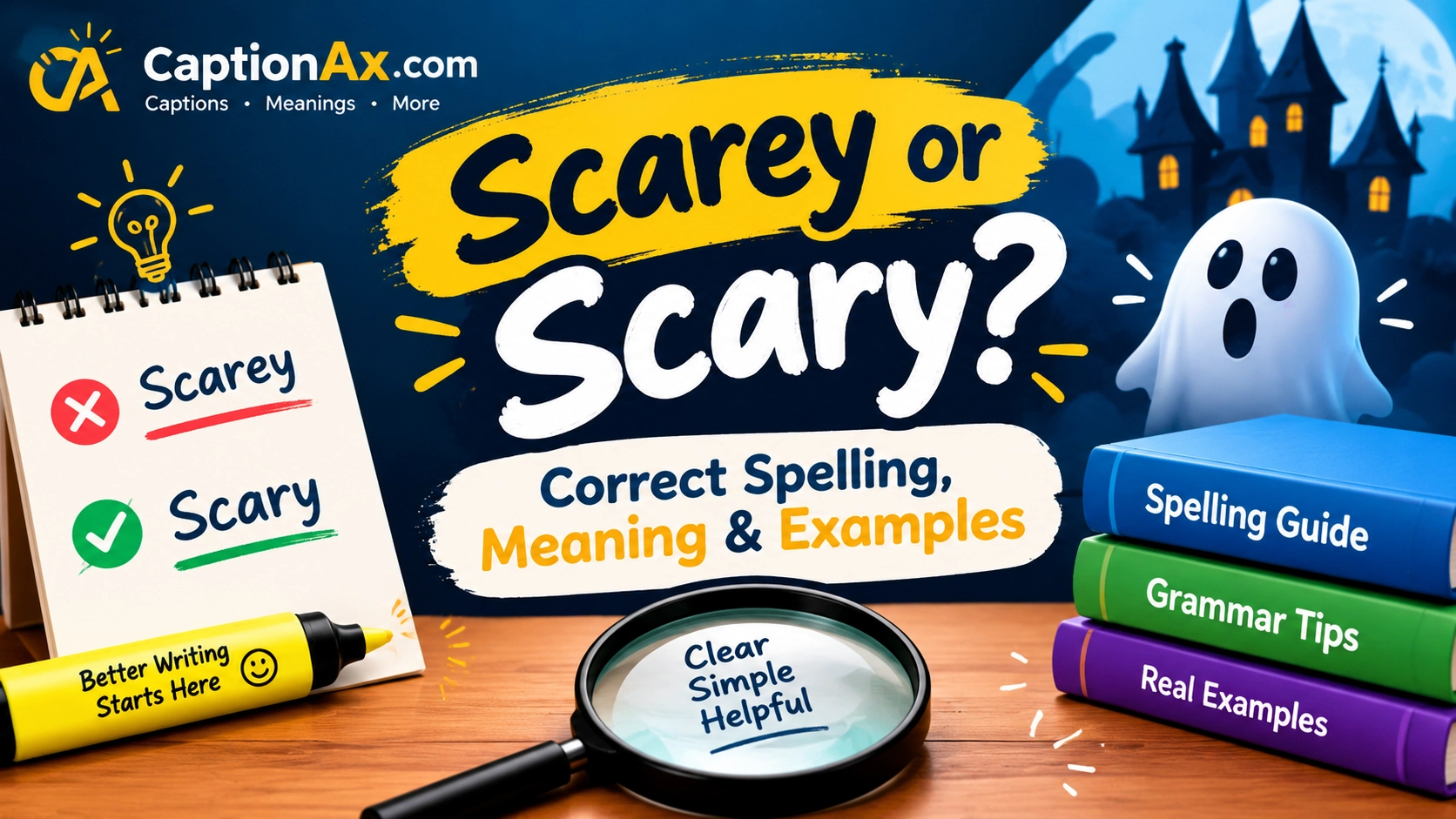
Have you ever paused while writing and wondered whether the correct spelling is Scarey or Scary? Both forms look similar and are pronounced alike, making this a common source of confusion for English learners, students, and everyday writers.
The answer is straightforward: scary is the standard and widely preferred spelling of the adjective meaning frightening or causing fear. However, scarey is not entirely nonexistent. Cambridge Dictionary identifies it as a British English variant, and Collins Dictionary also records it as a variant spelling.
For school assignments, professional emails, website articles, and everyday communication, scary is generally the safest choice. Understanding the distinction will help you avoid unnecessary spelling mistakes while recognizing legitimate variations in English.
In this guide, you will learn what scary means, whether scarey is a real word, how the two spellings differ, and how to use scary, scarier, and scariest correctly. You will also find practical examples, related words, grammar tips, and answers to common spelling questions.
Scarey or Scary: Which Spelling Is Correct?
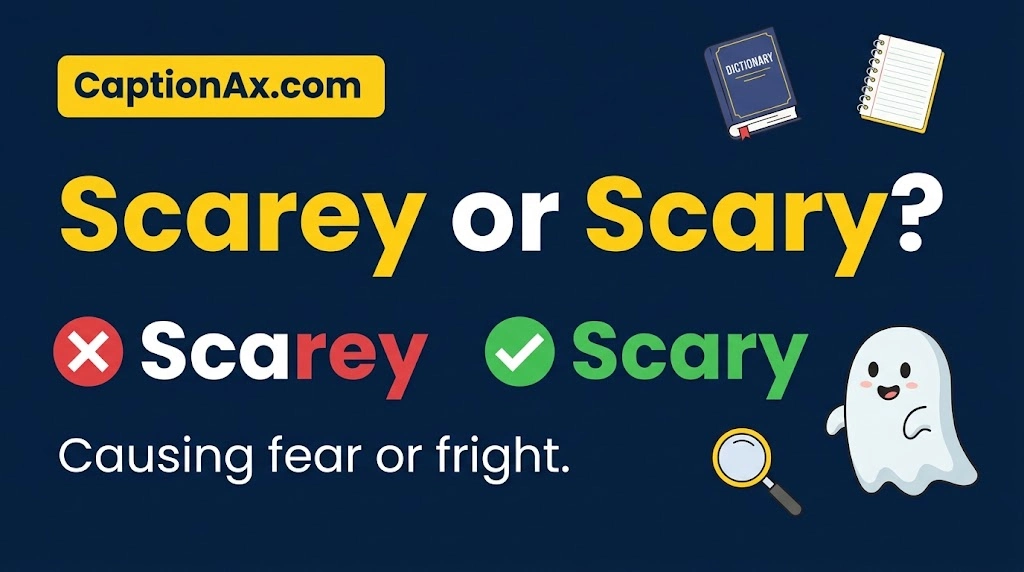
Scary is the standard spelling you should normally use in contemporary English. It is an adjective describing something that causes fear, fright, or alarm.
The spelling scarey is also documented as a variant by some dictionaries, particularly in British English. Therefore, it is more accurate to call scary the preferred standard form rather than claim that scarey never exists.
Consider these examples:
- Standard: The movie was scary.
- Standard: We heard a scary noise outside.
- Variant: The movie was scarey.
All three sentences communicate the same basic idea, but scary is the familiar spelling most readers expect.
Quick rule: Use Scary in ordinary writing unless you are deliberately preserving a variant spelling in a quotation, title, or other specific context.
What Does Scary Mean?
Scary is an adjective meaning frightening, alarming, or likely to make someone feel afraid. It can describe a person, place, sound, event, story, or experience.
The word is not limited to horror movies, ghosts, or supernatural situations. It can also describe a dangerous situation, an unexpected event, or something that creates uncertainty.
Examples:
- The abandoned house looked scary at night.
- That was a scary experience for everyone.
- The children watched a scary movie.
- Hearing a strange noise in the dark was scary.
- The sudden change in weather looked scary.
Scary can also describe something that creates serious concern rather than literal terror. For example, a sudden financial problem or an unexpected medical emergency may be described as scary.
Is Scarey a Real Word?
Yes, scarey is a documented variant spelling of Scary in some dictionaries. Cambridge Dictionary marks it as a UK variant, while Collins Dictionary explicitly identifies it as a variant spelling.
This distinction matters because a word can be recognized in a dictionary without being equally common or equally suitable for every writing situation.
Here is the practical difference:
- Scary: The standard, widely preferred spelling.
- Scarey: A less common, dictionary-recognized variant.
- Best choice for general writing: Scary.
For example, if you are submitting an essay, writing a professional email, or publishing an English-language article, scary is the more familiar choice.
If you encounter scarey in an older text, quotation, or particular publication, its presence does not automatically mean the writer invented the word. Nevertheless, the standard spelling is preferable for most modern writing.
Scary vs Scarey: Key Differences
The primary difference between scary and scarey is spelling preference, not their intended meaning when scarey is used as a variant.
| Feature | Scary | Scarey |
| Spelling status | Standard spelling | Recognized variant in some dictionaries |
| Meaning | Frightening or causing fear | Same basic meaning as a variant |
| Familiarity | Widely familiar | Less common |
| School assignments | Recommended | Usually avoid |
| Professional writing | Recommended | Usually unnecessary |
| Comparative form | Scarier | Use standard form scarier |
| Superlative form | Scariest | Use standard form scariest |
Examples:
- The storm looked scary.
- That was a scary moment.
- The storm looked scarey. (Variant spelling)
The most useful takeaway is that dictionary recognition and everyday spelling preference are not always identical. Both forms may be documented, but scary remains the most practical choice for general audiences.
Why Do People Spell Scary as Scarey?
People often write scarey because they associate the adjective with the verb scare. Since scare ends with an e, adding another letter before the final y may seem logical.
However, the established spelling is scary, formed by dropping the final e from scare before adding y.
Three factors help explain the confusion:
- Visual similarity: The two forms contain almost the same letters.
- Word formation: Writers may assume that the final e should remain when creating the adjective.
- Exposure to variants: Seeing scarey in online writing or other sources can reinforce the alternative spelling.
English spelling includes many historical patterns and exceptions, so guessing from a base word is not always reliable.
The simplest solution is to remember the established form directly:
Scare + y → scary
The final e is dropped before the y is added. This gives you the standard spelling without requiring you to memorize a complicated rule.
How to Spell Scary Correctly
The standard spelling is S-C-A-R-Y.
A useful memory tip is to focus on the ending: scary finishes with ry, not rey.
Correct forms include:
- Scary
- Scarier
- Scariest
Avoid these nonstandard forms when you intend the usual standard spellings:
- Scarry
- Scareyer
- Scareiest
Remember the three main forms:
| Word | When to use it | Example |
| Scary | Basic adjective | The story is scary. |
| Scarier | Comparing two things | This story is scarier than the last one. |
| Scariest | Comparing three or more things or identifying the extreme | That was the scariest scene. |
If you are uncertain, consult a reliable dictionary instead of relying entirely on how a word looks.
- Explore More: https://captionax.com/grimey-or-grimy/
Scary vs Scared: What Is the Difference?
To Scary and scared are related words, but they serve different purposes.
Scary describes something that causes fear, while scared describes someone who experiences fear.
Compare these sentences:
- The movie was scary.
- I was scared during the movie.
- The barking dog looked scary.
- The child felt scared when the dog barked.
- It was a scary situation, and everyone was scared.
The distinction is simple:
- Scary = causes fear.
- Scared = feels fear.
For example, saying “I was scary during the storm” suggests that you frightened someone else. If you mean that you experienced fear, write “I was scared during the storm.”
Understanding this difference improves clarity in schoolwork, professional communication, and everyday English.
Scare vs Scary: Meaning and Usage
To Scare and scary are related words with different grammatical roles.
Scare is commonly a verb meaning to frighten someone. It can also be a noun describing a sudden feeling of fear or an alarming incident.
Scary is an adjective that describes something that causes fear.
Examples of scare as a verb:
- The loud noise scared the cat.
- You scared me when you appeared suddenly.
- The sudden movement scared the children.
The Examples of scare as a noun:
- That was a real scare.
- The driver had a scare on the icy road.
Examples of scary as an adjective:
- The noise was scary.
- It was a scary experience.
- The film had a scary ending.
Notice how each word functions differently. Scare describes the action or incident, while scary describes the quality of something that causes fear.
Learning this relationship makes it easier to choose the correct word when constructing a sentence.
Scary, Scarier, and Scariest: Grammar Rules
Scary has three common forms used to express different degrees of fear: scary, scarier, and scariest.
Use scary when describing something without making a comparison.
Example: The story is scary.
Use scarier when comparing two things.
Example: This story is scarier than the one we read yesterday.
Use scariest when identifying the greatest degree of fear in a group.
Example: That was the scariest scene in the film.
| Form | Grammatical function | Example |
| Scary | Basic adjective | It was a scary night. |
| Scarier | Comparative adjective | Tonight feels scarier than last night. |
| Scariest | Superlative adjective | That was the scariest night of my life. |
Avoid double comparisons such as “more scarier” and “most scariest.” The words scarier and scariest already express comparison.
For natural, standard English, remember these forms rather than trying to build new ones from scarey.
Scarey or Scary in British and American English
Both British and American English use scary as the standard spelling.
The additional spelling scarey is recognized as a UK variant by Cambridge Dictionary, and Collins also documents it in British English. However, this does not mean that British writers must use scarey or that scary is an American-only spelling.
Examples:
- American English: The movie was scary.
- British English: The film was scary.
- Less common variant: The film was scarey.
The difference is therefore more nuanced than a simple British-versus-American spelling rule.
For an international audience, scary is the clearest choice because it is familiar across both major varieties of English.
If you are writing for a particular publication, follow its editorial preferences and preserve original spelling when quoting a source.
Correct and Incorrect Examples of Scary
Examples help show how the word works in everyday situations.
Correct standard examples
- The abandoned house looked scary.
- I heard a scary sound outside my bedroom.
- That was the scariest movie I have ever watched.
- The thunderstorm became scarier as the wind grew stronger.
- She told a scary story around the campfire.
- The thought of speaking before a large audience was scary.
- It was a scary moment, but everyone was safe.
- The film was scary without relying on graphic scenes.
- The dark forest looked scary after sunset.
- The unexpected news made the situation feel scary.
Scary and scared in context
- The roller coaster was scary.
- I was scared before the ride began.
- The dog looked scary, but it was friendly.
- The sudden noise scared me.
Spelling corrections
| Incorrect or nonstandard for the intended form | Standard form |
| The movie was scarry. | The movie was scary. |
| This movie is scareyer. | This movie is scarier. |
| That was the scareiest scene. | That was the scariest scene. |
| This film is more scarier than the first. | This film is scarier than the first. |
| That was the most scariest moment. | That was the scariest moment. |
Although scarey is recognized as a variant in some dictionaries, scary remains the preferred form for ordinary contemporary writing.
Synonyms and Alternatives for Scary
Using synonyms can make your writing more expressive and help you describe different kinds of fear more precisely.
| Synonym | Meaning or nuance | Example |
| Frightening | Causing fear | It was a frightening experience. |
| Terrifying | Causing intense fear | The storm was terrifying. |
| Spooky | Mysterious or ghostly | The old house looked spooky. |
| Creepy | Causing unease or discomfort | There was a creepy sound upstairs. |
| Alarming | Causing worry or concern | The sudden drop was alarming. |
| Chilling | Creating a strong feeling of dread | It was a chilling story. |
| Fearsome | Inspiring fear or respect | The creature looked fearsome. |
| Horrifying | Causing shock or horror | The scene was horrifying. |
| Unnerving | Making someone feel uneasy | The silence was unnerving. |
| Hair-raising | Extremely frightening or exciting | It was a hair-raising journey. |
These words are related, but they are not always interchangeable.
For instance, spooky often suggests a mysterious atmosphere, while alarming can describe a worrying event without any supernatural element. Terrifying generally expresses more intense fear than scary.
Choosing the right synonym helps your writing sound more precise and less repetitive.
Common Spelling Mistakes Related to Scary
Writers sometimes confuse scary with related words or create incorrect forms by applying spelling patterns mechanically.
Here are six mistakes to avoid.
1. Confusing scary with scared
Incorrect for the intended meaning: I felt scary during the movie.
Better: I felt scared during the movie.
2. Confusing scary with scare
Incorrect: That was a scare movie.
Better: That was a scary movie.
3. Using a double comparative
Incorrect: This film is more scarier than the first.
Better: This film is scarier than the first.
4. Using a double superlative
Incorrect: That was the most scariest scene.
Better: That was the scariest scene.
5. Adding an extra r
Incorrect: The house looked scarry.
Better: The house looked scary.
6. Treating scarey as the preferred standard form
For general contemporary writing, use scary. If you are quoting a source that uses scarey, preserve the original spelling when accuracy requires it.
Proofreading these forms can help you avoid mistakes in essays, emails, social media posts, and published articles.
People Also Ask
A:Scary is the standard spelling you should normally use. Some dictionaries recognize scarey as a variant, particularly in British English.
A:Yes. Cambridge and Collins record scarey as a variant spelling of scary. However, scary remains the widely preferred form for general contemporary writing.
A:Scary is an adjective meaning frightening, alarming, or causing fear. For example, “The movie was scary.”
A:No. The standard spelling is scary, without an e between the r and the final y.
A:Yes. Scary is standard in both varieties. Some dictionaries also recognize scarey as a British English variant.
Final Verdict
If you are choosing between Scarey and Scary, use scary for ordinary contemporary writing.
Scary is the standard, widely preferred spelling of the adjective meaning frightening or causing fear. Although scarey appears as a variant in some dictionaries, it is less common and generally unnecessary for everyday communication.
Remember these three forms:
- Scary: The basic adjective.
- Scarier: The comparative form.
- Scariest: The superlative form.
Also remember the difference between scary and scared: something scary causes fear, while someone who is scared experiences it.
With these simple rules, you can confidently use the correct spelling in essays, emails, website content, and everyday messages. For more practical spelling comparisons and English usage guides, explore related articles on CaptionAx.com.