Carrer or Career: Which Spelling Is Correct?
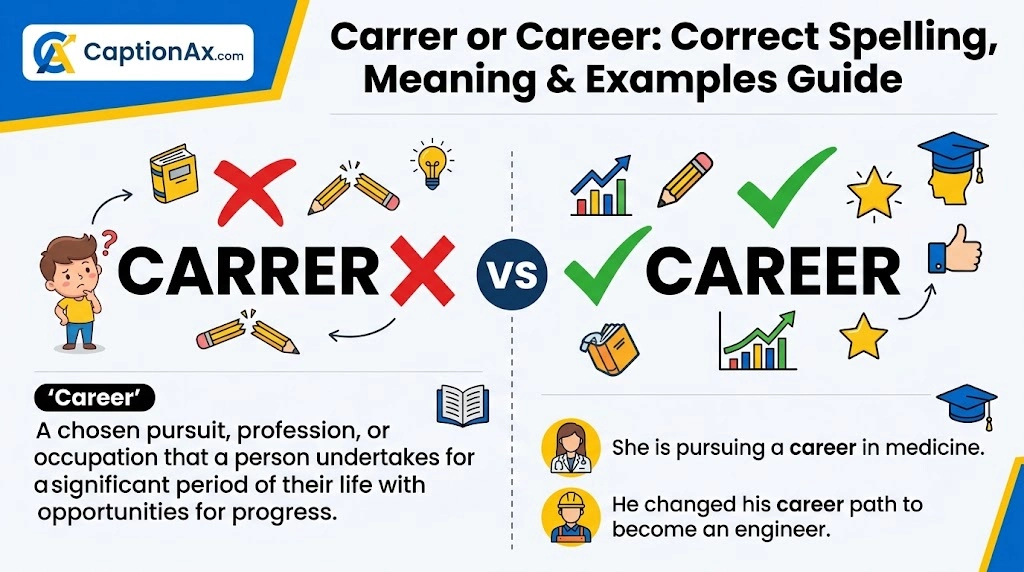
Have you ever wondered whether to write Carrer or Career? If you are talking about a profession, occupation, or someone’s working life, career is the correct spelling in standard English. Carrer is generally a misspelling in this context, not an alternative British or American spelling.
The difference may look small, but choosing the correct word helps you communicate clearly in school assignments, emails, résumés, cover letters, and professional profiles. The easiest way to remember the correct form is to focus on the two consecutive E’s in C-A-R-E-E-R.
In this guide, you’ll learn what career means, how to pronounce it, why people confuse the two spellings, and how career differs from similar words such as carrier and carer. You’ll also find practical sentence examples, a quick comparison table, spelling tips, and a short quiz to test your understanding.
Whether you’re learning English or simply checking a word before publishing something important, this guide will help you choose the right spelling with confidence.
Carrer or Career: Which Spelling Is Correct?
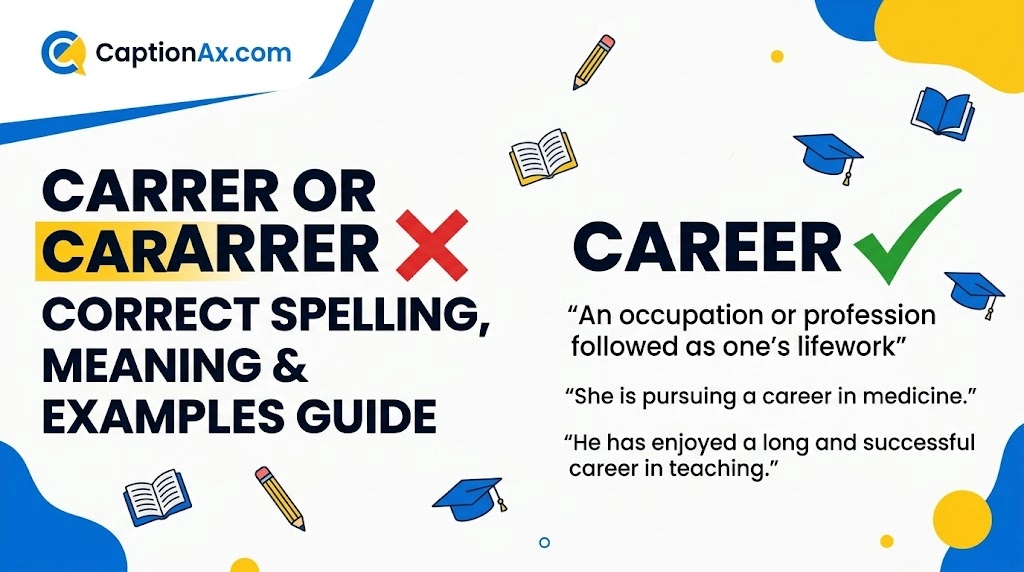
Career is the correct spelling when you mean a person’s profession, occupation, or professional journey. Carrer is generally incorrect when used with this intended meaning in standard English.
The main difference is the letter pattern in the middle of each word:
- Career: C-A-R-E-E-R — correct spelling.
- Carrer: C-A-R-R-E-R — incorrect when you mean a professional life.
For example:
- Correct: She wants to pursue a career in medicine.
- Incorrect: She wants to pursue a carrer in medicine.
Another example:
- Correct: He has built a successful career in marketing.
- Incorrect: He has built a successful carrer in marketing.
Remember that career contains two consecutive E’s, while the common misspelling carrer contains two consecutive R’s.
Quick answer: When discussing employment, professional goals, or long-term work, use career.
What Does Career Mean in English?
The word Career refers to a person’s profession, working life, or progression through jobs and professional roles. It can describe a particular professional field or the experience and development someone gains throughout their working years.
The Cambridge Dictionary defines career in terms of the job or series of jobs a person does during their working life, often with opportunities for advancement.
Examples include:
- She began her career as a primary school teacher.
- He hopes to build a career in software development.
- My sister is considering a career change.
- The athlete enjoyed a successful professional career.
- Good communication skills can support career development.
You will also encounter career in common expressions such as career path, career goals, career opportunities, career growth, and career planning.
A career does not necessarily mean staying in one position forever. Someone might start as a junior designer, become a senior designer, and later manage a creative team. These roles can form part of the same career.
What Does Carrer Mean?
In standard English, carrer is not the correct spelling of career when referring to a profession or working life. If you see it in an English sentence about employment, the writer most likely intended to use career.
For example:
Incorrect: She hopes to establish a carrer in journalism.
Correct: She hopes to establish a career in journalism.
However, it is important to consider the language and context. Carrer is a legitimate Catalan word meaning a street. Therefore, it would be inaccurate to claim that this letter sequence has no meaning in any language.
The distinction is simple: carrer is not the standard English spelling for a professional Career.
When writing in English, use career in résumés, cover letters, educational assignments, professional biographies, and business communications.
Career vs. Carrer: Key Differences
Although these spellings look similar, they serve different purposes when discussing English spelling.
| Feature | Career | Carrer |
| Standard English spelling for a profession | Correct | Incorrect |
| Meaning in this context | Professional life or occupation | Usually a spelling mistake |
| Letter pattern | Contains EE | Contains RR |
| Appropriate in a résumé | Yes | No, when career is intended |
| British English | Correct | Not an alternative spelling |
| American English | Correct | Not an alternative spelling |
Consider these sentences:
Correct: She is planning her career after graduation.
Incorrect: She is planning her carrer after graduation.
The second sentence contains a spelling error because the writer intends to discuss a professional future.
The key takeaway is to use career when referring to someone’s working life, professional development, or long-term occupational goals.
How Do You Spell Career Correctly?
The correct spelling is C-A-R-E-E-R.
A helpful way to remember it is to focus on the two E’s in the middle. People sometimes replace these vowels with RR when typing quickly or writing from memory.
Memorize these common expressions:
- Career development
- Career opportunities
- Career goals
- Career planning
- Career change
- Career advice
- Career advancement
Each expression uses the same correct spelling.
You can also check the word letter by letter:
- Start with C-A-R.
- Add two E’s.
- Finish with R.
The result is CAREER.
If you’re unsure about a spelling while writing, consult a reliable English dictionary or use a spell-checking tool. These resources can help you catch mistakes before submitting important documents.
Why Do People Confuse Carrer and Career?
People often confuse carrer and career because the words look similar, and the difference is easy to overlook.
Several factors can contribute to this mistake.
Typing too quickly: When you write quickly, you might accidentally enter RR instead of EE.
Uncertainty about English spelling: English spelling patterns can be challenging for learners, particularly when pronunciation does not reveal every letter.
Autocorrect limitations: Some keyboards and writing tools may fail to identify every mistake, especially when the incorrect sequence resembles a form used in another language.
Writing from memory: Even familiar words can be misspelled when you do not pause to check their letter sequence.
Limited proofreading: A small error can remain unnoticed when you focus on the overall meaning rather than individual words.
For example, someone might type, “I want to improve my carrer prospects,” without noticing the error.
The corrected sentence is: “I want to improve my career prospects.”
A useful habit is to proofread important writing carefully, especially when preparing job applications, academic work, or professional correspondence.
- Explore More: https://captionax.com/village-vs-subdivision/
How Do You Pronounce Your Career?
The word career has slightly different pronunciations in British and American English, but its spelling remains the same.
- British English: /kəˈrɪə(r)/
- American English: /kəˈrɪr/
You can approximate the pronunciation as “kuh-REER.” The stress falls on the second syllable.
Examples:
- She hopes to have a career in medicine.
- He changed his career after several years in finance.
- What career would you like to pursue?
The pronunciation can vary between speakers, but both British and American English use the spelling career.
Remember that pronunciation does not always reveal English spelling clearly. When in doubt, check the written form rather than relying entirely on how a word sounds.
Career vs. Job: What Is the Difference?
The words career and job are related, but they do not always mean the same thing.
A job generally refers to a particular position or the work someone performs for an employer. A career describes a broader professional journey that can include multiple jobs, skills, experiences, and stages of development.
Compare these examples:
Job: She accepted a job as a marketing assistant.
Career: She wants to build a career in digital marketing.
The first sentence describes a specific position. The second describes a broader professional direction.
Here is another comparison:
- Job: He works as a laboratory technician.
- Career: He has built a career in scientific research.
One person can have several jobs during a single career. For example, a teacher might begin at one school, move to another institution, and eventually become a school principal.
Understanding this distinction helps you use your career naturally when discussing long-term professional goals.
Career vs. Carrier vs. Carer
The words career, carrier, and carer look similar, but they have different meanings. Choosing the wrong one can change the meaning of a sentence.
| Word | Meaning | Example |
| Career | A person’s professional life or working journey | She chose a career in engineering. |
| Carrier | A person, company, or thing that carries or transports something; it also has specialized meanings | The delivery carrier arrived early. |
| Carer | A person who looks after someone who needs support, especially in British English | Her carer helped her with daily activities. |
Consider these examples:
- Career: He wants a career in healthcare.
- Carrier: The shipping carrier delivered the package.
- Carer: She works as a carer for older adults.
A carrier might transport goods or provide a service that carries something. A carer provides care and assistance. Neither word is interchangeable with career.
When writing about a profession or long-term working life, choose a career.
Is Career Spelled Differently in British and American English?
No. Both British and American English use career when referring to a profession, occupation, or working life.
Unlike words with recognized regional spelling variations, career does not change its spelling between these varieties of English.
Examples in British English:
- She is considering a career in education.
- He received useful career advice.
Examples in American English:
- She is considering a career in education.
- He received useful career advice.
The pronunciation may differ slightly, but the spelling remains the same.
Therefore, you should not use carrer as a British alternative or assume it is an American variant. In standard English, career is the correct spelling for a profession or working life.
How to Use Career in a Sentence
The best way to learn a word is to see how people use it in context. Career appears in conversations about work, education, professional development, and personal ambitions.
Here are 15 example sentences:
- She started her career in journalism after graduating from university.
- He wants to pursue a career in computer science.
- My brother is planning a career change next year.
- The training program helped her explore new career opportunities.
- She has enjoyed a successful career in nursing.
- His career goals changed after he gained more experience.
- The university offers career guidance to its students.
- They discussed their career plans during lunch.
- He hopes to advance his career through further education.
- Her career in music began when she was a teenager.
- Good communication skills can benefit your career.
- She took a break from her career to care for her family.
- The company offers opportunities for career development.
- He decided to follow a career in environmental science.
- The athlete retired after a remarkable professional career.
Notice how the spelling remains the same in every sentence.
Career can also function as a verb, although this meaning is less common in everyday conversation. As a verb, to career means to move rapidly, often in an uncontrolled way.
For example: “The car Careered down the hill.”
This usage differs from the noun referring to professional life, but the spelling is still career.
Common Career Spelling Mistakes to Avoid
Even familiar words can cause problems when you type quickly or fail to proofread your writing.
Here are common mistakes to watch for.
Mistake 1: Writing carrer instead of career
Incorrect: I want to build a carrer in business.
Correct: I want to build a career in business.
Mistake 2: Writing carreer
Incorrect: She has a successful carreer in teaching.
Correct: She has a successful career in teaching.
Mistake 3: Confusing career with carrier
Incorrect, if you mean a profession: He wants to become a carrier in medicine.
Correct: He wants to pursue a career in medicine.
Mistake 4: Confusing career with carer
Incorrect, if you mean a professional journey: She hopes to build a carer in law.
Correct: She hopes to build a career in law.
Mistake 5: Using the wrong spelling in professional documents
Incorrect spelling can make a document look less polished. Before sending a résumé, cover letter, or application, review the document carefully and correct any errors.
Spelling alone does not determine someone’s professional ability. However, accurate writing helps readers understand your message and presents your work more clearly.
Easy Tricks to Remember the Spelling of Career
You do not need complicated spelling rules to remember your career. A few simple techniques can help.
Trick 1: Remember the two E’s
Career contains two consecutive E’s: C-A-R-EE-R.
Whenever you type the word, check the middle.
Trick 2: Memorize a familiar phrase
Repeat “career goals” or “career path” a few times. These common expressions help reinforce the correct spelling.
Trick 3: Connect spelling with meaning
Think of a career as the path you follow throughout your working life. When you write about that path, remember to use career.
Trick 4: Practice with short sentences
Write a few sentences to reinforce the spelling:
- I am planning my career.
- She has clear career goals.
- He wants a career change.
Trick 5: Proofread before submitting
Use a spell-checker as a helpful second check, but do not rely on it entirely. Read important writing carefully before you send it.
The easiest rule to remember is simple: Career has two E’s in the middle.
Practice Quiz: Carrer or Career?
Test your understanding with these five questions. Choose the correct spelling for each sentence.
Question 1: She wants to pursue a _____ in medicine.
A. Carrer
B. Career
Question 2: He is planning his _____ goals.
A. Career
B. Carrer
Question 3: Which spelling is correct in standard English when discussing a profession?
A. Carrer
B. Career
Question 4: She changed her _____ after working in finance for five years.
A. Career
B. Carrer
Question 5: Which word contains two consecutive E’s?
A. Carrer
B. Career
Answers: 1—B, 2—A, 3—B, 4—A, 5—B.
If you answered all five correctly, you understand the main spelling distinction. If you missed any, review the spelling rule and examples above.
People Also Ask
A:Career is the correct spelling when referring to a profession, occupation, or person’s working life. Carrer is generally a misspelling in this context.
A:Career means a person’s profession, working life, or progression through jobs and professional roles. For example, someone might pursue a career in teaching, medicine, or engineering.
A:Carrer is not the standard English spelling for a professional life. However, the same spelling exists in other languages, including Catalan, where it means street.
A:Spell it C-A-R-E-E-R. Remember the two E’s in the middle to avoid the common mistake of writing carrer.
A:People may make this mistake because they type quickly, forget the letter sequence, or rely on pronunciation rather than checking the spelling.
Conclusion
When discussing a profession, occupation, or long-term working life, career is the correct spelling in standard English. The spelling carrer is generally an error when you intend to write about someone’s professional journey.
Remember the two E’s in career, learn how the word differs from Carrier and Carer, and review your writing before submitting important documents. With a little practice, you can avoid this common spelling mistake and use career confidently in everyday and professional English.
For more practical spelling guides and explanations of commonly confused English words, explore the related articles on CaptionAx.com.