Implicit vs Complicit: Meaning, Differences & Examples
Have you ever confused Implicit vs. Complicit because the words look and sound alike? Although they share several letters, they have different meanings. Understanding the distinction helps you communicate clearly in essays, professional emails, everyday conversations, and academic writing.
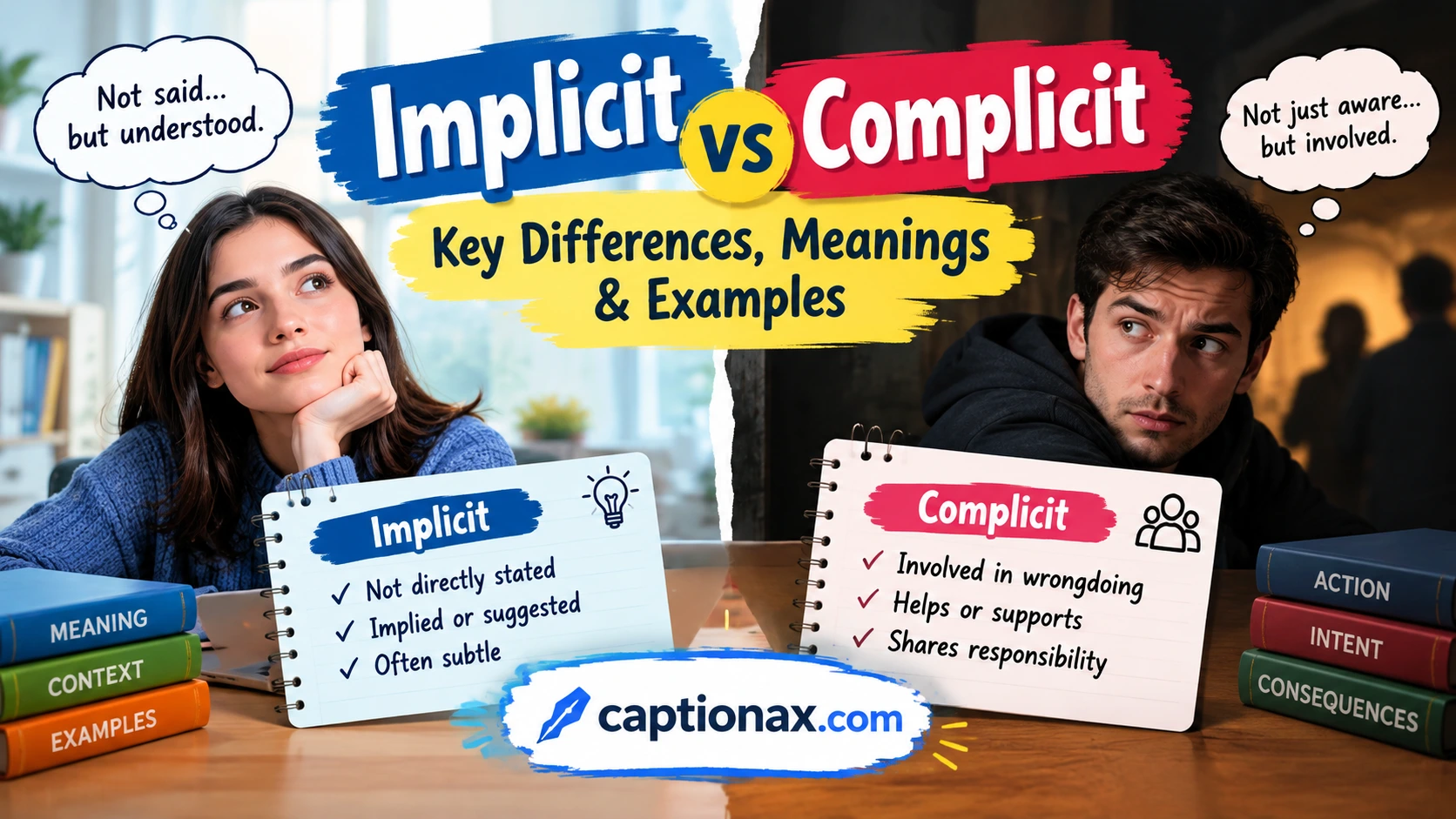
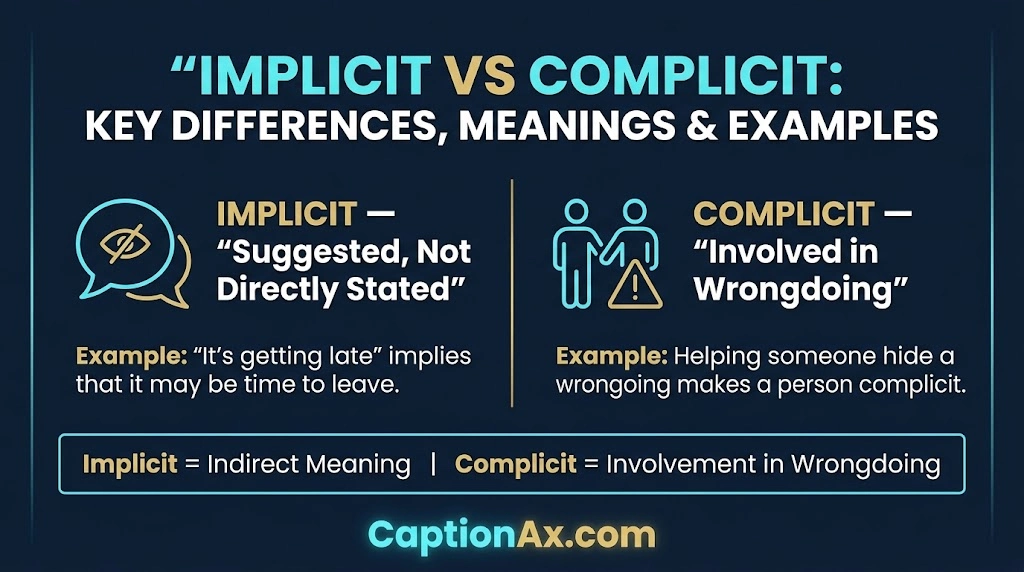
Implicit means suggested, understood, or expressed indirectly rather than stated openly. Complicit means involved in wrongdoing, usually through knowing participation, assistance, or cooperation.
For example, a manager’s email might contain an implicit warning about missed deadlines. However, a manager who knowingly helps conceal financial fraud may be complicit in the misconduct.
The easiest way to remember the difference is this: implicit relates to what is implied, while complicit relates to involvement in wrongdoing.
This guide explains the definitions, grammatical patterns, sentence examples, common mistakes, pronunciation, and practical differences between these two commonly confused words.
Implicit vs Complicit: What Is the Difference?
The main difference between implicit and complicit is their meaning and purpose.The word implicit describes something a speaker suggests or leaves unstated, while complicit describes someone who takes part in or helps with wrongdoing.
Consider these examples:
- Implicit: The manager’s response contained an implicit warning.
- Complicit: The manager was complicit in concealing the fraud.
In the first sentence, the warning is indirect. In the second, the manager participates in wrongdoing.
| Feature | Implicit | Complicit |
| Meaning | Suggested or understood indirectly | Involved in wrongdoing |
| Part of speech | Adjective | Adjective |
| Common contexts | Communication, assumptions, trust | Fraud, misconduct, cover-ups |
| Common phrase | Implicit agreement | Complicit in fraud |
| Typical tone | Neutral; context-dependent | Usually negative |
| Main focus | Meaning or understanding | Participation or responsibility |
Quick rule: Choose implicit when you mean implied or unspoken. Choose complicit when you mean involved in wrongdoing.
What Does Implicit Mean?
Implicit is an adjective that describes something suggested, understood, or present without being directly expressed.
An implicit message does not necessarily have to be secret. Its meaning may be communicated through context, behavior, wording, or shared expectations.
For example, if a supervisor says, “The client expects the report tomorrow,” the statement might carry an implicit request to finish the work promptly.
Common expressions include:
- Implicit trust: Confidence that does not need constant verbal reassurance.
- Implicit approval: Approval suggested indirectly rather than stated explicitly.
- Implicit agreement: An understanding inferred from circumstances or behavior.
- Implicit bias: An unconscious association that may influence judgment.
- Implicit expectation: An expectation that is understood without being directly stated.
- Implicit warning: A warning communicated indirectly.
Example sentences:
- Their friendship was built on implicit trust.
- The email contained an implicit warning about repeated delays.
- The policy creates an implicit expectation of professional conduct.
- His remarks carried an implicit criticism of the proposal.
- The agreement was implicit rather than written down.
Remember that implicit does not automatically mean dishonest, intentional, or negative. The surrounding context determines its meaning.
What Does Complicit Mean?
Complicit is an adjective describing someone who participates in, assists, or knowingly contributes to wrongdoing.
It is frequently used when discussing fraud, corruption, dishonesty, unethical conduct, and efforts to conceal misconduct.
For example, an employee who knowingly falsifies records to help a company hide fraud may be described as complicit in the scheme.
Common expressions include:
- Complicit in fraud: Involved in fraudulent activity.
- Complicit in a cover-up: Helping conceal wrongdoing.
- Complicit in corruption: Participating in or knowingly supporting corrupt conduct.
- Complicit in misconduct: Involved in improper or unethical behavior.
- Complicit in deception: Helping someone mislead others.
Example sentences:
- The accountant was complicit in the financial fraud.
- Investigators examined whether officials were complicit in the cover-up.
- The executives were accused of being complicit in the misconduct.
- The employee became complicit by knowingly altering the records.
- The organization faced criticism for being complicit in harmful practices.
The noun form is Complicity. For example: “The investigation examined his possible complicity in the scheme.”
One important distinction: knowing about wrongdoing does not automatically establish complicity in every situation. A person’s actions, knowledge, responsibilities, and the surrounding circumstances all matter.
Implicit vs Complicit: Quick Comparison Table
The following examples show which word fits different situations.
| Situation | Correct word | Reason |
| An expectation is not directly stated | Implicit | It is understood indirectly |
| A person helps conceal fraud | Complicit | The person participates in wrongdoing |
| Trust exists without verbal explanation | Implicit | The trust is understood |
| An employee knowingly falsifies evidence | Complicit | The employee assists misconduct |
| A comment indirectly criticizes a decision | Implicit | The criticism is suggested |
| Someone helps organize a cover-up | Complicit | The person contributes to concealment |
| A warning is communicated indirectly | Implicit | The warning is implied |
| A person knowingly assists corruption | Complicit | The person is involved in wrongdoing |
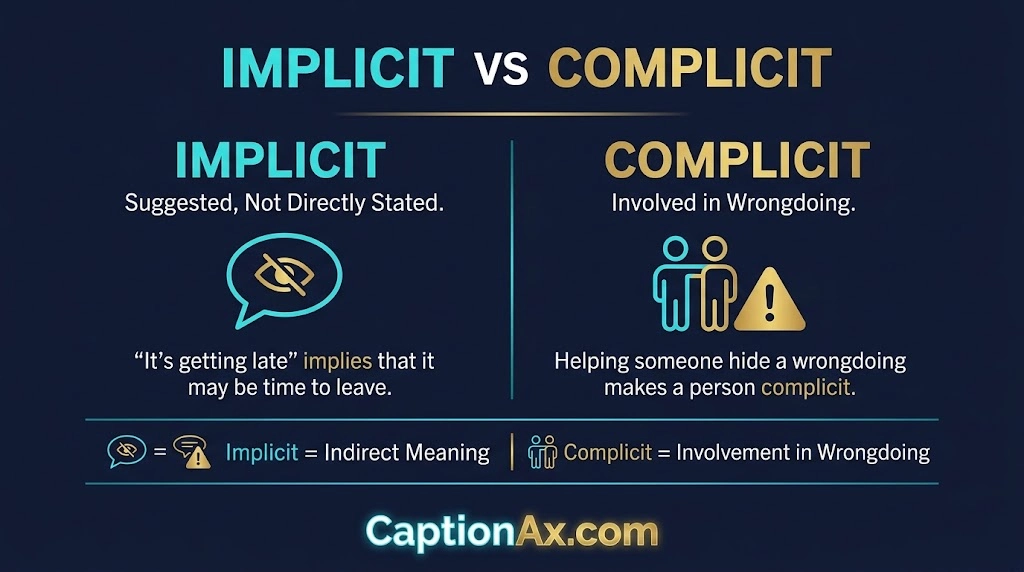
The most useful distinction is that implicit describes an Indirect Meaning or understanding, while complicit describes involvement in wrongdoing.
Implicit vs Complicit Examples in Sentences
Sentence pairs make the difference easier to understand because they show how each word works in a similar context.
Example 1: Workplace communication
- Implicit: The supervisor’s email contained an implicit request to finish the project early.
- Complicit: The supervisor was complicit in hiding the company’s safety violations.
Example 2: School
- Implicit: The classroom rules included an implicit expectation of mutual respect.
- Complicit: The students who helped falsify the results were complicit in the cheating.
To Example 3: Relationships
- Implicit: The couple had an implicit understanding about sharing household responsibilities.
- Complicit: He was complicit in his friend’s dishonest actions.
Example 4: Business
- Implicit: The agreement included an implicit expectation of confidentiality.
- Complicit: The executives were complicit in concealing fraudulent transactions.
Example 5: Public affairs
- Implicit: The speech contained an implicit criticism of the proposed policy.
- Complicit: The investigation examined whether officials were complicit in the cover-up.
To Example 6: Everyday conversation
- Implicit: Her raised eyebrow conveyed an implicit message of disagreement.
- Complicit: He became complicit by knowingly helping his colleague deceive the customer.
Notice that the words are not interchangeable. One describes what a situation communicates; the other describes a person’s connection to wrongdoing.
How to Use Implicit Correctly
Use implicit when describing an indirect message, an unstated assumption, an inferred expectation, or something understood without explicit wording.
Common grammatical combinations include:
- Implicit understanding
- Implicit consent
- Implicit assumption
- Implicit message
- Implicit expectation
- Implicit bias
- Implicit threat
- Implicit promise
Examples:
- The teacher’s instructions included an implicit expectation of punctuality.
- Her response carried an implicit warning.
- The researchers examined implicit attitudes.
- The agreement suggested an implicit commitment between the parties.
A useful editing test is to replace implicit with implied or unspoken. If the sentence retains its intended meaning, implicit may be appropriate.
Be especially careful with implicit consent. An unspoken implication should not automatically be treated as valid consent in medical, legal, or other sensitive situations.
How to Use Complicit Correctly
Use complicit when describing involvement in wrongdoing. One of its most common grammatical patterns is complicit in + wrongdoing or activity.
Examples:
- The employee was complicit in the theft.
- The executives were complicit in the cover-up.
- The organization was accused of being complicit in the abuse.
- Investigators questioned whether the manager was complicit in the scheme.
The basic structure is:
Subject + be + complicit + in + wrongdoing
For example: “The director was complicit in the fraud.”
Complicit can also appear with with when describing involvement alongside another person or group, depending on the sentence.
Remember the difference between the adjective and noun forms:
- Adjective: She was complicit in the scheme.
- Noun: Her complicity in the scheme was investigated.
- Explore More: https://captionax.com/instalments-or-installments/
Common Mistakes When Using Implicit and Complicit
These words are easy to confuse because of their similar spelling. The best solution is to identify the meaning you want before choosing the word.
| Incorrect or unclear sentence | Better sentence | Explanation |
| He was implicit in the robbery. | He was complicit in the robbery. | The intended meaning is involvement in wrongdoing. |
| The instructions were complicit. | The instructions were implicit. | The instructions communicated an indirect expectation. |
| They were implicit in the cover-up. | They were complicit in the cover-up. | The sentence describes participation. |
| The message was complicit. | The message was implicit. | The message is implied rather than directly stated. |
| Their friendship was based on complicit trust. | Their friendship was based on implicit trust. | The intended meaning is unspoken confidence. |
Context still matters. A phrase such as “a complicit smile” can be appropriate if it suggests shared knowledge or participation in wrongdoing. The goal is not to memorize rigid combinations but to select the word that accurately conveys your meaning.
Implicit vs Complicit in Everyday Situations
Both words appear in ordinary English, but they describe different aspects of a situation.
At school: A teacher may communicate an implicit expectation that students respect one another. A student who knowingly helps another student cheat may be complicit in the dishonesty.
At work: An email may contain an implicit request to complete a task quickly. An employee who knowingly falsifies a report may be complicit in misconduct.
In relationships: Two people may have an implicit understanding about sharing responsibilities. Someone who deliberately helps conceal harmful behavior may be complicit in it.
In business: A contract may create an implicit expectation through its wording or context. A company that knowingly helps conceal fraudulent transactions may be complicit in fraud.
In journalism: A statement may contain an implicit criticism of a public decision. A news report may investigate whether an individual was complicit in a scandal.
These examples show that implicit focuses on communication and understanding, whereas complicit focuses on participation and responsibility.
Is Silence Implicit Approval or Complicity?
Silence can have several meanings. Depending on the situation, it may suggest agreement, uncertainty, discomfort, fear, disagreement, or a decision not to respond.
Silence does not automatically establish implicit approval, and it does not automatically establish complicity.
Compare these situations:
- Possible implicit approval: A colleague remains silent during a routine proposal, and others interpret that silence as agreement. That interpretation may be mistaken.
- Possible complicity: An employee knowingly helps conceal evidence of fraud.
- Silence without approval: A witness remains quiet because they feel intimidated or unsafe.
- Failure to act despite a responsibility: Someone deliberately fails to act despite having a relevant professional or legal duty.
The correct description depends on context, knowledge, conduct, and responsibility. Where legal culpability is at issue, the applicable law and evidence must also be considered.
Implicit vs Complicit: Pronunciation and Word Origins
Although implicit and complicit look similar, their pronunciations and word histories provide additional context.
Implicit
- Pronunciation: im-PLIS-it
- Part of speech: Adjective
- Meaning: Implied, indirect, or understood without direct expression.
- Origin: Derived through Latin from implicitus, associated with something folded or entwined.
Complicit
- Pronunciation: kuhm-PLIS-it
- Part of speech: Adjective
- Meaning: Involved in wrongdoing.
- Origin: Formed in English in relation to complicity, the noun describing involvement in wrongdoing.
Both words end with a similar sound, so pronunciation alone is not the most reliable way to distinguish them. Learning their meanings and common grammatical patterns is more useful.
Synonyms and Related Words for Implicit and Complicit
The Synonyms help explain each word, but their meanings are not always identical.
Synonyms for implicit
- Implied
- Unspoken
- Indirect
- Inferred
- Understood
- Unexpressed
- Suggested
Example: “The agreement included an implicit promise.”
A similar sentence is: “The agreement included an implied promise.”
Synonyms for complicit
- Involved
- Participating
- Colluding, when cooperation in wrongdoing is intended
- Contributing to wrongdoing
- Culpable, in appropriate contexts
- An accessory, in certain legal contexts
Example: “The employee was complicit in the cover-up.”
A clearer alternative is: “The employee knowingly helped conceal the wrongdoing.”
Use words such as culpable, guilty, and accessory carefully because they may have specific legal implications that complicit does not establish by itself.
How to Remember the Difference Between Implicit and Complicit
Use this simple memory trick:
Implicit = Implied.
Think about an unspoken message, indirect warning, or expectation that is understood without being directly expressed.
Complicit = Connected to wrongdoing.
Think about someone who knowingly helps another person carry out or conceal a dishonest act.
Try asking yourself two questions:
- Am I describing an unstated meaning or understanding? Choose implicit.
- Am I describing someone’s involvement in wrongdoing? Choose complicit.
For example:
“The manager’s email contained an _____ warning.”
Answer: Implicit, because the warning was communicated indirectly.
“The manager was _____ in the cover-up.”
Answer: Complicit, because the manager participated in concealing wrongdoing.
Practice Quiz: Implicit or Complicit?
Test your understanding by selecting the correct word in each sentence.
1. The contract included an _____ expectation of confidentiality.
- A. Implicit
- B. Complicit
2. The accountant was _____ in the fraudulent scheme.
- A. Implicit
- B. Complicit
3. Their friendship was based on _____ trust.
- A. Implicit
- B. Complicit
4. The employees were accused of being _____ in the cover-up.
- A. Implicit
- B. Complicit
5. The speaker’s comments carried an _____ criticism of the policy.
- A. Implicit
- B. Complicit
Answers and explanations
- Implicit — The expectation is understood rather than directly stated.
- Complicit — The accountant is involved in wrongdoing.
- Implicit — The trust exists without requiring explicit expression.
- Complicit — The employees are alleged to have participated in concealing wrongdoing.
- Implicit — The criticism is suggested indirectly.
If you answered all five correctly, you understand the central distinction between these commonly confused words.
People Also Ask
A:Implicit means suggested or understood without being directly expressed. Complicit means involved in wrongdoing, usually through participation, assistance, or cooperation.
A:They are closely related, but their grammatical use differs. Implicit is an adjective, while implied is commonly used as the past participle of imply and can also function as an adjective.
For example, “The warning was implicit” and “The message implied a warning” use different sentence structures.
A:No. Complicit generally describes involvement in wrongdoing, but it does not automatically establish legal guilt. Legal responsibility depends on the relevant law and evidence.
A:Sometimes, depending on the circumstances and the person’s knowledge, conduct, and responsibilities. Silence alone does not automatically establish complicity.
A:“The manager’s email contained an implicit request to complete the project early.” The request was suggested rather than directly stated.
Conclusion
Understanding Implicit vs. Complicit becomes much easier when you focus on what each word describes. Implicit refers to something suggested or understood without being directly stated, while complicit refers to involvement in wrongdoing.
Use expressions such as implicit trust, implicit approval, and implicit expectations when discussing indirect understanding. Use phrases such as complicit in fraud, complicit in misconduct, and complicit in a cover-up when describing involvement in wrongdoing.
The simplest memory trick is implicit = implied; complicit = connected to wrongdoing. Keep this distinction in mind to choose the correct word in everyday conversations, academic assignments, and professional writing.