
Traveled or Travelled: Which Spelling Is Correct?
Have you ever paused while writing an essay, email or travel blog because you were unsure whether to type Traveled or Travelled? Both spellings are correct, and neither changes the meaning of the word. The difference comes from regional English spelling conventions.
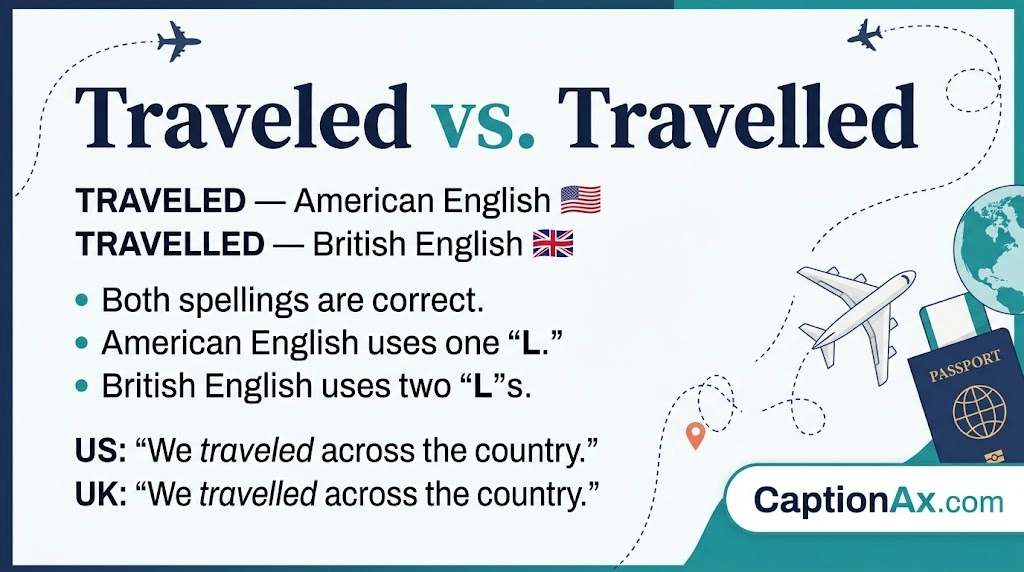
Traveled is the standard spelling in American English, while travelled is the standard spelling in British English. Both are forms of the verb travel and describe moving from one place to another. For example, an American writer might say, “We traveled across Canada,” while a British writer might write, “We travelled across Canada.”
The same pattern appears in related words: Americans generally write traveling and traveler, while British writers generally use travelling and traveller. These differences are spelling conventions, not differences in grammar or meaning.
If you are writing for a US audience, choose the single-l forms. If your readers expect British English, use the double-l forms. The following guide explains the rule, shows real-world examples, and helps you avoid common spelling mistakes.
Traveled or Travelled: Which Spelling Is Correct?
Both traveled and travelled are correct English spellings. The appropriate choice depends on which variety of English you are following.
| Spelling | Preferred variety | Example |
| Traveled | American English | We traveled to California. |
| Travelled | British English | We travelled to Scotland. |
The words have the same meaning and pronunciation. The extra l in travelled does not make it more formal, more grammatical or more accurate in every situation.
For a US school assignment, American business email or website aimed primarily at American readers, traveled is normally the appropriate choice. For a UK publication or document following British spelling, travelled is generally preferred.
Quick rule: Use traveled for American English and travelled for British English, unless your publication or organization specifies a different style.
What Does Traveled or Travelled Mean?
Traveled and travelled are the simple past and past participle forms of the verb travel. The verb usually means to go from one place to another, particularly over a distance.
Examples include:
- We traveled to Japan last spring.
- She travelled to London for a conference.
- They have traveled to several countries.
- He had travelled extensively before retiring.
Both spellings can also describe a person who has visited many places. For example, a well-traveled writer and a well-travelled writer express the same idea.
The word can describe more than journeys taken by people. A road can be heavily traveled or heavily travelled, and information can travel from one person to another. The spelling convention remains the same in the relevant forms.
Traveled vs. Travelled: Key Differences at a Glance
The following comparison summarizes the differences readers most often need to understand.
| Feature | Traveled | Travelled |
| Main spelling convention | American English | British English |
| Ending | One l before -ed | Two ls before -ed |
| Simple past | Yes | Yes |
| Past participle | Yes | Yes |
| Meaning | Went from place to place | Went from place to place |
| Pronunciation | Generally the same | Generally the same |
| Present participle | Traveling | Travelling |
| Noun form | Traveler | Traveller |
The distinction is regional, not grammatical. Both spellings work in the same sentence structures, and both are accepted English forms.
One important writing tip is to keep your spelling consistent. A document that uses traveled, travelling and traveller without a specific reason mixes conventions. That is usually an editing issue rather than a problem with the individual words.
Why Does American English Use Traveled?
American English generally uses one l in traveled, traveling and traveler. These forms are standard in American books, newspapers, academic assignments, business communication and websites.
Consider these examples:
- I traveled to New York for a meeting.
- We traveled across the country by train.
- She has traveled extensively for her research.
- The team traveled to another state for the competition.
- They are traveling to Florida next week.
The same convention appears in other words, such as canceled, canceling and counselor, although spelling rules differ from word to word and should not be applied mechanically to every English word.
If your audience is primarily American, use traveled, traveling and traveler consistently. A US-English dictionary or spellchecker can help you maintain that style throughout a document.
Why Does British English Use Travelled?
British English generally retains the double l in travelled, travelling and traveller. These spellings are established forms, not mistakes or informal alternatives.
Examples include:
- We travelled through Scotland during the summer.
- She travelled by train to visit her family.
- They have travelled around Europe together.
- The traveller arrived at the station early.
- We are travelling abroad next month.
These forms are also common in Australian English and other English-language contexts that follow similar conventions, although local preferences and publication styles can vary.
The important point is that the additional l does not change the meaning. If you are writing for a British publication, follow its house style and use travelled unless its guidelines specify otherwise.

Is Travelled Correct in American English?
Yes. Travelled is a recognized English spelling, but traveled is the standard American form. US readers generally understand both versions.
Compare these sentences:
- British-style spelling: We travelled to Florida last month.
- Standard American spelling: We traveled to Florida last month.
Both sentences communicate the same thing. The second simply follows the usual American convention.
There are situations in which retaining travelled makes sense in an American document, such as quoting a British author, reproducing an official title or discussing differences between English varieties.
For ordinary US-focused writing, however, traveled is usually the better choice. Follow the required style guide if you are writing for a school, publisher, employer or client.
Is Traveled Correct in British English?
Yes. Traveled is a valid American English spelling, but British English generally prefers travelled.
For example:
- American spelling: We traveled to Manchester last year.
- British spelling: We travelled to Manchester last year.
The meaning, tense and pronunciation remain essentially the same. The difference is a matter of regional spelling preference.
If you are writing a UK school essay, professional report or article for a British audience, use travelled unless the assignment or publisher requests American English. Applying the same convention to travelling and traveller will make the document more consistent.
Traveled or Travelled in a Sentence: Examples
Seeing the words in context is one of the easiest ways to remember when to use each form.
American English examples
- I traveled to Chicago during the holidays.
- We traveled by plane instead of driving.
- She traveled across three states for work.
- They traveled together after graduation.
- He has traveled to more than ten countries.
- The family traveled to the coast last weekend.
- Our manager traveled abroad for a conference.
- The train traveled through the mountains.
British English examples
- I travelled to Birmingham during the holidays.
- We travelled by train instead of driving.
- She travelled across three counties for work.
- They travelled together after graduation.
- He has travelled to several European countries.
- The family travelled to the coast last weekend.
- Our manager travelled abroad for a conference.
- The train travelled through the mountains.
You can also use the verb in questions and negative sentences:
- Question: Did you travel to Canada last year?
- Negative: I did not travel abroad last year.
- American present perfect: Have you traveled to Boston?
- British present perfect: Have you travelled to London?
Notice that travel remains in its base form after did and did not. This rule applies to both American and British English.
Traveled vs. Travelled in Different Verb Tenses
Understanding the verb forms helps you avoid grammar mistakes as well as spelling errors.
| Verb construction | American English | British English |
| Simple present | I travel | I travel |
| Simple past | I traveled | I travelled |
| Present perfect | I have traveled | I have travelled |
| Past perfect | I had traveled | I had travelled |
| Future | I will travel | I will travel |
| Present continuous | I am traveling | I am travelling |
| Simple negative past | I did not travel | I did not travel |
The regional difference appears in the past-tense, past-participle and -ing forms. The base verb travel remains the same.
Simple past: Use it for an action completed in the past.
- US: We traveled to Seattle yesterday.
- UK: We travelled to Cardiff yesterday.
Present perfect: Use have or has with the past participle.
- US: She has traveled extensively.
- UK: She has travelled extensively.
Past perfect: Use had with the past participle for an action completed before another past event.
- US: They had traveled for hours before reaching the hotel.
- UK: They had travelled for hours before reaching the hotel.
Important grammar rule: After did or did not, use travel, not traveled or travelled.
Incorrect: Did you travelled to Canada?
Correct: Did you travel to Canada?
- Explore More: https://captionax.com/lay-vs-lie/
Traveling or Travelling: Which Is Correct?
Both traveling and travelling are correct. They follow the same regional pattern as traveled and travelled.
- Traveling: Standard American spelling.
- Travelling: Standard British spelling and common in Australian English.
Examples:
- US: We are traveling to Boston tomorrow.
- UK: We are travelling to Bristol tomorrow.
- US: Traveling by train can be relaxing.
- UK: Travelling by train can be relaxing.
These forms can function as present participles in continuous tenses or as gerunds when an activity acts as a noun in a sentence.
For example, “Traveling is expensive” and “Travelling is expensive” are both grammatically correct.
When editing an article, check all related forms together. If you choose American English, use traveled, traveling and traveler. If you choose British English, use travelled, travelling and traveller.
Traveler or Traveller: Which Spelling Should You Use?
The noun traveler follows the same pattern. Both forms refer to a person who travels.
| American English | British English |
| Traveler | Traveller |
| Travelers | Travellers |
| Traveled | Travelled |
| Traveling | Travelling |
Examples:
- US: The traveler checked into the hotel.
- UK: The traveller checked into the hotel.
- US: Many travelers prefer direct flights.
- UK: Many travellers prefer direct flights.
For websites, travel agencies and tourism businesses, spelling consistency is particularly useful because content may include articles, product descriptions, booking information and marketing copy.
Choose a convention that suits your primary audience and apply it throughout your content. If a company has a specific editorial guide, that guide should take priority.
Well-Traveled or Well-Travelled: What Is Correct?
Both well-traveled and well-travelled are correct. The spelling depends on whether you follow American or British English.
The expression usually describes a person who has visited many places or gained considerable travel experience.
Examples:
- American: She is a well-traveled photographer.
- British: She is a well-travelled photographer.
- American: He is a well-traveled business consultant.
- British: He is a well-travelled business consultant.
The expression can also describe a road or route used by many travelers.
When the expression comes before a noun, a hyphen is commonly used, as in “a well-traveled writer.” When it follows a linking verb, an open form is also common, as in “the writer is well traveled.” Follow your dictionary or publication’s style guidance for the construction you are using.
Common Mistakes to Avoid When Using Traveled or Travelled
Even confident writers can mix up regional spelling conventions. These are the most common problems to watch for.
Mistake 1: Assuming one spelling is always wrong
Incorrect assumption: “Travelled is not a real English word.”
Correction: Travelled is standard British spelling, while traveled is standard American spelling.
Mistake 2: Mixing conventions without a reason
Inconsistent: “We traveled to London before travelling to Paris.”
Consistent American English: “We traveled to London before traveling to Paris.”
Consistent British English: “We travelled to London before travelling to Paris.”
Mistake 3: Using the past form after did
Incorrect: “Did you traveled to Canada?”
Correct: “Did you travel to Canada?”
The auxiliary did already marks the past tense, so the main verb takes its base form.
Mistake 4: Assuming the two forms have different meanings
They mean the same thing. The extra l does not indicate a different tense, action or level of formality.
Mistake 5: Forgetting related words
Using traveled in one paragraph and traveller in another can make an American-English article look inconsistent. Review the complete word family.
Mistake 6: Trusting spellcheck without checking its language setting
A US-English spellchecker may flag travelled, while a UK-English spellchecker may flag traveled. Check the document language before accepting automatic corrections.
How to Choose the Right Spelling for Your Audience
The simplest strategy is to identify your readers before writing and use the spelling convention they expect.
Writing for the United States
Use traveled, traveling and traveler. These forms suit most US-focused school assignments, websites and business communications.
Writing for the United Kingdom
Use travelled, travelling and traveller. Check the publisher’s guidelines if the content is for a specific publication or institution.
Writing for an Australian audience
The double-l forms are common in Australian English. Follow the relevant organization’s preferred style where one is available.
Writing for an international audience
Choose the English variety that best suits your principal readership. If the article specifically compares spelling differences, label examples clearly so readers understand why both versions appear.
Before publishing, use this quick checklist:
- Identify your target audience.
- Select American or British spelling.
- Check traveled/travelled, traveling/travelling and traveler/traveller.
- Verify grammar separately from spelling.
- Preserve the spelling in direct quotations and official titles.
- Proofread the entire document for consistency.
For CaptionAx, the most useful editorial practice is to set a preferred English variety for each article or content section and check it before publication. This reduces avoidable editing errors and makes your content more professional.
People Also Ask
A:Both are correct. Traveled is the standard American English spelling, while travelled is the standard British English spelling.
A:Travelled has two ls before -ed. The American equivalent, traveled, uses one l.
A:Yes. Traveled is the standard American English simple past and past participle of travel. It is also recognized as an American spelling in dictionaries.
A:No. It is a recognized British spelling, although traveled is generally preferred in standard American writing.
A:It is recognizable as American spelling, but British English generally prefers travelled. Follow your publisher’s spelling guide when one is specified.
Conclusion
The choice between Traveled and Travelled becomes easy once you understand the difference between American and British English. Both spellings are correct, share the same meaning, and function as the simple past and past participle of travel.
Remember these three rules:
- American English: traveled, traveling, traveler.
- British English: travelled, travelling, traveller.
- Grammar: Use the base form travel after did and did not.
Whether you are writing a school assignment, business email, travel blog or website article, choose the spelling that matches your audience and remain consistent throughout your writing.
For more practical English explanations, explore related spelling and grammar guides on CaptionAx.com.