Afterward vs. Afterword: Meaning, Spelling & Examples
Have you ever wondered whether to write Afterward or Afterword? These two English words look and sound similar, but they have different meanings and grammatical functions. Choosing the wrong one can change the meaning of your sentence.
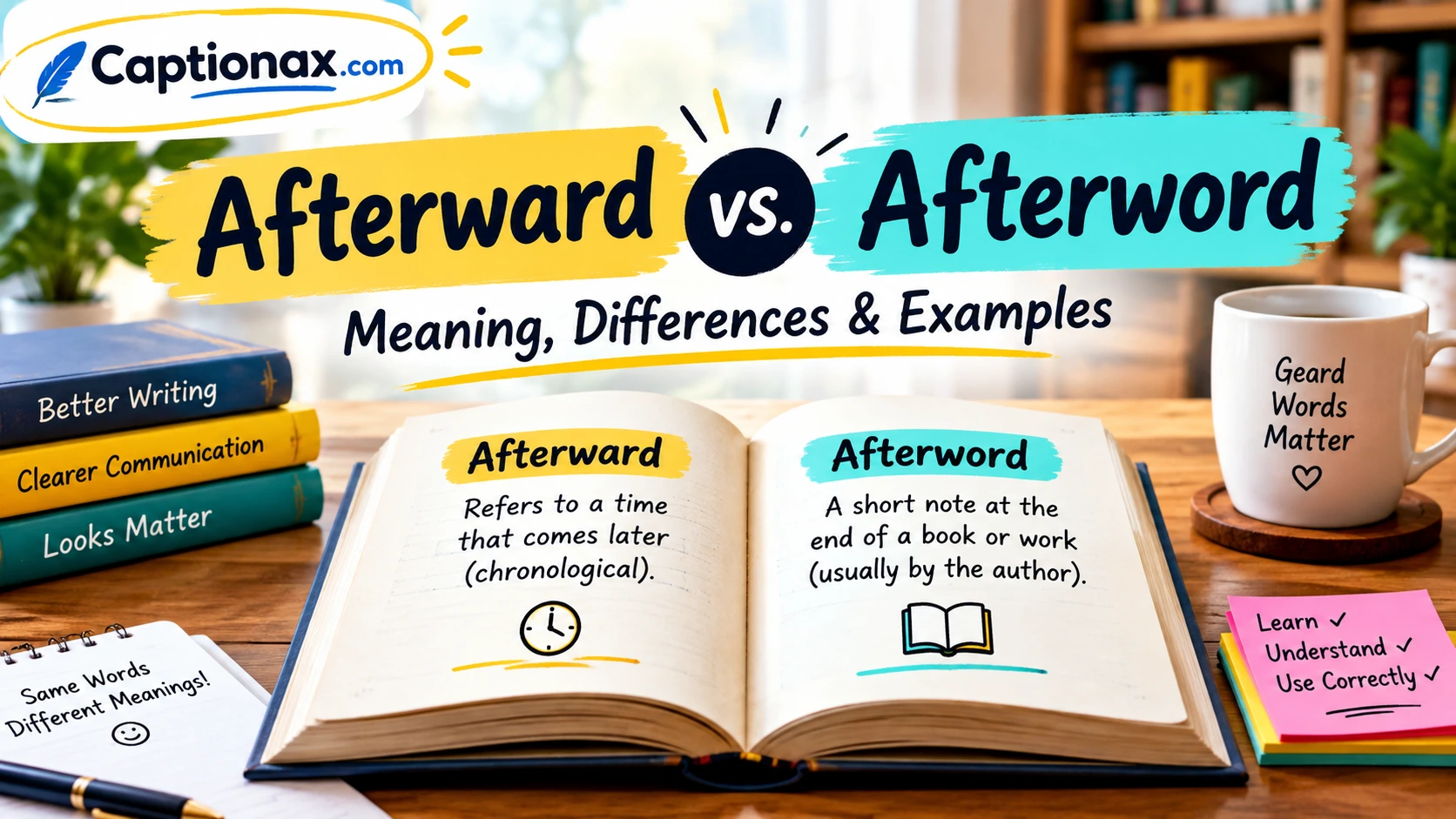
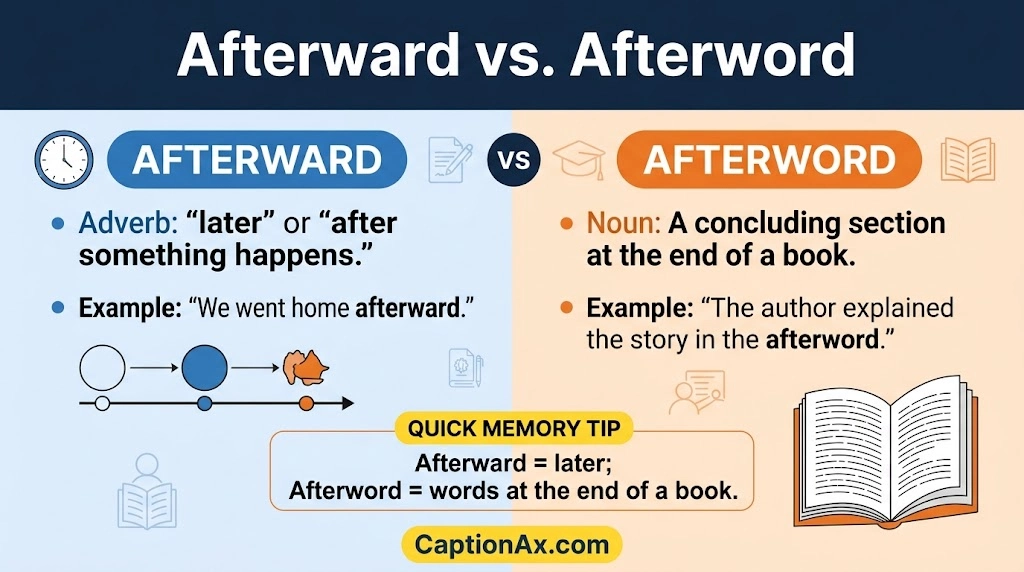
Afterward is an adverb meaning later or at a subsequent time. Afterword is a noun referring to a concluding section of a book or another written work. For example, “We discussed the story afterward” describes when a conversation happened, while “The book includes an afterword” refers to a section of writing.
The confusion becomes even greater when you encounter afterwards and afterwords. Although these spellings look related, they serve different purposes.
This guide explains the meanings, spelling rules, pronunciation, sentence examples, and common mistakes associated with afterward vs. afterword. Whether you are writing an essay, preparing a report, editing a book review, or improving your everyday English, you will learn how to choose the correct word confidently.
What Is the Difference Between Afterward and Afterword?
The main difference between afterward and afterword is that one describes time, while the other names a written section.
| Feature | Afterward | Afterword |
| Part of speech | Adverb | Noun |
| Meaning | Later; after an event | A concluding section of a book |
| Refers to time? | Yes | No |
| Refers to writing? | No | Yes |
| Example | We talked afterward. | I read the afterword. |
Use afterward when describing something that happens later. Use afterword when referring to a concluding piece of writing, usually found at the end of a book.
Examples:
- Correct: We finished dinner and went for a walk afterward.
- Correct: The author included an afterword explaining the book’s background.
- Incorrect: We finished dinner and went for a walk afterword.
- Incorrect: The author included an afterward explaining the book’s background.
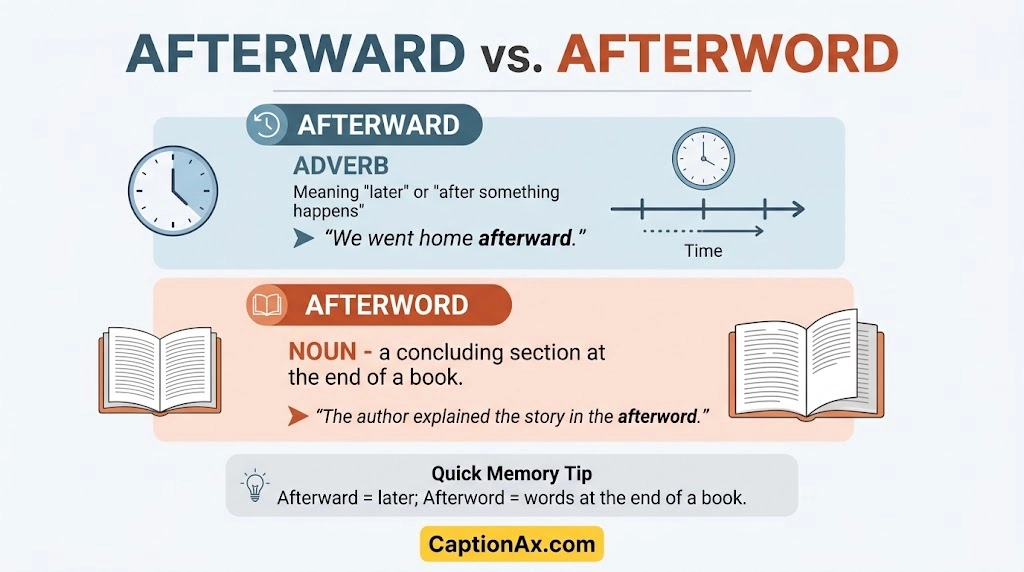
A quick memory trick makes the distinction easier: afterword contains the word “word,” so it refers to writing. Afterward tells you when something happens.
What Does Afterward Mean?
Afterward means later, subsequently, or after a previously mentioned event or time. It is an adverb that establishes the sequence of events.
For example, if you finish your homework and then watch a movie, you can say, “I watched a movie afterward.”
The word does not name an object or a section of writing. Instead, it explains when an action occurs.
Examples of afterward in sentences:
- We finished our lunch and went shopping afterward.
- She apologized afterward for her rude comment.
- The students discussed their results afterward.
- He felt much better shortly afterward.
- They moved to another city and started a business soon afterward.
- I will send you the documents afterward.
- The meeting ended, and everyone returned to work afterward.
- She understood the problem only long afterward.
You will often find afterward at the end of a sentence, but it can also appear at the beginning.
For example: “Afterward, we returned to the office.”
Expressions such as soon afterward, shortly afterward, and long afterward are also common. They indicate how much time passes before the next event.
What Does Afterword Mean?
An Afterword is a concluding section of a book or another written work that provides additional commentary, background information, reflections, or context.
It may be written by the original author, an editor, a scholar, or another contributor. Its purpose depends on the publication and the information readers need after completing the main text.
Examples of afterword in sentences:
- The afterword explains how the novel was written.
- I enjoyed the book, but the afterword was especially informative.
- The editor contributed an afterword to the revised edition.
- Her afterword discusses the historical events behind the story.
- The book’s afterword provides additional information about the research.
- The author thanked her collaborators in the afterword.
- The afterword helped readers understand the book’s central argument.
- The new edition includes an afterword by a literary historian.
Because afterword is a noun, it can follow words such as a, an, the, this, and that.
For example, “The afterword was helpful” is correct because afterword names the section being discussed.
Quick tip: If you can replace the word with “a concluding section of a book,” afterword is probably the correct choice.
Afterward vs. Afterword: Quick Comparison Table
Use this table to review the essential differences.
| Question | Afterward | Afterword |
| What does it mean? | At a later time | A concluding written section |
| What is its grammatical role? | Adverb | Noun |
| Can it describe when something happens? | Yes | No |
| Can you read it in a book? | No, not as a named section | Yes |
| Is it used in everyday conversation? | Yes | Mostly when discussing writing |
| Example | We spoke afterward. | I enjoyed the afterword. |
The most reliable way to choose between these words is to examine the meaning of the sentence rather than the appearance of the spelling.
If you are describing the timing of an event, use afterward. If you are naming a written section, use afterword.
How to Use Afterward in a Sentence
Use afterward when you want to explain that something happens after another event. It is appropriate in informal conversations, academic assignments, professional emails, and longer narratives.
At the end of a sentence:
- We visited the museum and had lunch afterward.
- She called her friend afterward.
- I completed the report and checked the figures afterward.
At the beginning of a sentence:
- Afterward, we returned to the hotel.
- Afterward, the teacher explained the answers.
- Afterward, everyone understood what had happened.
With expressions of time:
- Shortly afterward, the train arrived.
- Soon afterward, the company announced its decision.
- Long afterward, he remembered the conversation.
- Immediately afterward, the team began preparing for the next match.
One important grammar distinction is that afterward can stand alone, while the preposition after can introduce a noun phrase.
Compare these examples:
- Correct: We went home afterward.
- Correct: We went home after the meeting.
- Incorrect: We went home afterward the meeting.
In the final example, use after the meeting because a noun phrase follows the preposition after.
How to Use Afterword in a Sentence
Use Afterword when referring to a concluding piece of writing in a book or similar publication.
The word is especially useful in book reviews, literary discussions, publishing, and academic writing.
Examples:
- The afterword provides useful context for understanding the novel.
- I read the afterword after finishing the final chapter.
- The author wrote an afterword for the anniversary edition.
- The editor’s afterword explains the book’s historical significance.
- The afterword discusses the author’s research process.
- The publisher added an afterword to the revised edition.
You can also use afterword in more formal sentences.
For example: “The editor’s afterword offers a valuable perspective on the historical context of the novel.”
Here, afterword identifies a specific section that adds commentary to the publication.
Remember that an afterword is not necessarily written by the original author. Depending on the book, it may be contributed by an editor, critic, researcher, or another knowledgeable person.
Afterward vs. Afterword Example Sentences
Comparing similar sentences is an effective way to understand these commonly confused words.
| Afterward: time | Afterword: written section |
| I read the book and wrote a review afterward. | I read the book’s afterword. |
| We discussed the novel afterward. | The afterword discusses the novel’s themes. |
| She contacted the author afterward. | The author wrote an afterword for the new edition. |
| The lecture ended, and we spoke afterward. | The lecturer contributed an afterword to the textbook. |
| He understood the story better afterward. | The afterword clarified the story’s historical background. |
- Explore More: https://captionax.com/at-least-vs-atleast/
Consider these additional examples.
Example 1
Incorrect: We finished the meeting and went home afterword.
Correct: We finished the meeting and went home afterward.
Why? The sentence describes when the people went home.
Example 2
Incorrect: The editor wrote an afterward for the book.
Correct: The editor wrote an afterword for the book.
Why? The sentence refers to a concluding section of writing.
Example 3
Correct: We discussed the novel afterward.
Correct: We read the novel’s afterword.
Why? Both sentences are grammatical, but the first refers to the timing of a discussion, while the second identifies a section of the book.
Afterword vs. Afterwords: What Is the Difference?
Afterword and afterwords differ in number.
- Afterword: One concluding section of a written work.
- Afterwords: More than one concluding section.
Examples:
- The author added an afterword to the paperback edition.
- The collected edition contains afterwords written for several earlier publications.
- I read the afterword before writing my review.
- The anthology includes afterwords from multiple contributors.
The plural spelling afterwords is also easy to confuse with afterwards. However, their meanings are different.
Compare:
- We went home afterwards. — This describes when we went home.
- The collection contains two afterwords. — This refers to two written sections.
To remember the distinction, look for the word word inside afterword. When the sentence refers to writing, afterword or afterwords may be correct. When it describes a later event, afterward or afterwards is appropriate.
Afterward vs. Afterwards: Are They the Same?
Yes. Afterward and afterwards are both correct adverbs meaning later or at a subsequent time.
The difference is mainly regional preference. American English generally favors afterward, while British English commonly uses afterwards. Both forms are understood internationally.
Examples:
- American English: We went for a walk afterward.
- British English: We went for a walk afterwards.
Both sentences communicate the same meaning.
You may encounter either spelling in international English. If you are writing for a specific publication, follow its preferred style and use one form consistently.
The key point is that neither afterward nor afterwards refers to a concluding section of a book. That meaning belongs to afterword.
Is Afterward a Noun or an Adverb?
Afterward is an adverb. It provides information about when an action or event happens.
Examples:
- We ate dinner afterward.
- She felt relieved afterward.
- The team celebrated shortly afterward.
In each sentence, afterward indicates the timing of an action or state.
By contrast, afterword is a noun because it names a written section.
Compare:
- Adverb: We discussed the book afterward.
- Noun: We discussed the book’s afterword.
Understanding the parts of speech makes proofreading easier. If the word describes when something happened, afterward is appropriate. If it names Afterward vs. Afterword something that can be read, edited, or included in a publication, afterword is the better choice.
How to Remember Afterward vs. Afterword
You do not need to memorize a complicated grammar rule to distinguish these words.
Memory trick 1: Afterword contains “word.”
Think of an afterword as additional words written at the end of a book.
Example: “The author added an afterword to explain the research.”
Memory trick 2: Afterward tells you when.
Think of afterward as another way to say later.
Example: “We finished the research and presented our findings afterward.”
You can also ask yourself one simple question: Am I describing a later event or naming a written section?
- A later event → afterward.
- A written section → afterword.
- Multiple written sections → afterwords.
- A later event in a sentence using the alternative spelling → afterwards.
These associations make the difference easier to remember when writing essays, emails, reviews, or everyday messages.
Common Mistakes to Avoid
Because the spellings are similar, writers sometimes choose the wrong word. Here are the most common mistakes to check for when editing.
Mistake 1: Using afterword to mean later
Incorrect: We finished the meeting and went home afterword.
Correct: We finished the meeting and went home afterward.
Mistake 2: Using afterward to describe a book section
Incorrect: The book includes an afterward by the editor.
Correct: The book includes an afterword by the editor.
Mistake 3: Confusing afterwards with afterwords
Incorrect: We discussed the issue afterwords.
Correct: We discussed the issue afterwards.
If you mean multiple concluding sections, however, afterwords may be correct.
Mistake 4: Assuming afterward and afterwards have different meanings
Both forms mean later. Their main difference is regional preference.
Mistake 5: Treating an afterword and an epilogue as always identical
An epilogue typically provides a final part of a narrative or describes what happens after the main story. An Afterword usually offers separate commentary, reflections, or background information about the work. Their purposes can overlap, but the terms are not interchangeable in every context.
Checking the meaning before choosing the spelling will prevent most of these errors.
Afterward vs. Afterword in Academic and Professional Writing
Both words are appropriate in formal writing, but they serve different purposes.
In essays and reports
Use afterward when describing the sequence of events, research activities, or decisions.
Example: “The researchers reviewed the results and conducted additional tests afterward.”
In book reviews
Use afterword when discussing a concluding section of a publication.
Example: “The afterword provides useful context for interpreting the author’s argument.”
In emails and workplace communication
Use afterward when referring to an action that will happen later.
Example: “I will send the revised document afterward.”
In publishing and literary criticism
Use afterword when identifying a section that offers commentary about a book.
Example: “The new edition features an afterword by a specialist in modern literature.”
For polished professional writing, select the word that conveys your intended meaning. Regional consistency matters when choosing afterward or afterwards, but it does not change the distinction between those adverbs and the noun afterword.
Practice Quiz: Choose the Correct Word
Test your understanding of afterward, afterword, afterwards, and afterwords.
- We finished our homework and watched television ______.
- A. afterword
- B. afterward
- C. afterwords
- The author included an ______ in the revised edition.
- A. afterward
- B. afterword
- C. afterwards
- We went to the restaurant and returned home ______.
- A. afterwords
- B. afterward
- C. afterword
- The book’s ______ explains the historical background.
- A. afterword
- B. afterward
- C. afterwards
- The collected edition contains two additional ______.
- A. afterward
- B. afterwards
- C. afterwords
Answer key
- B — afterward
- B — afterword
- B — afterward
- A — afterword
- C — afterwords
If you answered all five correctly, you understand the main distinction. Remember that afterward and afterwards describe time, while afterword and afterwords refer to written sections.
People Also Ask
A:Both are correctly spelled English words, but they have different meanings. Afterward means later, whereas afterword refers to a concluding section of a book. Choose the word that matches your intended meaning.
A:Afterward is an adverb that indicates time. Afterword is a noun that names a written section, usually found near the end of a book or publication.
A:Yes. Afterward is written as one word, without a space or hyphen.
A:Yes. Afterword is a standard English noun for a concluding section that provides commentary, background, or additional information about a written work.
A:Yes. Both mean at a later time. Afterward is generally preferred in American English, while afterwards is particularly common in British English.
Conclusion
The difference between Afterward and Afterword comes down to one simple distinction: time versus text. Use afterward to describe something that happens later, and use afterword to refer to a concluding section of a book.
If you encounter afterwards, remember that it is another correct form of afterward, commonly preferred in British English. Afterwords is the plural of afterword and refers to multiple written sections.
When proofreading, ask yourself whether you are describing when an action happened or naming a piece of writing. That quick check will help you choose the correct word in essays, emails, reports, book reviews, and everyday communication.
Explore more spelling and grammar guides on CaptionAx.com to build your vocabulary and write with greater confidence.