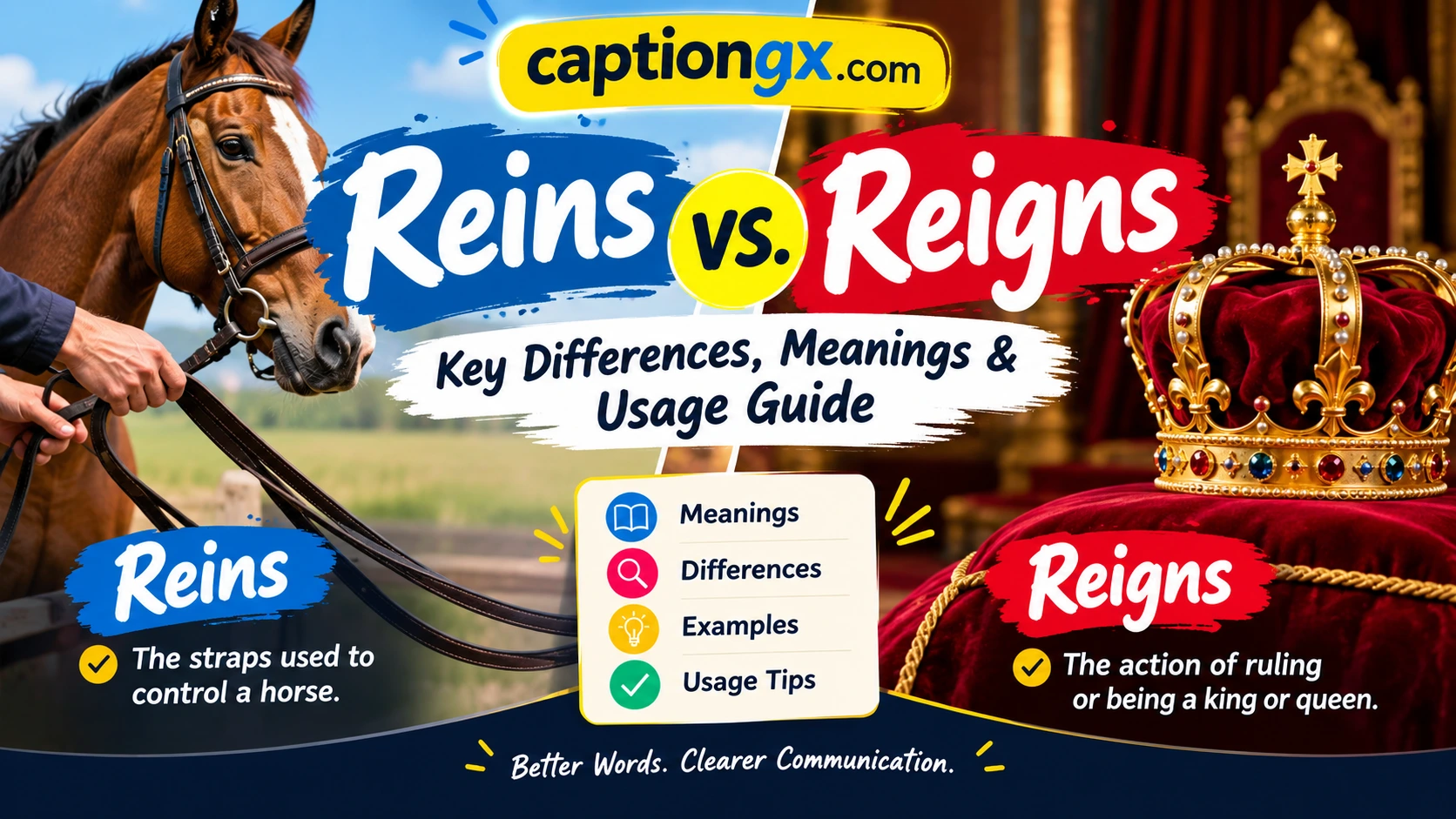
Reins vs. Reigns: Meaning, Differences & Examples
Have you ever paused while writing because you couldn’t decide whether to use Reins or Reigns? These two words sound exactly alike, but their meanings are different. Choosing the wrong one can make an otherwise correct sentence confusing or incorrect.
The difference is simple: reins are straps used to guide a horse and can also represent control or responsibility. Reigns is the plural of reign, meaning periods of rule, or the verb form used when a singular subject rules or dominates. The correct spelling depends on what your sentence means.
For example, “She took the reins of the company” means she assumed control. However, “The queen’s reign lasted 30 years” refers to her period of rule.
Both words are correct English spellings, so a spell-checker might not catch the mistake when one is used in place of the other. Understanding their meanings, grammatical roles, and common expressions will help you choose the right word in essays, emails, business writing, and everyday conversations.
Reins vs. Reigns: What’s the Difference?
Reins and reigns are homophones, meaning they sound alike but have different spellings and meanings.
| Word | Meaning | Example |
| Reins | Horse-control straps; figuratively, control or responsibility | She took the reins of the company. |
| Reigns | Multiple periods of rule, or the verb meaning rules or dominates | The king reigns over the kingdom. |
| Rein | A strap used to guide a horse; also a verb meaning to restrain | Please rein in your spending. |
| Reign | To rule or a period of rule | Her reign lasted decades. |
| Rain | Water falling from clouds | Heavy rain delayed the match. |
The easiest way to remember the difference is to connect reins with riding and control and reigns with rulers and ruling. This distinction also explains why the correct idiom is “take the reins,” not “take the reigns.”
What Does Reins Mean?
Reins is the plural form of rein. The word has a literal meaning connected to horse riding and a figurative meaning associated with control, leadership, and responsibility.
1. Reins in horse riding
In horse riding, reins are straps attached to a bridle that a rider holds to guide or control a horse. Riders use them to communicate directions and manage movement.
Examples:
- The rider held the reins firmly while crossing the field.
- She gently pulled the reins to slow the horse.
- The trainer handed the reins to an experienced rider.
- The child learned how to hold the reins correctly.
In each sentence, reins refers to physical riding equipment. Cambridge Dictionary also records the word’s literal meaning and its use in established expressions.
2. Reins as a symbol of control
In everyday English, reins often represents authority or the responsibility to direct something. The meaning comes from the way reins help a rider guide a horse.
Examples:
- The new director took the reins of the organization.
- It’s time to take the reins of your own future.
- She handed over the reins after years of leadership.
- The new manager now holds the reins of the department.
These examples don’t involve horses. They use the idea of guiding an animal as a metaphor for managing a business, project, team, or personal responsibility.
3. Common expressions with reins
Learn these phrases as complete expressions to avoid spelling mistakes.
| Expression | Meaning | Example |
| Take the reins | Assume control | Maya took the reins of the project. |
| Hold the Reins | Maintain control | The board still holds the reins. |
| Hand over the reins | Transfer responsibility | The founder handed over the reins. |
| Free rein | Freedom to act | The designer received free rein. |
| Keep a tight rein | Control something carefully | They kept a tight rein on costs. |
| Rein in | Restrain, limit, or reduce | We need to rein in expenses. |
Notice that rein in is a verb phrase, while reins usually appears as a plural noun in expressions such as “take the reins.” The expressions share a connection to control, but their grammatical forms differ.
What Does Reigns Mean?
Reigns has two main grammatical uses. It can be the plural noun form of reign, referring to multiple periods of rule, or the third-person singular present-tense form of the verb reign.
The base word reign describes ruling or exercising authority. It can also describe something that dominates or prevails in a particular situation.
1. Reigns as a plural noun
When reigns is a noun, it refers to two or more periods of rule or authority.
Examples:
- The two monarchs had very different reigns.
- Historians compared the reigns of several rulers.
- The book examines the reigns of kings from different dynasties.
- Their reigns shaped the region’s political history.
A helpful clue is the presence of a plural subject or words such as several, different, two, or multiple. These often indicate that the sentence refers to more than one period of rule.
2. Reigns as a verb
When reigns is a verb, it describes what a singular subject does. Depending on the context, it can mean rules, prevails, or dominates.
Examples:
- The king reigns over the kingdom.
- She reigns supreme in her chosen field.
- Calm reigns throughout the village.
- Creativity reigns in the artist’s studio.
- Confusion reigns when the instructions are unclear.
In “The king Reigns,” the word describes an action or state of authority. In “The monarchs had different reigns,” it is a noun describing periods of rule.
3. Reigns in modern contexts
The word isn’t limited to kings and queens. Writers also use it in business, sports, entertainment, and everyday descriptions.
Examples:
- The reigning champion hopes to defend the title.
- Confidence reigns in the team’s locker room.
- Competition reigns in the fast-moving industry.
- Excitement reigns during the final minutes of the match.
In the phrase reigning champion, reigning means currently holding a title. The word relates to authority or dominance, not horse-control equipment.
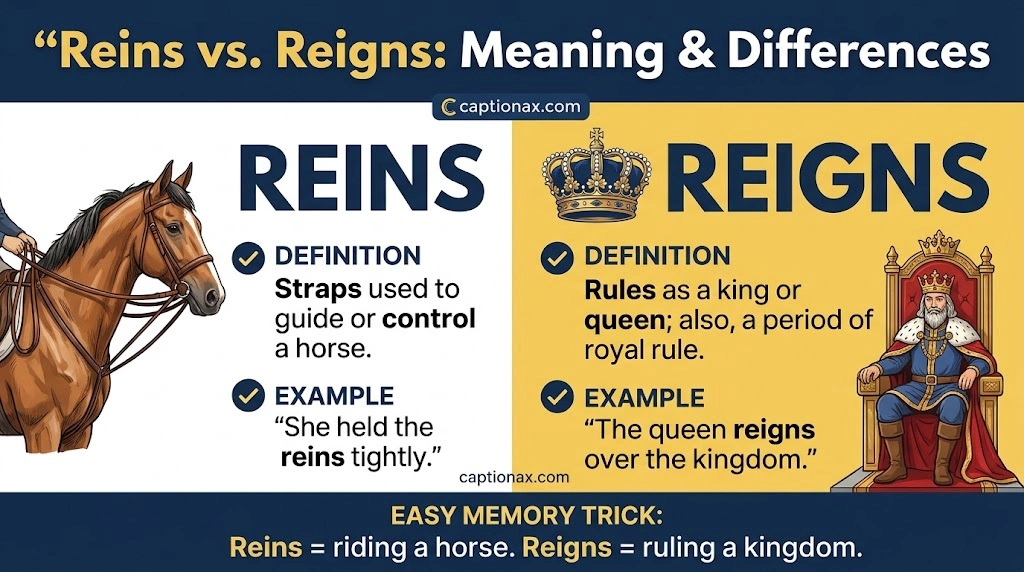
Reins vs. Reigns in Example Sentences
Seeing the words in context makes the distinction easier to understand.
| Correct sentence | Why it is correct |
| The rider adjusted the reins. | Refers to horse equipment. |
| The new CEO took the reins. | Means the CEO assumed control. |
| The king’s reign lasted 25 years. | Refers to one period of rule. |
| The rulers had different reigns. | Refers to multiple periods of rule. |
| She reigns supreme in chess. | Means she dominates her field. |
| The manager reined in unnecessary expenses. | Reined in means controlled or reduced. |
| The queen reigns over the kingdom. | Reigns is a verb. |
| The retiring director handed over the reins. | Means responsibility was transferred. |
Examples for school and academic writing
- The historian studied the reigns of three medieval kings.
- The student explained how the queen’s reign affected the country.
- The rider carefully held the reins during the demonstration.
- The researcher argued that fear reigns in communities facing uncertainty.
To Examples for work and business
- The new department head took the reins last Monday.
- The company is trying to rein in operating expenses.
- The report compares the reigns of several political leaders.
- Innovation reigns supreme in the company’s marketing strategy.
Examples for social media and everyday conversation
These words can also appear naturally in captions, posts, and personal updates.
- “Taking the reins of my own journey.”
- “Let creativity reign.”
- “Time to rein in my spending habits.”
- “Confidence reigns when you believe in yourself.”
The key is to choose the spelling based on the intended meaning, not the pronunciation.
Is It “Take the Reins” or “Take the Reigns”?
The correct standard expression is “take the reins.”
It means to assume control, accept responsibility, or become the person directing a situation. The idiom comes from horse riding, where a rider holds the reins to guide an animal.
Correct examples:
- She will take the reins of the project next month.
- After the founder retired, his daughter took the reins.
- I’m ready to take the reins of my own life.
- The assistant coach took the reins during the manager’s absence.
Incorrect for this intended meaning:
- She will take the reins of the project next month.
- His daughter took the reigns of the company.
Why is “take the reins” correct?
Think about what the expression describes: someone taking hold of the means to guide or direct an activity. That image connects directly to horse-riding reins.
Memory trick: If someone is taking control, imagine them holding reins in their hands. Use reigns when your sentence refers to ruling or periods of rule.
Reins of Power vs. Reigns of Power
The established expression is “the reins of power.”
It refers to control or authority held by a person, organization, government, or institution. The word reins is used metaphorically to describe the ability to direct something.
Examples:
- The new leader took the reins of power after the election.
- The president handed over the reins of power to a successor.
- The board now holds the reins of power within the organization.
- The previous administration relinquished the reins of power.
By contrast, reigns is appropriate when you mean separate periods of rule.
Compare:
- Correct: The general took the reins of power.
- Correct: Historians compared the reigns of two emperors.
- Incorrect for the established idiom: The general took the reigns of power.
Quick rule: Use reins for holding or transferring control. Use reigns for periods of rule or as a verb meaning rules or dominates.
- Explore More: https://captionax.com/macaroon-vs-macaron/
Free Rein vs. Free Reign
The standard expression is “free rein.” It means allowing someone considerable freedom to act, decide, create, or explore without unnecessary restrictions.
The phrase comes from horse riding. When a rider loosens the reins, the horse has greater freedom of movement. The image later developed into a metaphor for personal or creative freedom.
Examples:
- The designer was given free rein to redesign the website.
- The teacher gave students free rein over their creative projects.
- My editor gave me free rein to develop the article.
- The children had free rein to invent their own games.
Although free reign appears in informal writing, it is generally treated as a nonstandard version of the traditional idiom when the intended meaning is freedom to act.
Compare:
- Free rein: Freedom to act or create.
- Reign: A period of rule or the exercise of authority.
A writer can be given free rein to develop a story, while a monarch can have a long reign.
When to Use Reins and When to Use Reigns
The best way to choose the correct spelling is to identify what your sentence describes.
Use reins when the sentence involves control
Choose reins when you mean:
- The straps used to guide a horse.
- Taking responsibility for a project, team, or organization.
- Handing control to another person.
- Holding or loosening control.
- The established expressions free rein and reins of power.
Examples:
- The rider gathered the reins.
- She took the reins of the business.
- He handed over the reins to his successor.
- The team was given free rein to experiment.
Use reigns when the sentence involves ruling or dominance
Choose reigns when you mean:
- Multiple periods of a ruler’s authority.
- A singular subject ruling or exercising authority.
- A feeling or quality dominating a situation.
- The verb form used in expressions such as reigns supreme.
Examples:
- The two kings had different reigns.
- The monarch reigns over the country.
- Hope reigns supreme in the community.
- Confusion reigns when communication breaks down.
A three-question test
Before choosing a spelling, ask yourself:
- Am I talking about horse straps or taking control? Use reins.
- Am I talking about ruling, dominance, or periods of rule? Use reign or reigns, depending on the grammar.
- Am I using a familiar expression such as “take the reins” or “free rein”? Use the established spelling rein/reins.
This test works for essays, emails, reports, stories, social media captions, and professional documents.
Common Mistakes to Avoid
Even experienced writers can confuse these words because both are legitimate English spellings. A spell-checker may accept the wrong word if it is spelled correctly but used in the wrong context.
| Common mistake | Correct form | Explanation |
| Take the reigns | Take the reins | The idiom refers to taking control. |
| Free reign | Free rein | The established phrase means freedom to act. |
| Reigns of power, meaning control | Reins of power | The idiom refers to holding authority. |
| The horse’s reigns | The horse’s reins | The straps are reins. |
| The king’s reins lasted 20 years | The king’s reign lasted 20 years | A reign is a period of rule. |
| She reign in her spending | She reins in her spending | Reins in is the correct verb form. |
Why spell-check tools may miss these errors
Automated writing tools often identify whether a word is spelled correctly, but that doesn’t always mean it is the right word for the sentence.
For example, take the reigns contains a correctly spelled English word, yet it is the wrong choice for the established Reins vs. Reigns idiom meaning to assume control.
To proofread effectively, check the meaning and grammatical role of each word rather than relying on spelling tools alone.
Reins, Reigns, Rein, Reign, and Rain Compared
The words rein, reign, and rain are pronounced alike in standard English. However, they have distinct meanings.
| Word | Meaning | Example |
| Rein | A horse-control strap; to restrain or control | Rein in your enthusiasm. |
| Reins | Horse-control straps; figuratively, control | She took the reins. |
| Reign | To rule or a period of rule | The queen’s reign was peaceful. |
| Reigns | Multiple periods of rule, or rules as a verb | The king reigns over the land. |
| Rain | Water falling from clouds | Heavy rain flooded the street. |
Although the words sound alike, rain refers to weather, while rein and reign belong to different meaning groups.
Compare these sentences:
- The rider held the reins in the rain.
- The king’s reign continued despite the rain.
- She took the reins when the rain began.
Each sentence demonstrates how Reins vs. Reigns surrounding words make the intended meaning clear.
Easy Ways to Remember the Difference
You don’t need to memorize a complicated grammar rule. A few simple associations can help you remember which spelling to use.
1. Reins = Riding and Responsibility
Associate reins with a horse and the act of guiding it. Extend that image to taking charge of a project, team, or organization.
Example: The new manager took the reins.
2. Reigns = Rulers and Rule
Connect reigns with kings, queens, monarchs, and periods of authority.
Example: The monarch reigns over the kingdom.
3. Rein = Restrain; Reign = Rule
Remember the base words:
- Rein: Associated with guiding or restraining.
- Reign: Associated with ruling or holding authority.
This is especially useful when deciding between rein in spending and reign supreme.
4. Learn the expressions as complete phrases
Memorize these expressions rather than guessing the spelling each time:
- Take the reins.
- Hold the reins.
- Hand over the reins.
- Free Rein.
- Rein in spending.
- Reign supreme.
- The king’s reign.
Learning these expressions as complete units makes the correct spelling easier to recall.
Reins vs. Reigns Practice Quiz
Test your understanding with these seven questions. Choose the correct word for each sentence before checking the answers.
Quick spelling test
0/7 answered
1. The new director will take the _____ of the department.
reigns
reins
2. The queen’s _____ lasted for several decades.
reins
reign
3. The company needs to _____ in unnecessary spending.
reign
rein
4. The designer was given free _____.
rein
reign
5. Confidence _____ supreme during the final round.
reigns
reins
6. The rider adjusted the horse’s _____.
reins
reigns
7. Historians studied the _____ of two ancient rulers.
reins
reigns
Check my answers
People Also Ask
A:Both are correct words, but they have different meanings. Reins refers to horse-control straps and figuratively to control or responsibility. Reigns refers to multiple periods of rule or is the verb form meaning rules or dominates.
A:The standard expression is “take the reins.” It means to assume control or responsibility, based on the image of holding a horse’s reins.
A:“The rider held the reins” refers to horse equipment. “The monarch reigns over the country” describes someone exercising authority. The context determines which spelling is correct.
A:Free rein is the standard expression when you mean unrestricted freedom to act or create. Free reign is commonly treated as a mistaken version of this idiom.
A:“Reins of power” refers to control or authority held by a person, organization, or government. For example, “The new leader took the reins of power.”
Final Verdict
The choice between Reins and Reigns depends on what you want to communicate.
Use reins for horse-control straps and figurative expressions involving control, responsibility, or freedom. Use reigns for multiple periods of rule or as the verb describing someone or something that rules or dominates.
Remember these two examples:
- “She took the reins of the company.” — She assumed control.
- “The queen’s reign lasted decades.” — The sentence describes her period of rule.
Once you connect reins with riding and control, and reigns with rulers and authority, the difference becomes much easier to remember. When proofreading, always check the intended meaning rather than relying on pronunciation or spell-check alone.
If you enjoy learning the differences between confusing English words, explore more spelling and grammar guides on CaptionAx.com.