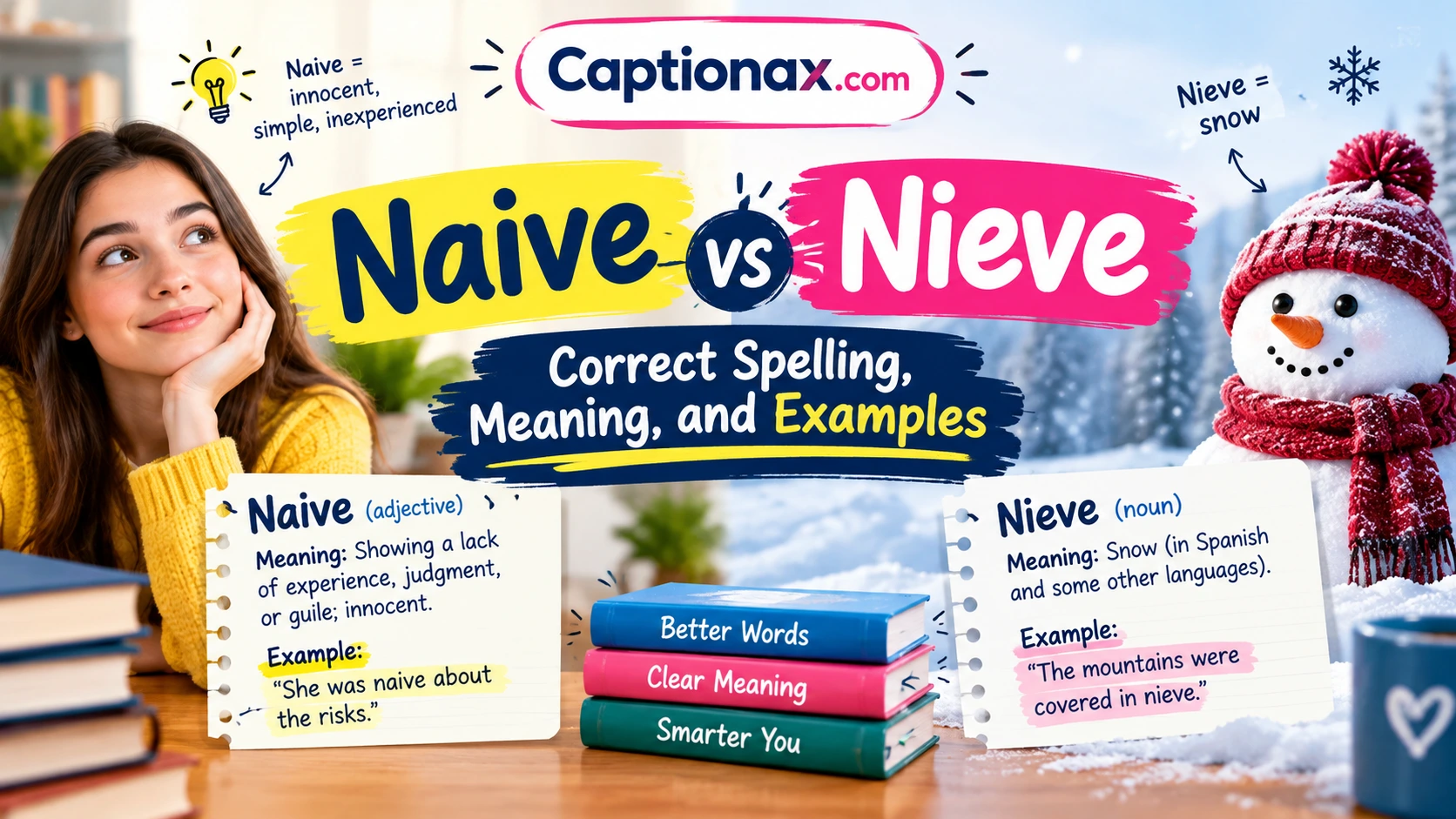
Naive vs Nieve: Correct Spelling & Meaning
Have you ever wondered whether the correct spelling is Naive or Nieve? These words look similar, and the unusual vowel combination in naive can make it confusing for English learners and everyday writers.
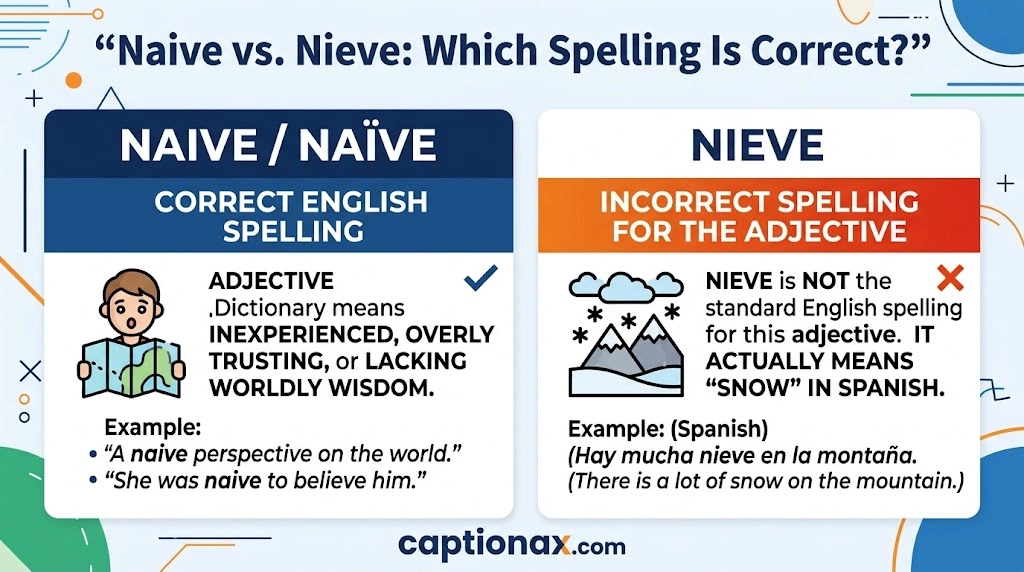
The correct spelling for someone who lacks experience, practical judgment, or worldly knowledge is naive. You can also write naïve, which is an accepted alternative spelling. However, nieve is not the standard spelling of this English adjective.
There is one important detail: nieve can have separate meanings in other contexts. It is the Spanish word for “snow” and is also recorded as a rare English dialect noun meaning a hand or fist.
In this guide, you will discover the difference between naive and nieve, understand their meanings, explore realistic example sentences, learn how to pronounce naive, and test your knowledge with a short spelling quiz.
What Does Naive vs Nieve Mean?
Naive vs nieve is a spelling comparison that helps readers distinguish the correct English adjective from a similar-looking word. Use naive or naïve when describing someone who is inexperienced, innocent, or overly trusting. Do not use nieve as a substitute for this adjective in standard English.
Here is the difference at a glance:
| Word | Meaning or use | Correct in standard English? |
| Naive | Inexperienced or lacking practical judgment | Yes |
| Naïve | Alternative spelling of naive | Yes |
| Nieve | Spanish word for snow; also a rare English dialect noun | Yes, in its separate contexts |
| Nieve used to mean naive | Incorrect spelling for the intended adjective | No |
Example:
Correct: She was naive to believe every promise he made.
Also correct: She was naïve to believe every promise he made.
Incorrect for this meaning: She was nieve to believe every promise he made.
The main rule is simple: when describing a person’s experience or judgment, remember the spelling N-A-I-V-E.
What Does Naive Mean in English?
Naive is an adjective describing a person, belief, assumption, or decision that shows limited experience, knowledge, or practical judgment.
A naive person may trust others too easily, underestimate a challenge, or fail to recognize risks because they have not encountered similar situations before.
For example, someone who believes every online advertisement without checking its claims might be described as naive. Likewise, a new business owner who assumes a company will become profitable immediately may have a naive understanding of business.
The word does not automatically mean unintelligent. An intelligent person can still be naive about an unfamiliar subject.
Common meanings of naive
1. Inexperienced
A person has limited knowledge of a particular situation.
Example: The new employee was naive about office politics.
2. Innocent or trusting
A person expects others to be honest and may not anticipate deception.
Example: The child had a naive belief that everyone always told the truth.
3. Unrealistic
An idea or plan ignores important facts, difficulties, or practical limitations.
Example: It was naive to expect the entire project to finish in one day.
4. Unsophisticated
A person or approach may lack awareness of how complicated a situation can be.
Example: His naive understanding of the market led him to underestimate the competition.
The precise meaning depends on context. Sometimes naive simply describes inexperience; in other situations, it criticizes poor judgment.
What Does Nieve Mean?
Nieve is not the standard spelling of the English adjective naive. Nevertheless, it is a real word in other contexts.
There are two important meanings to understand.
Nieve as a spelling mistake
When someone writes, “He is nieve,” intending to say that a person is inexperienced or overly trusting, the correct spelling is naive or naïve.
For example:
Incorrect: She made a nieve assumption.
Correct: She made a naive assumption.
Nieve as a separate word
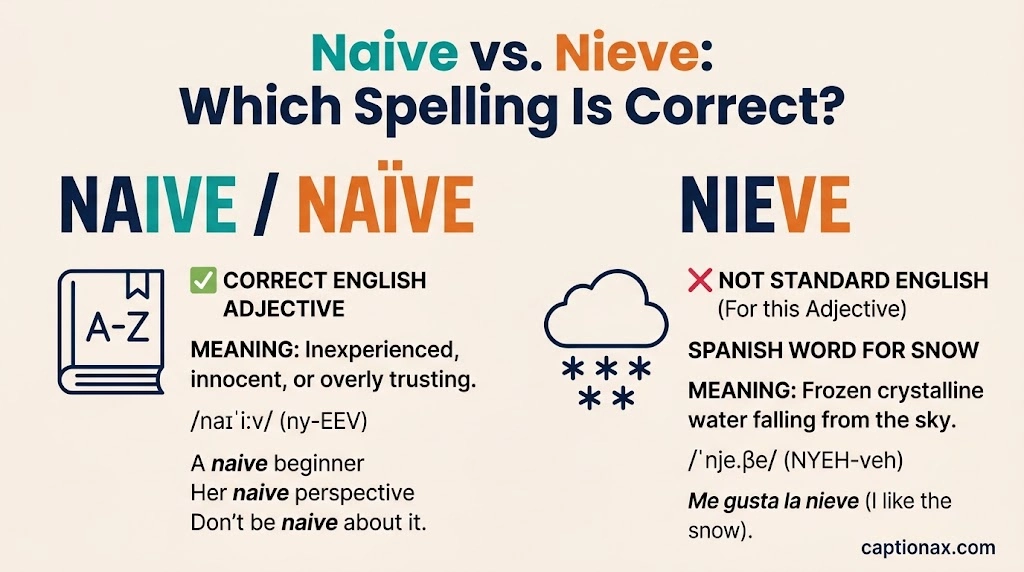
In Spanish, nieve means snow.
Example:
Spanish: La nieve es blanca.
English: The snow is white.
Nieve is also documented as a rare English dialect noun meaning a hand or fist. This is a separate, uncommon use and is not the meaning intended in ordinary spelling comparisons.
Therefore, whether nieve is correct depends on the language and context. If you are describing someone’s judgment or experience in English, use naive.
Naive vs. Nieve: Key Differences at a Glance
The following table summarizes the spelling, meaning, and usage of each form.
| Feature | Naive | Naïve | Nieve |
| Standard English adjective | Yes | Yes | No |
| Meaning | Inexperienced or overly trusting | Same as naive | Different meanings in other contexts |
| Part of speech for the intended meaning | Adjective | Adjective | Not the intended adjective |
| Common English usage | Common | Common and accepted | Uncommon in English |
| Example | A naive decision | A naïve decision | La nieve es blanca |
| Interchangeable with naive? | Yes, as the standard form | Yes | No |
The most important distinction is that naive and naïve are alternative spellings of the same adjective, while nieve has separate uses.
Why Do People Confuse Naive and Nieve?
There are several reasons why people confuse these two spellings.
1. The words contain similar letters
Both words contain five letters, and their appearance is nearly identical. The main difference is the order of the letters “a” and “i.”
Correct: N-A-I-V-E
Incorrect for the adjective: N-I-E-V-E
When typing quickly, it is easy to reverse the vowel order accidentally.
2. The pronunciation is unusual
The pronunciation of naive is not immediately obvious to every English learner. Someone who hears the word before seeing it written may guess the wrong spelling.
Learning the written form alongside the pronunciation can prevent this mistake.
3. The accented spelling looks unfamiliar
Some readers first encounter naïve, with two dots over the letter i. They may assume that the accented version is the only correct spelling or that it represents a different word.
In fact, both naive and naïve are accepted English spellings.
4. English spelling is not always predictable
English contains many words whose spellings cannot be reliably guessed from their pronunciation alone.
The easiest solution is to memorize the spelling and practice using the word in complete sentences.
Is Naïve Also Correct?
Yes. Both naive and naïve are correct English spellings with the same basic meaning and pronunciation.
The spelling naïve uses a diaeresis, the two dots above the letter i. This mark indicates that adjacent vowels are pronounced separately rather than being treated as a single combined vowel sound.
Consider these examples:
- Her expectations were naive.
- Her expectations were naïve.
- It was a naive assumption.
- It was a naïve assumption.
All four sentences are correct.
For everyday digital writing, naive is convenient because it does not require a special character. In formal writing, either form can be appropriate, depending on the publication’s preferred style.
The important point is consistency. If you choose naïve, use that spelling consistently throughout the same document unless a quotation or source requires otherwise.
- Explore More: https://captionax.com/lacs-or-lakhs/
How Do You Pronounce Naive?
The word naive is generally pronounced with two syllables. Cambridge Dictionary gives the pronunciation as /naɪˈiːv/.
An easy approximation is “nye-EVE,” with the stress on the second syllable.
Break it down as follows:
- First syllable: “nye”
- Second syllable: “eve”
- Full pronunciation: “nye-EVE”
Both naive and naïve are pronounced the same way.
If you are unsure about the pronunciation, listen to a reputable dictionary’s audio recording and repeat the word aloud.
Remember that pronunciation and spelling are related but different. Knowing how a word sounds does not always reveal its exact spelling.
Naive vs. Nieve Example Sentences
The best way to learn the difference between naive and nieve is to see how the words appear in context.
The Naive in everyday conversations
- I was naive to think everyone would agree with me.
- She is young but not naive.
- It was naive to assume the problem would solve itself.
- He had a naive understanding of how relationships work.
- Being kind does not mean being naive.
Naive in school and education
- The student made a naive assumption about the historical event.
- It would be naive to rely on only one source for the assignment.
- Her first interpretation was naive, but she improved after further research.
- The teacher explained why the argument was naive.
- A naive reading of the passage overlooked its deeper meaning.
Naive in business and professional writing
- The proposal was naive because it ignored operating costs.
- It is naive to expect a new business to become profitable overnight.
- His estimate was naive because it excluded unexpected expenses.
- The team developed a more realistic plan after reviewing the risks.
- A naive investment decision can expose a person to unnecessary risk.
The Naive in online safety and relationships
- A naive user might trust a suspicious message.
- It was naive to share personal information with an unknown account.
- She was naive to believe every promise without asking questions.
- A person can be trusting without being completely naive.
- It would be naive to assume every online profile is genuine.
Nieve used in a separate context
- In Spanish, nieve means snow.
- The phrase “la nieve” refers to “the snow” in Spanish.
- A historical dialect dictionary may record nieve as a noun referring to a hand or fist.
These examples demonstrate why context matters. Naive is the standard spelling for the English adjective, while nieve belongs to different contexts.
Naive vs. Innocent vs. Gullible
To Naive, innocent, and gullible are related words, but they are not interchangeable in every sentence.
Naive
Describes limited experience or judgment, especially when someone does not recognize the complexity of a situation.
Example: He was naive about the costs of running a business.
Innocent
Can describe someone who is not guilty of wrongdoing, has harmless intentions, or lacks knowledge of something.
Example: The child had innocent intentions.
Gullible
Describes someone who is easily persuaded to believe something, especially when it is false.
Example: A gullible shopper might believe a fake advertisement.
Comparison table
| Word | Main idea | Example |
| Naive | Limited experience or judgment | He was naive about investing. |
| Innocent | Lack of guilt or harmful intention | She had innocent intentions. |
| Gullible | Easily deceived | He was gullible enough to believe the scam. |
A person can be innocent without being naive. Similarly, someone can lack experience without believing every false claim they encounter.
Choose the word that communicates your intended meaning most accurately.
Is Naive a Negative Word?
The word naive can sound neutral, sympathetic, or critical depending on the context.
When describing a child or someone encountering an unfamiliar situation, it may simply suggest innocence or limited experience.
When describing a business plan, financial decision, or argument, it often suggests that the person has Naive vs Nieve overlooked important facts.
Compare the following examples.
Neutral: She was naive about the challenges of moving abroad.
Critical: The proposal was naive because it ignored the available evidence.
More diplomatic: The proposal underestimated the practical challenges.
In professional communication, it is often better to describe the specific problem rather than label someone as naive.
For example, instead of saying, “Your approach is naive,” you could say, “The plan may need to account for additional costs and risks.”
This approach is clearer, more constructive, and less likely to sound insulting.
Naivety vs. Naiveté: What Is the Difference?
Naivety and naiveté are accepted English noun forms related to naive. Both refer to the quality or state of being naive.
Examples:
- His naivety made him vulnerable to misleading promises.
- Her naiveté became apparent when she ignored the warning signs.
- The manager recognized the naivety of the original plan.
The adjective describes a person, belief, or action. The noun describes the quality itself.
| Word | Part of speech | Example |
| Naive | Adjective | His judgment was naive. |
| Naively | Adverb | She naively trusted the claim. |
| Naivety | Noun | His naivety was understandable. |
| Naiveté | Noun | Her naiveté surprised the team. |
Both naivety and naiveté are accepted. The accented form retains a French-style spelling, while naivety is convenient for ordinary English writing.
Do not confuse these forms with nieve. It is not a spelling variant of naivety or naiveté.
Common Naive Spelling Mistakes
Even familiar English words can be misspelled when their letter patterns are unusual.
Mistake 1: Writing nieve instead of naive
Incorrect: That was a nieve response.
Correct: That was a naive response.
Mistake 2: Assuming naïve is the only correct spelling
Incorrect assumption: Naive is always misspelled unless it has an accent.
Correct rule: Both naive and naïve are accepted English spellings.
Mistake 3: Treating naive as a synonym for unintelligent
Incorrect assumption: Every naive person lacks intelligence.
Correct understanding: Naive generally refers to limited experience, knowledge, or judgment. It does not automatically describe intelligence.
Mistake 4: Using naive for every bad decision
A decision might be careless, reckless, uninformed, or unrealistic without necessarily being naive.
Choose the word that accurately describes the specific problem.
Mistake 5: Assuming nieve has no meaning in any context
Although nieve is incorrect as a substitute for the English adjective naive, it has separate documented uses.
Recognizing the context helps you avoid both spelling mistakes and incorrect definitions.
Easy Tricks to Remember the Correct Spelling
Use these simple techniques to remember the difference between naive and nieve.
1. Memorize the letter order
Write the word slowly:
N – A – I – V – E
Pay particular attention to the first three letters. The correct adjective begins with “nai,” not “nie.”
2. Practice a complete sentence
Repeat this sentence:
“I was naive about the risks.”
Writing the word in context can make it easier to remember than memorizing isolated letters.
3. Learn related words together
Remember this word family:
- Naive
- Naively
- Naivety
- Naiveté
Recognizing the shared spelling pattern can help you avoid confusing these words with nieve.
4. Connect spelling with meaning
When you want to describe someone as inexperienced or overly trusting, think of the word naive.
When you encounter nieve in Spanish text or a historical dictionary, consider its separate meaning instead.
5. Use spell-checking tools wisely
Spell-checking tools can identify many spelling errors, but they may not understand the meaning you intend. If a word is accepted in another language, software may not flag it.
Read the complete sentence to make sure the spelling fits the context.
Practice Quiz: Naive or Nieve?
Test your knowledge with these five questions.
Question 1: Which spelling describes someone who trusts people too easily?
A. Nieve
B. Naive
C. Neive
Question 2: Which alternative spelling is also accepted in English?
A. Naïve
B. Nieve
C. Neive
Question 3: Complete the sentence: “It was _____ to ignore the warning signs.”
A. Nieve
B. Naieve
C. Naive
Question 4: What does the Spanish word nieve mean?
A. Experience
B. Snow
C. Innocence
Question 5: Does naive automatically mean unintelligent?
A. Yes
B. No
Quiz answers and explanations
1. B — Naive. This is the standard English adjective for someone who lacks experience or is overly trusting.
2. A — Naïve. Both naive and naïve are accepted spellings.
3. C — Naive. The sentence describes an unrealistic or inexperienced decision.
4. B — Snow. Nieve is the Spanish word for snow.
5. B — No. A person can be intelligent but inexperienced in a particular situation.
If you answered all five correctly, you understand the essential difference between the two spellings.
People Also Ask
A:Naive is the correct spelling when describing someone who is inexperienced, innocent, or overly trusting. Naïve is also accepted, while naive is not the standard spelling of this adjective.
A:Yes. Nieve is the Spanish word for snow and is also recorded as a rare English dialect noun meaning a hand or fist. It is not interchangeable with naivety in standard English.
A:Naive means inexperienced or too willing to trust others. It can describe a person, belief, or decision that overlooks risks or practical realities.
A:Neither spelling is more correct in general English usage. Both are accepted. Choose the version that fits your preferred style and use it consistently.
A:Spell the word N-A-I-V-E. You can also write N-A-Ï-V-E as naïve. Do not use nieve when you intend the English adjective.
Conclusion
The difference between Naive vs Nieve becomes easy to understand once you know the spelling, meaning, and context of each word.
Use naive when describing someone or something that shows limited experience, knowledge, or practical judgment. The alternative spelling naïve is also correct. By contrast, nieve has separate uses, including the Spanish word for snow, but it is not interchangeable with naive in standard English.
Remember the letters N-A-I-V-E, review the example sentences, and use the practice quiz to check your understanding. A small spelling detail can make your writing clearer, more accurate, and more professional.
Explore more English spelling comparisons and word-meaning guides on CaptionAx.com to continue improving your everyday vocabulary.