Cancelled or Canceled: Meaning & Examples
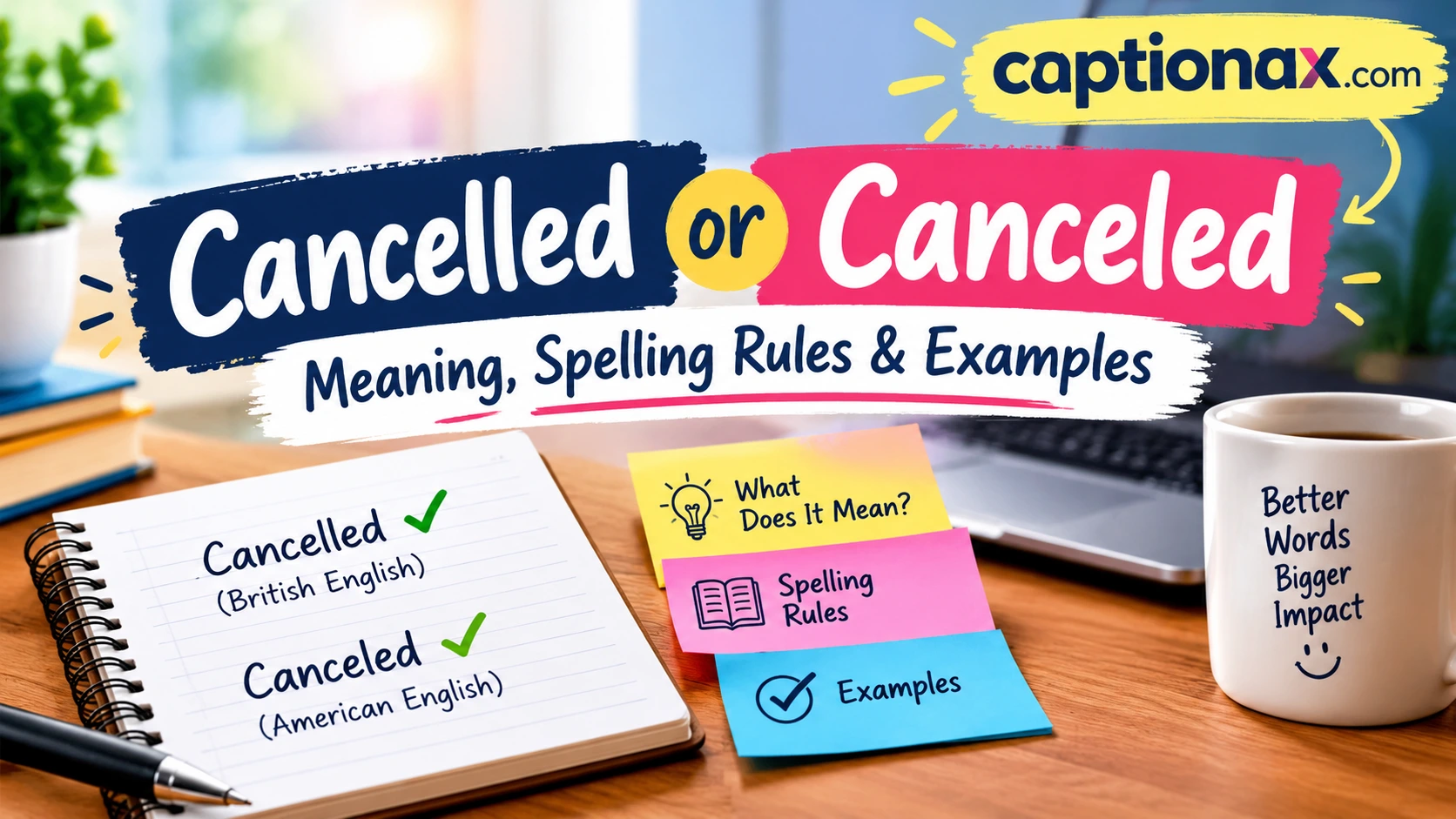
Have you ever wondered whether to write Cancelled or Canceled? Both spellings are correct, but the preferred form depends on the variety of English you use. American English generally favors canceled, while British English typically uses cancelled.
The difference is spelling, not meaning or pronunciation. Both words are the past tense and past participle of cancel, which means to call off, stop, or invalidate something that was previously planned or arranged.
Understanding this distinction helps you write confidently in emails, essays, business documents, website articles, and everyday messages. It also prevents confusion when you encounter related forms such as canceling, cancelling, and cancellation.
In this guide, you’ll discover which spelling to use, how American and British conventions differ, and how to apply both forms correctly with practical examples.
Cancelled or Canceled: Which Spelling Is Correct?
Both cancelled and canceled are correct spellings of the past tense and past participle of cancel. The main difference is regional preference.
- Canceled: More common in American English.
- Cancelled: Standard and more common in British English.
For example:
- American English: The airline canceled the flight.
- British English: The airline cancelled the flight.
Both sentences have the same meaning. If you’re writing for an American audience, canceled is generally the preferred choice. For a British audience, cancelled is usually more appropriate.
Importantly, cancelled is not automatically wrong in American English, and canceled is not inherently incorrect in British English. Both forms occur in published writing. Choose the spelling that matches your audience and follow it consistently.
What Do Canceled and Cancelled Mean?
The words canceled and cancelled mean that something planned, scheduled, or arranged was called off or discontinued.
They are used when referring to flights, appointments, meetings, subscriptions, orders, events, and other arrangements.
Examples:
- The airline canceled the flight because of severe weather.
- The school cancelled classes for the day.
- I canceled my subscription before the renewal date.
- The organizers cancelled the outdoor concert.
- She canceled her appointment because of a scheduling conflict.
The spelling does not change the meaning. Both forms can function as the simple past tense or the past participle of cancel.
Simple past: The manager canceled the meeting yesterday.
Present perfect: The manager has cancelled the meeting.
Both examples are grammatically correct. The spelling reflects the preferred English variety rather than a difference in tense or meaning.
Canceled vs. Cancelled in American and British English
American and British English use different conventions for several words that end in a single L in their base form.
| Word form | American English | British English |
| Base verb | Cancel | Cancel |
| Past tense | Canceled | Cancelled |
| Past participle | Canceled | Cancelled |
| Present participle | Canceling | Cancelling |
| Common noun | Cancellation | Cancellation |
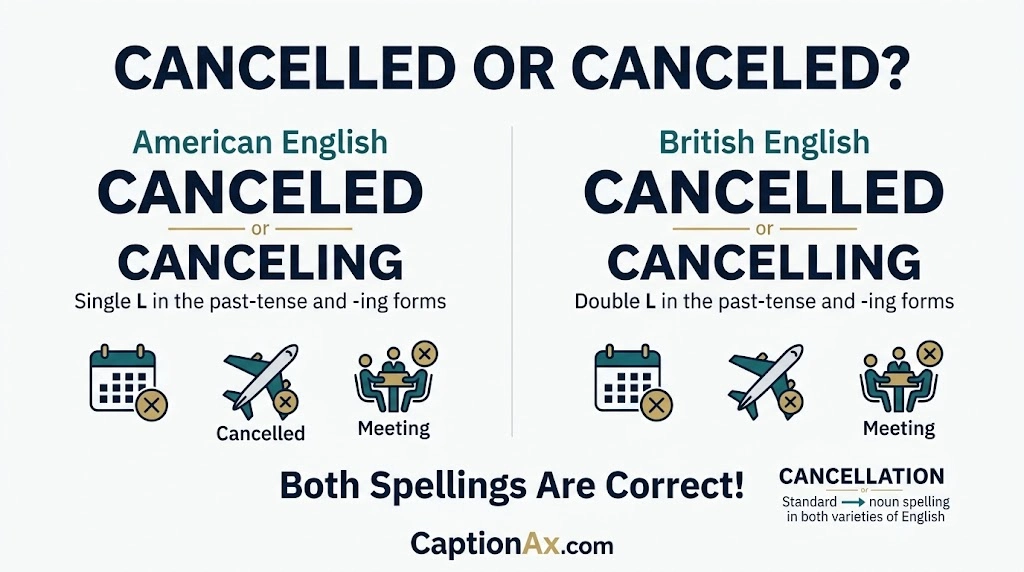
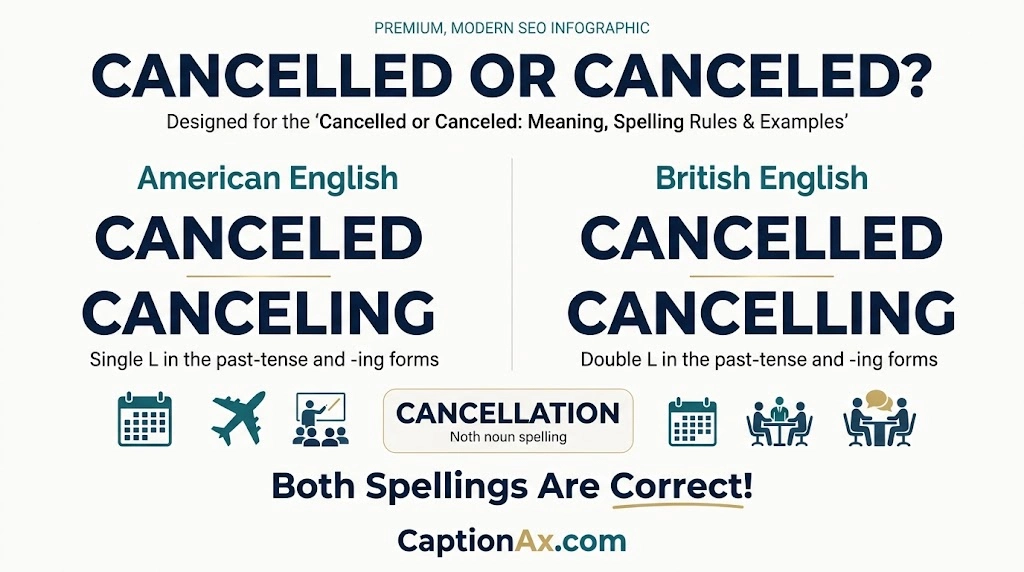
American English generally uses one L in canceled and canceling. British English typically doubles the L in cancelled and cancelling.
Is canceled correct in American English?
Yes. Canceled is the standard and more common American spelling. It appears in American newspapers, business correspondence, school assignments, and everyday communication.
Example: The company canceled the product launch because of production delays.
Although cancelled also appears in US writing, canceled is the usual choice when following American English conventions.
Is cancelled correct in British English?
Yes. Cancelled is the standard British spelling.
Example: The train service was cancelled because of a technical problem.
British writers generally use cancelling for the corresponding present participle. These forms are particularly useful to recognize when reading British publications or writing for a UK audience.
What about Canadian and Australian English?
Cancelled and cancelling are common in Canadian and Australian English. However, regional usage and individual editorial preferences can vary. When writing for a particular organization, publication, or academic institution, follow its established style guide.
Canceling or Cancelling: Which Is Correct?
Both canceling and cancelling are correct forms of the verb cancel. The preferred spelling usually follows the same regional pattern as canceled and cancelled.
- Canceling: More common in American English.
- Cancelling: Standard in British English.
Examples:
- American English: I am canceling my gym membership.
- British English: I am cancelling my gym membership.
- American English: They are canceling the event.
- British English: They are cancelling the event.
The difference is a spelling convention, not a change in meaning. Both forms describe the same action.
When writing an article, report, or business email, choose the appropriate spelling for your audience. Avoid switching between regional forms without a clear reason.
Cancellation or Cancelation: Which Is Correct?
Cancellation is the standard and widely recommended noun spelling in both American and British English.
The noun refers to the act of canceling something or the fact that an arrangement has been called off.
Examples:
- The cancellation of the concert disappointed thousands of fans.
- We received an email confirming the cancellation.
- The airline announced the cancellation of several flights.
- A late cancellation may incur a fee.
You may encounter cancelation with one L, particularly in American usage, but it is much less common. For most formal, educational, and professional writing, cancellation is the safer choice.
Remember the main word forms:
- Base verb: cancel
- Past tense: canceled or cancelled
- Present participle: canceling or cancelling
- Noun: cancellation
The noun is a useful exception to remember because it retains the double L in the standard spelling regardless of the regional preference for the past-tense form.
Canceled vs. Cancelled: Quick Comparison Table
Use this table when you need to make a quick spelling decision.
| Writing situation | Recommended form |
| Writing for a US audience | Canceled |
| Writing for a UK audience | Cancelled |
| Using the present participle in US English | Canceling |
| Using the present participle in UK English | Cancelling |
| Referring to the act of canceling | Cancellation |
| Following a publication’s house style | Use its prescribed spelling |
The simplest rule is to identify your audience first. Both past-tense spellings are valid, but one may be more appropriate for your particular readers.
Canceled or Cancelled in a Sentence: 12 Examples
The following examples show how both spellings work in everyday and professional situations.
Examples using canceled
- The airline canceled our flight because of heavy snow.
- I canceled my online order after noticing the incorrect address.
- The manager canceled the meeting at the last minute.
- The school canceled classes because of the storm.
- She canceled her subscription before the next billing cycle.
- The organizers canceled the outdoor festival due to safety concerns.
Examples using cancelled
- The airline cancelled our flight because of heavy snow.
- I cancelled my online order after noticing the incorrect address.
- The manager cancelled the meeting at the last minute.
- The school cancelled classes because of the storm.
- She cancelled her subscription before the next billing cycle.
- The organisers cancelled the outdoor festival due to safety concerns.
The first six examples use the common American spelling. The remaining examples use the British spelling; organisers also follows a common British spelling convention.
Notice that the meaning remains identical. Only the spelling convention changes.
Why Do American and British English Spell It Differently?
American and British English developed different spelling conventions over several centuries. Historical variation, dictionaries, educational practices, and editorial standards all contributed to the forms used today.
American lexicographer Noah Webster is often associated with American spelling reform. His dictionaries helped establish several differences between American and British English. However, it would be misleading to suggest that he single-handedly invented the spelling canceled. Merriam-Webster documents earlier variation, including the use of cancelled in Webster’s 1806 dictionary and canceled in his 1828 dictionary.
The distinction now forms part of a broader pattern of regional spelling differences.
| American English | British English |
| Traveled | Travelled |
| Labeled | Labelled |
| Modeled | Modelled |
| Canceled | Cancelled |
| Canceling | Cancelling |
These examples illustrate a common pattern, but English spelling is not governed by a single rule that works identically for every word. When in doubt, consult a reputable dictionary or the style guide relevant to your writing.
- Explore More: https://captionax.com/busing-or-bussing/
Common Spelling Mistakes to Avoid
Both canceled and cancelled are correct, but several related mistakes can make writing less accurate.
1. Mixing American and British spellings unnecessarily
For example, using canceled in one paragraph and cancelled in another may create an inconsistent style.
Better approach: Choose the preferred variety of English and apply it throughout the document, except when quoting a source or following a specific editorial requirement.
2. Writing cancled instead of canceled
Incorrect: The appointment was cancled.
Correct: The appointment was canceled.
Also correct: The appointment was cancelled.
The incorrect form omits a letter and is not a standard spelling.
3. Using cancellation when cancellation is expected
Although cancelation exists as a less common variant, cancellation is the standard choice for most formal writing in both American and British English.
4. Assuming one regional form is always wrong
It is inaccurate to label cancelled an outright spelling error in the United States or canceled an error in every British context. Regional frequency and editorial preference determine which form is most suitable.
5. Confusing cancellation with postponement
A cancellation means that an arrangement has been called off. A postponement means it has been delayed or moved to a later date.
For example:
- Canceled: The event will not proceed as originally planned.
- Postponed: The event has been moved to a later time or date.
An event may eventually be rescheduled after cancellation, but the words do not mean the same thing.
Which Spelling Should You Use in Formal Writing?
The right spelling depends on your audience, organization, and preferred style guide.
For American English: Use canceled and canceling in essays, reports, business emails, and website content.
For British English: Use cancelled and cancelling when writing for UK readers or following British editorial conventions.
To international audiences: Identify the main audience for your document and use the corresponding spelling consistently.
For academic assignments: Follow your institution’s instructions and any required style guide.
For editing and proofreading: Check the whole document for regional consistency. Related words such as color/colour, organize/organise, and traveled/travelled can help reveal which spelling system is being used.
A spellchecker may flag an accepted regional variant when its language setting differs from your intended audience. Check the language settings before assuming that a flagged word is incorrect.
People Also Ask
A:Both are correct. Canceled is more common in American English, while cancelled is the standard and more common British form.
A:Yes. Canceled is the standard American spelling of the past tense and past participle of cancel.
A:Yes. Cancelled is standard in British English and common in several other English varieties.
A:Both are correct. American English generally favors canceling, while British English typically uses cancelling.
A:The standard spelling is cancellation, with two Ls, in both American and British English.
Final Verdict
Both cancelled and canceled are correct spellings of the past tense and past participle of cancel. The main difference is regional preference.
Use canceled for American English and cancelled for British English. For the related forms, American English generally favors canceling, British English typically uses cancelling, and cancellation is the standard noun spelling in both varieties.
When in doubt, identify your audience, follow the relevant style guide, and maintain consistency throughout your writing. This simple approach will help you spell the word confidently in emails, essays, articles, and professional documents.
Explore more spelling and grammar guides on CaptionAx.com to make everyday writing clearer and more confident.