Bearer vs Barer: Meaning, Correct Spelling & Examples
Have you ever wondered whether to write Bearer or Barer? These two English words look and sound similar, but they have different meanings. Choosing the correct one depends on what you want to communicate.
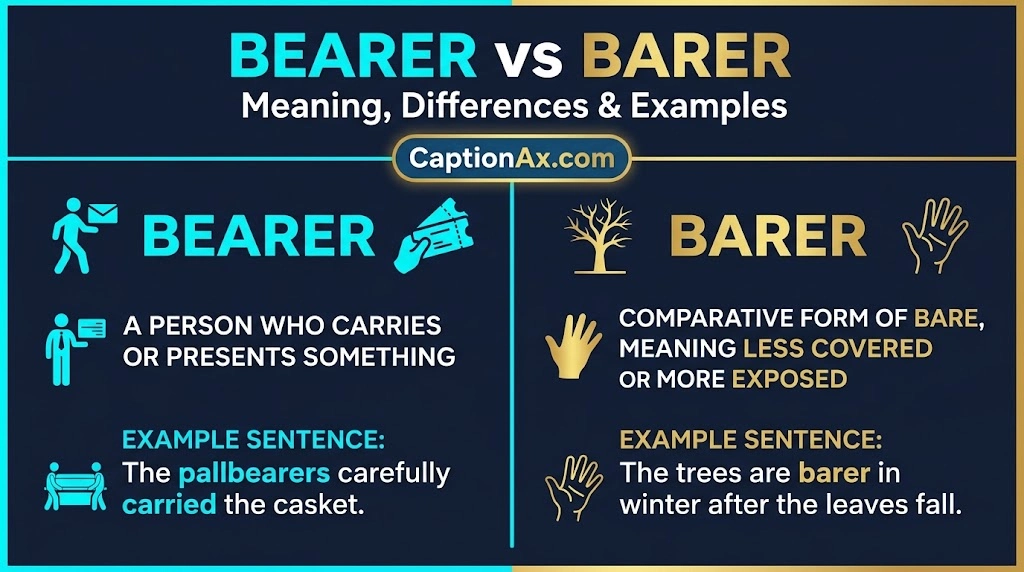
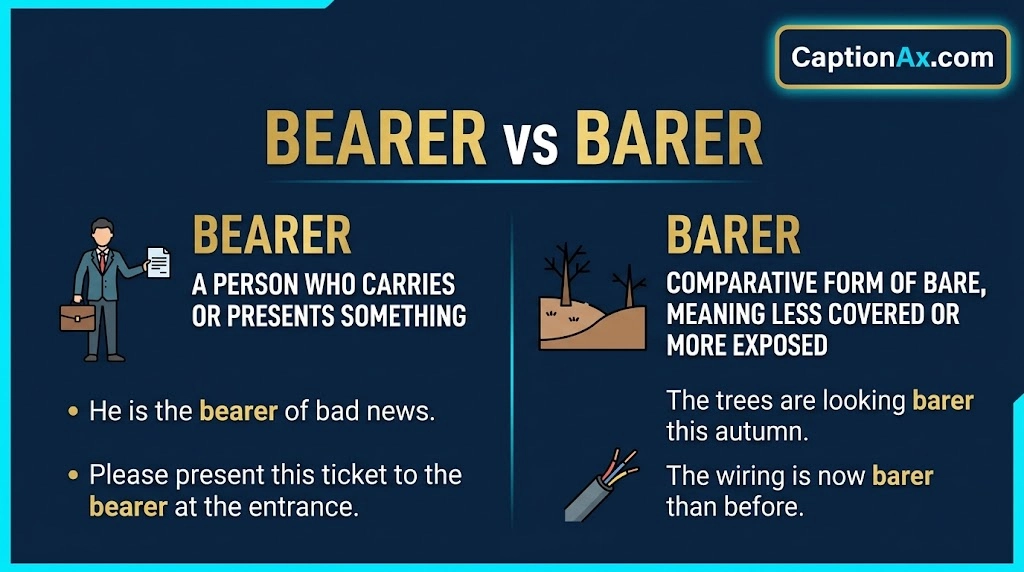
Bearer is a noun that refers to a person or thing that carries, holds, or delivers something. Barer is the comparative form of bare, meaning more uncovered, exposed, or sparse.
For example, someone who delivers important information is the bearer of bad news. However, a room with fewer decorations may look barer than it did before.
Both spellings are correct, but they are not interchangeable. Understanding their meanings, grammatical roles, and common expressions will help you avoid mistakes in emails, school assignments, professional documents, and everyday writing.
In this guide, you’ll learn the difference between bearer and barer, discover practical sentence examples, explore common spelling mistakes, and test your knowledge with a quick quiz.
Bearer vs Barer: What’s the Difference?
The main difference between bearer vs barer is their meaning and grammatical function. Bearer is a noun for someone or something that carries, holds, or brings something. Barer is a comparative adjective describing something that is more uncovered or sparse than another thing.
Consider these examples:
- Bearer: She was the bearer of wonderful news.
- Barer: The walls looked barer after we removed the paintings.
The first sentence identifies someone who delivers information. The second compares the appearance of the walls before and after their decorations were removed.
Bearer vs Barer at a Glance
| Feature | Bearer | Barer |
| Part of speech | Noun | Comparative adjective |
| Base word | Bear | Bare |
| Main meaning | Someone or something that carries, holds, or delivers | More uncovered, exposed, or sparse |
| Common context | People, messages, flags, documents | Rooms, walls, trees, landscapes |
| Example | He was the bearer of bad news. | The room looked barer without furniture. |
| Correct phrase | Ring bearer | Barer walls |
Quick rule: If the word refers to carrying or delivering something, use bearer. If it means more bare or uncovered, use barer.
What Does Bearer Mean?
Bearer is a noun describing someone or something that carries, holds, presents, or brings something. The word can refer to physical objects, messages, documents, responsibilities, or people who represent a cause.
For example, a flag bearer carries a flag during a procession, while a bearer of bad news delivers unpleasant information.
The word also appears in financial and legal expressions, such as bearer bond and payable to bearer. In these contexts, its precise meaning depends on the relevant document and applicable rules.
Examples of Bearer in Sentences
- She was the bearer of exciting news.
- The flag bearer walked at the front of the parade.
- The ring bearer carried the wedding rings carefully.
- He became the bearer of an important message.
- The bearer presented the document at the entrance.
- Nobody wanted to be the bearer of disappointing news.
- The ceremonial bearer carried the award onto the stage.
- The letter’s bearer delivered it to the office.
In each example, bearer refers to a carrier, holder, or person who conveys something.
Common Expressions With Bearer
Bearer of bad news: Someone who delivers unpleasant information.
Example: I’m sorry to be the bearer of bad news, but the event has been postponed.
Bearer of good news: Someone who brings positive information.
Example: She was the bearer of good news about the scholarship.
Ring bearer: A person who carries the rings during a wedding ceremony.
Example: Our nephew proudly served as the ring bearer.
Flag bearer: A person who carries a flag during a procession or event.
Example: The flag bearer led the delegation into the stadium.
Standard-bearer: Someone who carries a standard or represents a movement, organization, or cause.
Example: She became a standard-bearer for educational reform.
Bearer document: A document whose associated rights may depend on possession and its applicable legal terms.
These expressions use bearer because they involve carrying, presenting, holding, delivering, or representing something.
What Does Barer Mean?
Barer is the comparative form of the adjective bare. The word bare describes something that is uncovered, exposed, plain, or without its usual covering or decoration.
Use barer when comparing two things or two states and describing one as more uncovered or sparse.
For example:
“The room looked barer after we removed the curtains.”
This means that the room appeared more empty or less decorated than before.
Examples of Barer in Sentences
- The walls looked barer after we removed the paintings.
- The trees became barer as winter approached.
- His desk appeared barer without the books and photographs.
- The landscape looked barer after the vegetation disappeared.
- The shelves seemed barer after the boxes were removed.
- The garden looked barer after the flowers were cut.
- The apartment appeared barer after the furniture was moved.
- The hillside looked barer after the heavy rain washed away some vegetation.
In each sentence, barer describes a comparative change in covering, decoration, or fullness.
Bare, Barer, and Barest: What’s the Difference?
These three forms express different degrees of the same quality.
| Word | Grammatical form | Example |
| Bare | Positive adjective | The walls are bare. |
| Barer | Comparative adjective | These walls look barer than those. |
| Barest | Superlative adjective | This is the barest room in the house. |
Use bare for a basic description, barer to compare two things, and barest to identify the most uncovered or sparse one in a group.
Depending on the sentence, more bare may also sound natural. However, barer is the standard comparative form.
When Should You Use Bearer?
Use bearer when referring to a person or thing that carries, holds, presents, or delivers something.
1. When Someone Delivers News
Correct: “I hate to be the bearer of bad news.”
The person is delivering unpleasant information.
Incorrect: “I hate to be the barer of bad news.”
The second sentence uses the wrong word because barer does not mean a messenger or carrier.
2. When Someone Carries an Object
Correct: “The flag bearer walked at the front of the procession.”
The person carries a flag, so bearer is the correct choice.
3. When Someone Carries Wedding Rings
Correct: “The young ring bearer smiled at the guests.”
The word identifies the person carrying the rings during the ceremony.
4. When Someone Presents a Document
Correct: “The bearer of the invitation presented it at the reception desk.”
Here, bearer identifies the person presenting the invitation.
5. When Discussing Financial Terminology
The word appears in expressions such as bearer bond and payable to bearer. These are specialized financial terms, and their legal implications depend on the instrument and applicable rules.
The important point is that bearer refers to a carrier or holder, not to something becoming more uncovered.
When Should You Use Barer?
Use barer when comparing something with another object or an earlier state and describing it as more uncovered, exposed, plain, or sparse.
1. Describing a Room
Correct: “The living room looked barer after we removed the sofa.”
The room now has fewer furnishings.
2. Describing Trees
Correct: “The trees looked barer after the autumn leaves fell.”
The trees have less foliage than before.
3. Describing Walls
Correct: “The walls appeared barer without the framed photographs.”
The walls have fewer decorations.
4. Describing a Landscape
Correct: “The hillside looked barer after the vegetation disappeared.”
The landscape appears more exposed.
5. Describing a Desk
Correct: “Her desk looked barer than mine because she kept only a laptop on it.”
The comparison indicates that her desk has fewer objects.
Remember that barer expresses a comparison. If you’re simply describing something as uncovered, bare may be the better choice.
- Explore More: https://captionax.com/attornies-or-attorneys/
Bearer vs Barer Examples in Sentences
Comparing the two words in different situations makes their meanings easier to understand.
Example 1: News
- Bearer: He was the bearer of the unexpected news.
- Barer: The room looked barer after the announcement party ended and the decorations were removed.
The first sentence refers to a messenger. The second describes a room that has fewer decorations.
Example 2: A Wedding
- Bearer: The ring bearer walked beside the bride.
- Barer: The reception hall looked barer after the floral arrangements were removed.
Example 3: A Document
- Bearer: The bearer presented the letter to the receptionist.
- Barer: The display looked barer after the documents were taken away.
For Example 4: Nature
- Bearer: The guide was the bearer of the expedition’s official message.
- Barer: The trees looked barer after the storm.
Example 5: Decorations
- Bearer: The bearer carried the award into the hall.
- Barer: The stage looked barer after the decorations were removed.
Example 6: Everyday Writing
- Bearer: She was the bearer of an important announcement.
- Barer: The shelves looked barer after the books were packed.
These examples show that the correct spelling depends on what the sentence means, not simply on how the word sounds.
Is It Bearer or Barer of Bad News?
The correct expression is “bearer of bad news.”
It refers to someone who communicates unpleasant information.
For example:
“I’m sorry to be the bearer of bad news, but our flight has been canceled.”
The word bearer is correct because the person is delivering the information.
“Barer of bad news” is incorrect for this intended meaning. Although barer is a valid English word, it does not mean someone who delivers a message.
The same rule applies to positive information:
- She was the bearer of good news.
- He became the bearer of an important announcement.
- Nobody wanted to be the bearer of disappointing news.
Whenever the sentence refers to someone bringing or communicating information, choose bearer.
Bearer in Common Phrases and Specialized Terms
The word bearer appears in several everyday and specialized expressions.
| Expression | Meaning |
| Ring bearer | A person who carries wedding rings |
| Flag bearer | A person who carries a flag |
| Bearer of good news | Someone who brings positive information |
| Bearer of bad news | Someone who delivers unpleasant information |
| Standard-bearer | Someone who carries a standard or represents a cause |
| Bearer token | A computing credential whose possession may grant access when accepted by a system |
| Bearer Bond | A financial instrument associated with possession-based rights under its applicable terms |
These expressions demonstrate that the bearer can refer to physical carrying, communicating information, symbolic representation, or specialized concepts.
By contrast, barer is generally used when comparing how uncovered, plain, or sparse something is.
Why Do People Confuse Bearer and Barer?
Several factors make these words easy to mix up.
1. Similar Pronunciation
In many English accents, bearer and barer sound alike or nearly alike. This makes the difference difficult to recognize when listening rather than reading.
2. Similar Spelling
Both words contain similar letters, but the spelling difference changes the meaning of the sentence.
3. Different Base Words
The words come from different base forms:
- Bear → Bearer
- Bare → Barer
Remembering the base word helps you choose the correct spelling.
4. Different Grammatical Functions
Bearer is a noun, while barer is a comparative adjective.
For example, “The bearer delivered the message” identifies a person. “The room looked barer” compares the appearance of a room.
5. Unequal Familiarity
Many writers encounter bearer in familiar phrases such as “bearer of bad news” but use barer less often. This can lead to the mistaken belief that barer is not a real word.
Both are legitimate English words, but they serve different purposes.
How to Remember the Difference Between Bearer and Barer
Use these simple memory tricks to make the distinction easier to remember.
Trick 1: Think about carrying.
If someone carries a flag, presents a document, or brings news, use bearer.
Trick 2: Think about bare surfaces.
If a room becomes less decorated or trees lose their leaves, use barer when making a comparison.
Trick 3: Replace the word with a simpler phrase.
Ask whether bearer can be replaced with “carrier” or “person delivering something.” If it can, the bearer is likely correct.
If barer can be replaced with “more uncovered” or “more sparse,” it may be the right word.
Trick 4: Check the sentence structure.
- “The ___ delivered the letter.” → Bearer
- “The room looked ___ after we moved out.” → Barer
The grammatical role and intended meaning usually reveal the correct spelling.
Common Bearer vs Barer Mistakes
Here are common mistakes and their corrections.
| Incorrect sentence | Correct sentence |
| She was the barer of good news. | She was the bearer of good news. |
| The barer carried the flag. | The bearer carried the flag. |
| The room looked bearer without furniture. | The room looked barer without furniture. |
| The trees became bearer in winter. | The trees became barer in winter. |
| He was the barer of the official letter. | He was the bearer of the official letter. |
| The walls looked bearer after the paintings were removed. | The walls looked barer after the paintings were removed. |
The correct choice depends on the intended meaning. If the word refers to carrying or delivering something, use bearer. If it compares degrees of bareness, use barer.
Also remember that bare may be more appropriate when no comparison is being made.
People Also Ask
A:Both are correct English words. Bearer refers to someone or something that carries, holds, or delivers something. Barer is the comparative form of bare, meaning more uncovered or sparse.
A:Yes. Barer is the comparative form of the adjective bare. For example, “The shelves looked bare after the books were removed.”
A:The correct expression is bearer of bad news. A bearer is someone who brings or communicates information.
A:The plural is bearers. For example, “The bearers carried the ceremonial flag.”
A:The standard comparative is barer, and the superlative is barest. Depending on the context, “more bare” may also be appropriate.
Test Your Knowledge: Bearer or Barer?
Choose the correct word for each sentence.
- She was the ______ of exciting news.
- The walls looked ______ after we removed the paintings.
- The ______ of the invitation received admission.
- The trees became ______ during the winter.
- He was the ______ of the official letter.
Answers
- Bearer
- Barer
- Bearer
- Barer
- Bearer
How did you do? If you answered all five correctly, you’ve understood the central distinction between these commonly confused words.
If you missed one, revisit the examples and ask whether the sentence describes a carrier or compares something that has become more uncovered.
Final Verdict
The choice between Bearer vs Barer comes down to meaning and grammar. Use bearer for someone or something that carries, holds, presents, or delivers something. Use barer when describing something that is more uncovered, exposed, plain, or sparse than another thing.
Remember the connection between bearer and bear, and between barer and bare. This simple distinction will help you choose the correct spelling in everyday conversations, academic assignments, and professional writing.
For more help with commonly confused words, explore related spelling and grammar guides on CaptionAx.com and keep building your English vocabulary with practical examples.