
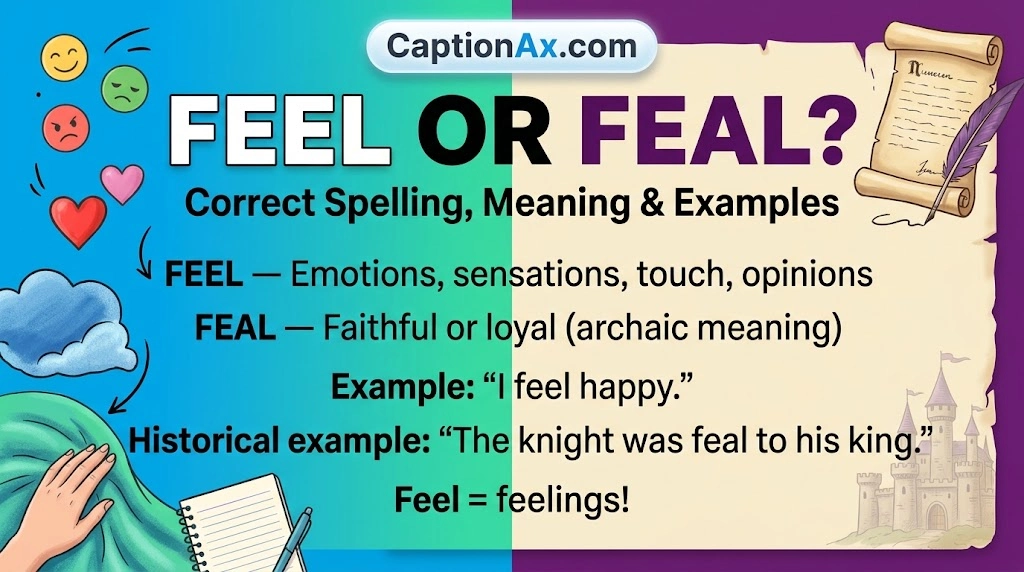
Correct Spelling, Meaning & Examples
Have you ever wondered whether to write Feel or Feal? These two words look almost identical and can sound alike, making it easy to choose the wrong spelling when writing quickly. However, their meanings and everyday uses are different.
Feel is the standard modern English word used to describe emotions, physical sensations, touch, opinions, and impressions. For example, you might feel happy, feel cold, or feel confident about a decision. Its past tense is felt, not fealed.
Feal, on the other hand, is a rare, archaic English adjective meaning faithful or loyal. It is mainly relevant when reading historical texts or discussing older forms of English.
If you are writing a text message, school assignment, email, social media caption, or professional document, you will almost certainly need feel or one of its grammatical forms.
This guide explains the difference between feel and feal, provides useful sentence examples, covers common grammar mistakes, and answers the questions English learners frequently ask about these confusing words.
Feel or Feal: Which Spelling Is Correct?
Feel is the correct spelling for almost all everyday modern English situations involving emotions, sensations, touch, or opinions. Feal is a real word, but its historical meaning is different.
| Word | Meaning | When to use it |
| Feel | Experience, sense, touch, or have an opinion | Everyday modern English |
| Feal | Faithful or loyal | Rare historical or archaic contexts |
Examples:
- Correct: I feel happy today.
- Incorrect for this meaning: I feal happy today.
- Correct: She felt nervous before the interview.
- Incorrect: She fealed nervous before the interview.
- Historical usage: The knight remained feal to his king.
The important distinction is that feal is not always a misspelling. It can be valid in a historical context, but it cannot replace feel when describing an emotion or physical sensation.
What Does Feel Mean?
Feel is a common English word that functions as both a verb and a noun. As a verb, it describes experiencing something, noticing a physical sensation, touching an object, or expressing an opinion. As a noun, it can describe the texture or atmosphere of something.
Feel as an emotion
Use feel when describing an emotional state such as happiness, sadness, excitement, disappointment, or nervousness.
Examples:
- I feel happy when I spend time with my family.
- She feels nervous before an important exam.
- They felt disappointed by the final result.
- He feels excited about his new job.
- I feel much better after getting some rest.
Feel as a physical sensation
The word also describes physical experiences, including heat, cold, pain, tiredness, and discomfort.
Examples:
- I feel cold because the window is open.
- She felt pain in her shoulder.
- Can you feel the warm sunlight?
- He feels tired after a long day.
- I felt a sudden movement beside me.
Feel as an action involving touch
When you touch something to discover its texture, shape, temperature, or condition, feel is the appropriate word.
Examples:
- Feel this fabric; it is incredibly soft.
- She felt the surface of the table.
- The blanket feels rough against my skin.
- He felt along the wall to find the light switch.
- This jacket feels comfortable.
Feel as an opinion or impression
You can use feel to express a belief, opinion, or personal judgment.
Examples:
- I feel that we made the right decision.
- She feels the proposal needs improvement.
- We feel this solution is more practical.
- He felt something was wrong.
- I feel confident about the future.
Feel as a noun
As a noun, feel can describe the texture of an object or the character and atmosphere of a place.
Examples:
- The room has a peaceful feel.
- This fabric has a smooth feel.
- The restaurant has a welcoming feel.
- The design gives the website a modern feel.
What Does Feal Mean?
Feal is a rare, archaic English adjective meaning faithful or loyal. It is not the normal spelling used when talking about feelings, physical sensations, or opinions.
Dictionary.com traces the word to around 1550–1560 and connects its origin to Old French feal, with a link to fealty, a term associated with loyalty and allegiance.
Examples of feal in historical writing
These illustrative sentences demonstrate the historical adjective:
- The knight remained feal to his king.
- The servant was described as feal and loyal.
- The old poem praised a feal companion.
For contemporary readers, words such as faithful, loyal, and trustworthy are generally clearer alternatives.
Compare:
- Archaic: The knight was feal to his king.
- Modern: The knight was loyal to his king.
If you encounter feal in an old book or poem, consider the surrounding passage before deciding whether it is an error.
Feel vs Feal: Key Differences
The main difference is meaning, not simply spelling. Feel is an everyday modern word, whereas feal is chiefly a historical term.
| Feature | Feel | Feal |
| Modern everyday usage | Common | Rare |
| Main meaning | Experience or sense something | Faithful or loyal |
| Part of speech | Verb and noun | Archaic adjective |
| Describes emotions | Yes | No, not in its historical sense |
| Describes physical sensations | Yes | No, not in its historical sense |
| Used in ordinary emails | Yes | Generally not |
| Past tense of feel | Felt | Not a form of feel |
| Historical writing | Common word still usable | May appear in archaic contexts |
The simplest rule is to use feel whenever you are describing how someone experiences something or what impression something creates.
Feel or Feal in Example Sentences
The following examples show how the correct choice depends on the intended meaning.
| Incorrect or unsuitable choice | Correct or clearer wording |
| I feal happy today. | I feel happy today. |
| She feals tired. | She feels tired. |
| I fealed nervous yesterday. | I felt nervous yesterday. |
| This shirt feals soft. | This shirt feels soft. |
| I am fealing better. | I am feeling better. |
| The knight was feal to his king. | The knight was loyal to his king. |
The last example is different from the others: feal can be valid in historical usage, but loyal is usually more natural in modern writing.
Examples for everyday conversation
- I feel great today.
- Do you feel better now?
- I feel tired after work.
- She feels happy with the results.
- He felt nervous before speaking.
To Examples for school and professional writing
- I feel confident about my examination.
- We feel that the evidence supports our conclusion.
- She felt prepared for the interview.
- I feel this report needs further review.
- The team feels ready to begin the project.
Examples for touch and texture
- This pillow feels soft.
- The water feels cold.
- I felt the rough surface of the stone.
- The material feels different from the sample.
- Can you feel the difference between these fabrics?
Common Mistakes When Using Feel and Feal
Understanding these mistakes will help you choose the correct word in everyday writing.
Mistake 1: Using feal to describe an emotion
Incorrect: I feal excited about the trip.
Correct: I feel excited about the trip.
Use feel for emotions, whether you are describing happiness, excitement, sadness, or uncertainty.
Mistake 2: Assuming feal is a British spelling
Incorrect assumption: British English uses feal, while American English uses feel.
Correct explanation: Feel is the standard modern spelling in both British and American English. Feal has a separate historical meaning; it is not a general regional alternative.
Mistake 3: Writing fealed as the past tense
Incorrect: I fealed much better yesterday.
Correct: I felt much better yesterday.
Feel is an irregular verb, so its past tense is felt, not fealed.
Mistake 4: Assuming every unusual word is a typo
If feal appears in a historical text, it may be intentional. Check its context and meaning before correcting it.
Mistake 5: Confusing pronunciation with spelling
Words that sound alike can still have different spellings and meanings. When you are unsure, identify the meaning you want to express instead of relying on pronunciation alone.
- Explore More: https://captionax.com/dieing-vs-dying/
Feel, Feels, Felt, and Feeling: Grammar Rules
Feel is an irregular verb. Its main forms are feel, felt, and felt. The forms feels and feeling are also used according to the sentence’s subject and grammatical structure.
| Verb form | When to use it | Example |
| Feel | Present tense with I, you, we, or they | I feel happy. |
| Feels | Present tense with he, she, or it | She feels confident. |
| Felt | Simple past tense | He felt tired yesterday. |
| Felt | Past participle with a helping verb | I have felt this way before. |
| Feeling | Continuous forms | I am feeling better now. |
When to use each form
- Feel: Use it for present-tense statements such as “I feel fine.”
- Feels: Use it with a third-person singular subject, as in “She feels ready.”
- Felt: Use it for past experiences, as in “We felt relieved.”
- Feeling: Use it in continuous constructions, as in “They are feeling better.”
Remember that feal is not the past tense of feel. The correct past-tense form is felt.
Is Feal a Real Word?
Yes. Feal is a real English word recorded in dictionaries as an archaic adjective meaning faithful or loyal. It is not, however, a standard replacement for feel in modern everyday writing.
Consider these examples:
- Modern: I feel happy.
- Modern: She feels nervous.
- Historical: The knight was feal to his king.
The first two describe emotions and require feel or feels. The third illustrates the historical meaning of feal.
If you are writing a contemporary message, essay, or work email, use feel for an experience and loyal or faithful when describing allegiance.
Is Feal the British Spelling of Feel?
No. Feal is not a general British English alternative to feel. The standard spelling for the everyday verb is feel in both British and American English.
Compare these genuine regional spelling differences:
- British English: colour; American English: color.
- British English: centre; American English: center.
- Both varieties: feel.
Therefore, write feel happy, feel cold, and feel better regardless of which major variety of English you follow.
Why Do People Confuse Feel and Feal?
Several factors can make the two words easy to mix up.
- Similar pronunciation: They can sound alike, so hearing the word may not reveal its spelling.
- Similar appearance: Both are short words with four letters.
- Unfamiliar vocabulary: Someone encountering feal in an old text may assume it is a spelling variant of feel.
- Typing errors: Writing quickly can lead to an incorrect letter choice.
- Uncertainty about English spelling: Similar sounds do not always correspond to the same spelling pattern.
The best solution is to connect the word with its intended meaning. If you are describing an emotion, sensation, touch, or opinion, choose feel or the appropriate grammatical form.
How to Remember the Correct Spelling
Use this simple memory trick:
Feel = feelings.
Both words begin with the letters fee, making the association easy to remember when you are describing emotions or sensations.
You can also remember these common phrases:
- Feel happy
- Feel tired
- Feel better
- Feel cold
- Feel confident
- Feel the difference
If you are writing one of these expressions, use feel or its correct grammatical form, such as feels, felt, or feeling.
For historical writing, remember that feal can mean faithful or loyal.
Quick Practice: Feel or Feal?
Test your understanding with these five sentences. Choose the word that best fits each sentence.
1. I ___ much better after getting some rest.
feel
feal
2. She ___ nervous before her first interview.
feels
feals
3. He ___ disappointed when he heard the news.
fealed
felt
4. The old poem described a ___ companion.
feal
feel
5. This fabric ___ soft against my skin.
feals
feels
Check answers
People Also Ask
A:Feel is the correct spelling for everyday English when describing emotions, physical sensations, touch, or opinions. Feal is a rare historical word meaning faithful or loyal.
A:Yes. Dictionaries record feal as an archaic adjective meaning faithful or loyal. Its existence does not mean it can replace feel in ordinary modern sentences.
A:The past tense of feel is felt. The past participle is also felt.
Example: “I felt tired yesterday, but I feel better today.”
A:No. Feel is the standard modern spelling in British and American English. Feal is a separate historical word, not a regular regional spelling alternative.
A:They can be pronounced alike in common English usage. However, similar pronunciation does not make their spellings or meanings interchangeable.
Final Verdict
The choice between Feel and Feal becomes straightforward once you understand their meanings.
- Feel: The standard modern word for emotions, physical sensations, touch, opinions, and impressions.
- Feal: A rare, archaic adjective meaning faithful or loyal.
- Felt: The correct past tense and past participle of feel.
For everyday messages, school assignments, professional emails, and website content, choose feel when describing an experience or sensation. Use feal only when its historical meaning is genuinely appropriate.
Remember the simplest rule: If you are talking about how you feel, spell it F-E-E-L.
Explore more English spelling guides on CaptionAx.com to strengthen your vocabulary and avoid common writing mistakes.