Meaning, Differences & Examples
Have you ever paused while writing because you were unsure whether to use Extensible or Extendible? The two words look almost identical, and both relate to the idea of extending something. However, they are not equally common in every context.
The good news is that both words are valid English words.Extensible commonly appears in software development and technical writing to describe systems that support additional features. Extendible provides another way to describe something that people can extend.
The best word depends on what you want to describe. If you are writing about software architecture, an extensible framework is a natural choice. If you want to make a ladder longer or extend a lease for additional time, use extendable for a clearer expression.
In this guide, you will discover the meanings of extensible and extendible, compare them with extendable, explore practical examples, and learn how to choose the most natural wording for academic, professional, technical, and everyday English.
Extensible vs Extendible: The Quick Answer
People use both extensible and extendible to describe something they can extend, but they use each word in different contexts.
- Extensible: Especially common in software, programming, and system design when additional functionality can be added.
- Extendible: A recognized alternative associated with the ability to extend something.
- Extendable: Often the most familiar choice for physical objects that can become longer or periods that can last longer.
For example, “The platform has an extensible architecture” sounds natural in software documentation. “The ladder is extendable” is a straightforward description of physical equipment.
The key distinction is generally one of usage and convention, not a universal rule that makes one word correct and the other incorrect.
Quick Comparison Table
| Feature | Extensible | Extendible | Extendable |
| Basic meaning | Capable of being extended | Capable of being extended | Capable of being extended |
| Typical association | Software and technical systems | General extension | Physical length and duration |
| Software writing | Particularly natural | Less conventional in many contexts | Also possible in suitable contexts |
| Physical objects | Possible | Possible | Often the clearest choice |
| Spelling status | Correct | Correct | Correct |
| Example | Extensible software | Extendible term | Extendable ladder |
These are practical usage tendencies, not strict grammatical boundaries. Context and established terminology should guide your final choice.
What Does Extensible Mean?
Extensible is an adjective meaning capable of being extended, expanded, or adapted. In computing, it often describes software, programming languages, frameworks, or architectures that can accommodate additional features or functionality.
For example, an extensible application might allow developers to install plugins, connect third-party services, or introduce new modules without rebuilding the entire system.
The word is not restricted to computing, but its technical use is particularly well established. Cambridge Dictionary identifies extensible as a computing-related term for programs or languages that users can change to suit their needs.
Examples of Extensible in Sentences
- The developers created an extensible framework for future projects.
- Our application uses an extensible architecture.
- The programming language supports extensible functionality.
- The platform has an extensible plugin system.
- The company needs an extensible solution for its growing business.
- Researchers developed an extensible model for further experiments.
- The software provides an extensible interface for developers.
- The system uses an extensible structure that accommodates new modules.
- An extensible database design can support evolving requirements.
- The team selected an extensible framework for its long-term flexibility.
Common Uses of Extensible
Software Development: Describes applications that support additional features, plugins, or integrations.
Programming languages: Developers can adapt these languages or environments to support additional functionality.
System architecture: Describes systems designed to accommodate new modules or capabilities.
Research and analysis: Researchers can expand or apply a model, method, or framework more broadly.
General English: May describe other things capable of extension when the word fits the intended meaning.
What Is the Meaning of Extensibility?
Extensibility is the noun form of extensible. It refers to the capacity of a system, product, or framework to be extended.
For example:
“The extensibility of the platform allows developers to add new integrations.”
In software engineering, extensibility is useful because it can help a system accommodate changing needs without requiring a complete redesign.
What Does Extendible Mean?
Extendible is an adjective meaning capable of being extended. It is a valid English word and should not automatically be marked as a spelling mistake.
The word overlaps in meaning with extendable. Depending on the context, it may describe something that can be made longer, continued for additional time, or expanded.
For example:
“The agreement includes an extendible period.”
This sentence communicates that the period can be Extended, although a more direct alternative might be “The agreement allows the period to be extended.”
For physical objects, contracts, and time periods, extendable is often a familiar alternative. Oxford explicitly recognizes extendible as another form of extendable.
Examples of Extendible in Sentences
- The agreement includes an extendible term.
- The deadline may be extendible with written approval.
- The equipment features an extendible arm.
- The design includes an extendible section.
- The arrangement provides an extendible period.
- The project schedule may be extendible under certain conditions.
- The structure contains an extendible component.
- The contract permits an extendible term subject to its stated conditions.
These examples illustrate how the word can be used. In formal writing, particularly legal or contractual writing, describing the actual extension conditions may be clearer than relying on the adjective alone.
Is Extendible an Outdated Word?
No. It is better described as a less common alternative in many contexts than as an outdated or incorrect word.
Its suitability depends on the audience, style guide, and established terminology. If your readers are more familiar with extendable, using that form may improve clarity. In technical writing, extensible is often preferable when describing systems that can gain new functionality.
What Is the Meaning of Extendibility?
Extendibility is the noun associated with extendible. It describes the ability or quality of being capable of extension.
For example:
“The extendibility of the agreement depends on the conditions stated in the contract.”
The related noun extendability is also used with extendable. When writing for a general audience, however, a direct phrase such as “the ability to extend the agreement” may be easier to understand.
Extensible vs Extendible: What Is the Main Difference?
The most useful distinction is their typical usage rather than an absolute difference in definition.
Extensible is especially natural when the subject is a system or framework that can accommodate additional functionality. Extendible is a valid alternative when describing something capable of extension, but extendable may be more familiar in general English.
Consider these examples:
- Software: “The application has an extensible architecture.”
- Physical equipment: “The ladder is extendable.”
- Agreement: “The contract may be extended for another year.”
- General alternative: “The structure has an extendible section.”
The fourth sentence is understandable, but the most natural adjective can vary according to the object being described.
Which Word Is More Common in Technical Writing?
Extensible is particularly well established in technical writing, especially in terms such as extensible architecture, extensible framework, and extensible software.
Using the terminology that your audience already recognizes helps make technical documentation more consistent.
Which Word Is Better for Everyday English?
Extendable is often the simplest choice when describing an object that can become longer or a period that can last longer.
For example, “an extendable ladder” and “an extendable lease” are familiar constructions in dictionary examples.
If you are unsure which adjective sounds natural, rewriting the sentence with “can be extended” is often an effective solution.
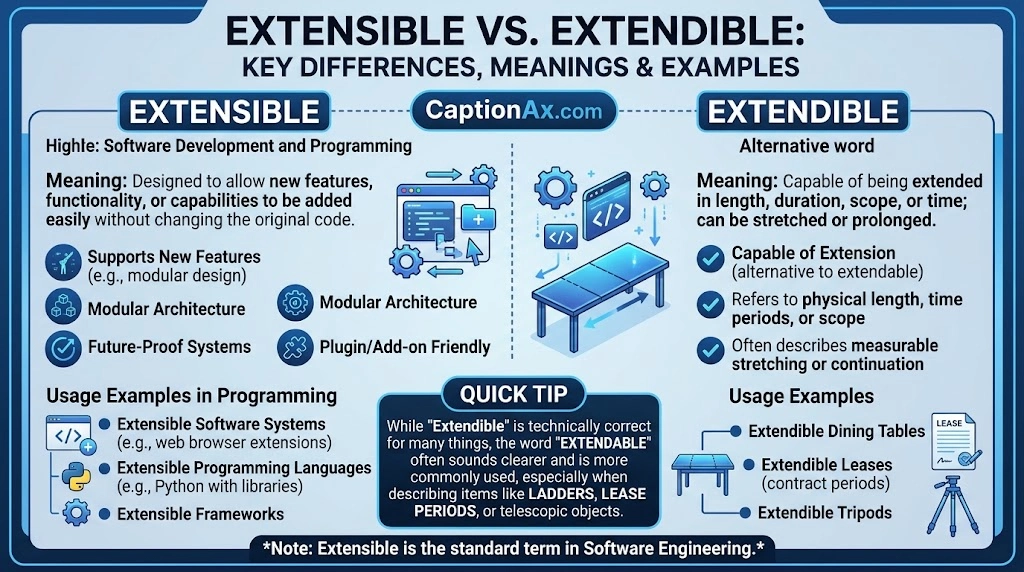
Extensible vs Extendible vs Extendable
These three adjectives are closely related, but each has a slightly different usage profile.
Extensible
Best-known context: software and system design
Describes something that can accommodate new functionality.
Example: The application has an extensible plugin architecture.
Extendible
Best-known role: alternative adjective
Expresses the ability to be extended and overlaps with extendable.
Example: The agreement has an extendible term.
Extendable
Best-known context: length or duration
Describes something that can be made longer or continued.
Example: The ladder has an extendable section.
The distinction is not absolute: extendable can also be used in technical contexts, and extensible can describe things outside computing. Choose the word that accurately conveys the intended meaning and fits your audience.
- Explore More: https://captionax.com/deem-fit-meaning/
When Should You Use Extensible?
Use extensible when you want to emphasize the ability to add capabilities, features, components, or functionality.
1. Software and Applications
An application is extensible when its design allows additional capabilities to be introduced.
Example: The extensible application supports third-party integrations.
2. Programming Languages
A programming language may be described as extensible when its functionality can be adapted or enhanced.
Example: The language provides an extensible environment for specialized development.
3. Frameworks and Architecture
Extensible is a natural choice for systems that accommodate additional modules or integrations.
Example: The company selected an extensible framework for future projects.
4. Research and Analytical Models
The adjective can also describe a method or model that can be expanded or applied to additional situations.
Example: The researchers designed an extensible model for future studies.
5. Formal and Technical Documentation
When a technical audience expects established terminology, extensible can communicate the intended concept precisely.
Example: The documentation explains how to develop an extensible interface.
When Should You Use Extendible?
Extendible can be appropriate when something is capable of being extended. However, consider whether extendable or a direct verb phrase would be clearer.
1. Contracts and Agreements
Example: The agreement contains an extendible term.
Clearer alternative: “The agreement may be extended under the stated conditions.”
2. Deadlines and Time Periods
Example: The deadline may be extendible with approval.
Clearer alternative: “The deadline may be extended with approval.”
3. Physical Objects
Example: The equipment has an extendible arm.
More familiar alternative: “The equipment has an extendable arm.”
4. General Descriptions
Example: The design includes an extendible section.
Depending on the object, extendable or “a section that can be extended” may sound more natural.
Writing tip: Correctness is only one part of good writing. Familiar wording, precision, and readability matter too.
Extensible vs Extendible: Examples in Sentences
Use these paired examples to see how the words work in context.
| Context | Example | Preferred wording |
| Software | The platform supports an extensible plugin system. | Extensible |
| Programming | The framework is extensible enough for new modules. | Extensible |
| Ladder | The ladder can reach the upper floor. | Extendable ladder |
| Lease | The lease can continue for another year. | Extendable lease |
| Contract | The parties may extend the agreement by mutual consent. | Direct verb phrase |
| Research | The model can accommodate new variables. | Extensible model |
| Equipment | The arm can be made longer. | Extendable arm |
| General writing | The original period can be increased. | Can be extended |
More Examples of Extensible
- The company is building an extensible content management system.
- An extensible architecture can accommodate additional components.
- The developers created an extensible API for external integrations.
- The framework offers extensible tools for advanced users.
- The design is extensible enough to support future requirements.
More Examples of Extendible
- The contract includes an extendible period.
- The arrangement may be extendible under specific conditions.
- The equipment has an extendible component.
- The term is extendible if the parties agree.
- The design features an extendible section.
These examples demonstrate possible usage, not a claim that every construction is equally common. Where a more familiar alternative communicates the same idea, prefer the clearer wording.
Common Mistakes to Avoid
Mistake 1: Calling Extendible Incorrect
Extendible is a recognized English word. Its lower familiarity in some contexts does not make it universally incorrect.
Better approach: Explain that it is a valid alternative and recommend the most natural form for the sentence.
Mistake 2: Assuming Extensible Is Only for Computers
Although extensible is especially established in computing, it is not limited to software.
Better approach: Consider the intended meaning and the conventions of your subject area.
Mistake 3: Treating Extendible and Extendable as Completely Different
These words have overlapping meanings. A rigid distinction between the two is not supported by their dictionary treatment.
Better approach: Focus on natural usage rather than inventing a strict rule.
Mistake 4: Using Unnecessarily Complicated Language
“The agreement is extendible” may be understandable, but “The agreement may be extended” can be more direct.
Better approach: Prefer clear verbs when they communicate the meaning more precisely.
Mistake 5: Ignoring Established Technical Terminology
Replacing a familiar technical term with a less conventional alternative may reduce clarity.
Better approach: Follow the terminology used in Extensible vs Extendible the relevant documentation, specification, or editorial style guide.
Synonyms and Related Words
The following terms can express related ideas, although they are not interchangeable in every context.
| Word | Meaning | Example |
| Extendable | Capable of being made longer or continued | An extendable ladder |
| Expandable | Capable of increasing in size, capacity, or scope | An expandable storage system |
| Adaptable | Able to change to meet different needs | An adaptable design |
| Scalable | Able to accommodate growth in demand or workload | A scalable application |
| Flexible | Able to accommodate different conditions | A flexible arrangement |
| Modular | Organized into separate components | A modular framework |
| Extensibility | The capacity to be extended | Software extensibility |
| Extendability | The quality of being extendable | The extendability of the design |
| Extendibility | The quality of being extendible | The extendibility of the term |
For software, extensibility and scalability are related but different concepts. Extensibility concerns adding functionality; scalability concerns handling increased demand or workload.
For physical objects, extendable is often the clearest choice. For contracts, writing that an agreement “may be extended” can be more precise than using an adjective alone.
How to Remember the Difference
If you frequently confuse extensible and extendible, use this practical guide:
- Software and new functionality: Extensible is generally the natural choice.
- Physical length: Extendable is usually familiar and clear.
- Additional time: Extendable or “can be extended” is often straightforward.
- Alternative spelling: Extendible is valid and overlaps with extendable.
Remember that these are usage recommendations, not absolute grammatical rules.
The simplest test is to ask yourself: What exactly can be extended? If you mean a system’s functionality, extensible is a strong option. If you mean the length Extensible vs Extendible of an object or the duration of an arrangement, extendable may be clearer.
Which Word Is Better for Formal and Technical Writing?
For technical writing, extensible is usually the stronger choice when discussing software architecture, frameworks, programming languages, or systems that accommodate additional features.
For example:
“The platform uses an extensible architecture that supports third-party modules.”
For business and legal documents, precision is more important than choosing between similar adjectives.
Instead of writing “The agreement is extendible,” consider:
“The agreement may be extended for an additional six months with written approval.”
Use this wording only when it accurately reflects the agreement’s terms. The actual legal effect depends on the contract and applicable law.
For everyday writing, choose the word that your readers will understand immediately. Extendable is often appropriate for Extensible vs Extendible physical objects and periods, while “can be extended” is a useful alternative when the adjective feels awkward.
People Also Ask
A:Both are valid English words. Extensible is particularly common in software and technical writing, while extendible is a less common alternative that overlaps with extendable.
A:Yes. Extendible is a recognized adjective meaning capable of being extended. It should not automatically be treated as a spelling error.
A:The main distinction is typical usage rather than a strict difference in meaning. Extensible is especially familiar in technical contexts, while extendible overlaps with extendable in general English.
A:No. Extensible is particularly common in computing, but it can also describe other things capable of being extended or expanded.
A:Their meanings overlap substantially. Both can describe something that is capable of being extended. Extendable is often the more familiar form for physical length or duration.
Final Verdict
The choice between Extensible and Extendible is not simply a matter of correct versus incorrect spelling. Both words are valid and share the idea of being capable of extension.
Choose extensible when describing software, programming frameworks, or systems designed to accommodate additional functionality. Choose extendable when describing something that can be made longer or a Extensible vs Extendible period that can continue. Use extendible when it suits the context and your preferred style.
When in doubt, prioritize clarity. A phrase such as “can be extended” is often the easiest way to communicate your meaning without creating unnecessary confusion.
For more help with commonly confused English words, explore related spelling and usage guides on CaptionAx.com.