Correct Spelling, Meaning & Examples
Have you ever paused while writing a message because you could not decide between Receiver vs Reciever? These spellings look almost identical, but only one is correct in standard English.
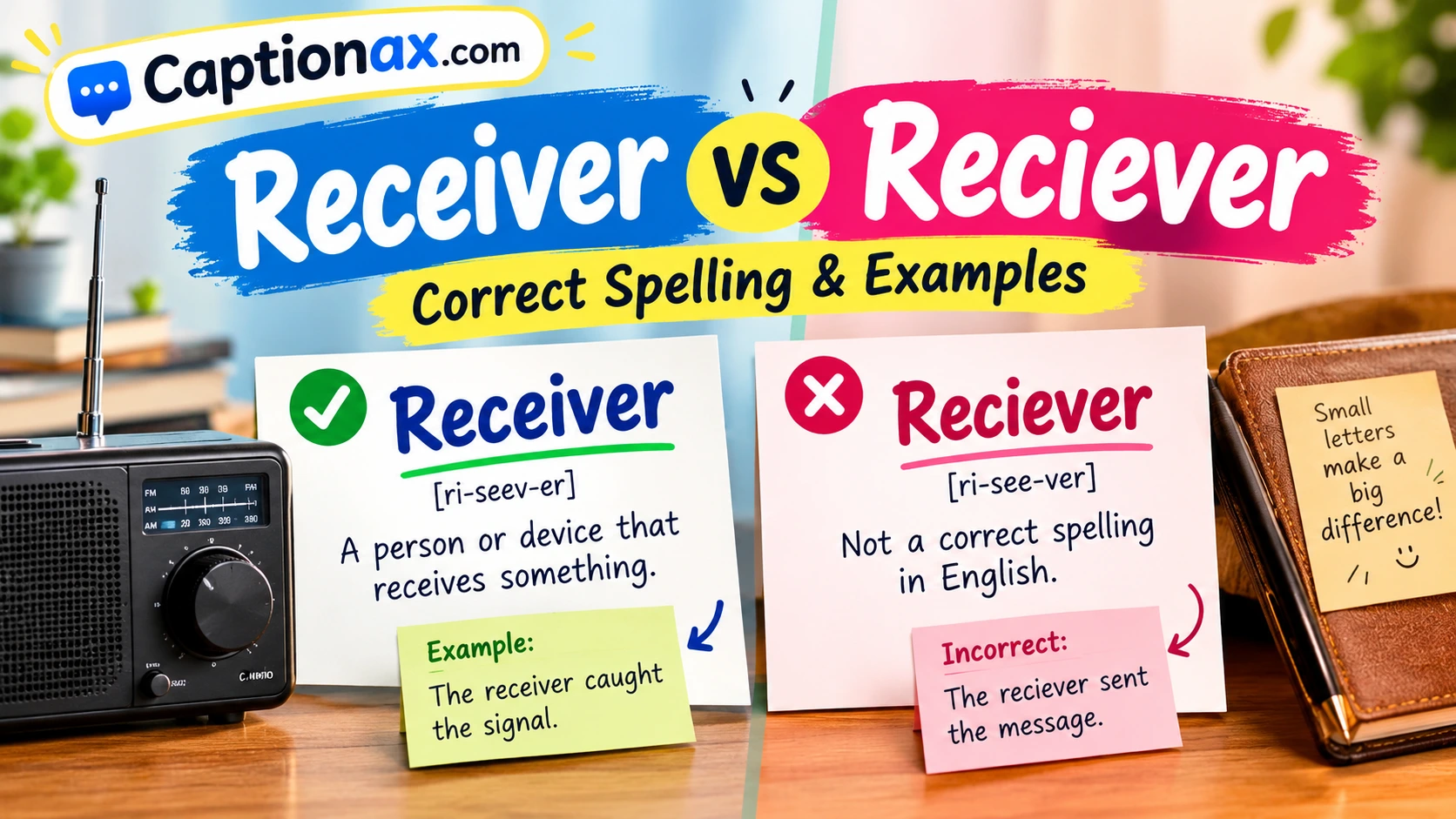
Receiver is the correct spelling. Reciever is a misspelling. The easiest way to remember the difference is to connect receiver with the verb receive. Both contain the letter sequence cei, which helps you avoid reversing the e and i.
Whether you are writing an email, completing a school assignment, describing electronic equipment, or proofreading an article, knowing the correct spelling can make your writing clearer and more professional.
In this guide, you will learn what receiver means, why reciever is incorrect, how to remember the spelling, and how to use the word in different contexts. You will also discover the difference between receiver and recipient, review practical example sentences, and test your knowledge with a short quiz.
Receiver vs Reciever: Which Spelling Is Correct?
Receiver is correct, and reciever is incorrect. The second form is a common spelling error, not an accepted alternative spelling in standard English.
The key difference is the order of the letters e and i.
| Word | Correct? | Explanation |
| Receiver | Yes | A person or thing that receives something |
| Reciever | No | A misspelling of receiver |
| Receive | Yes | A verb meaning to get or accept something |
| Recieve | No | A misspelling of receive |
| Received | Yes | The past-tense form of receive |
| Recieved | No | A misspelling of received |
| Receiving | Yes | The present participle or gerund of receive |
| Recieving | No | A misspelling of receiving |
Correct: The receiver signed for the package.
Incorrect: The reciever signed for the package.
The intended meaning may be understandable in the incorrect sentence, but the spelling is still wrong. Use receiver in schoolwork, business correspondence, website content, and other formal or professional writing.
What Does Receiver Mean?
A receiver is a noun that generally refers to a person or device that receives something. Its precise meaning depends on the context.
The Cambridge Dictionary includes meanings related to telephone equipment, radio and television equipment, American football, and official responsibilities in business or law.
Here are five common uses:
- A person who receives something: The receiver confirmed that the delivery had arrived.
- An electronic device: The satellite receiver lost its signal during the storm.
- A telephone handset: She picked up the receiver and called the office.
- An American football player: The receiver caught a pass from the quarterback.
- A legal or business official: The court appointed a receiver to manage certain assets.
Although these meanings differ, the Receiver vs Reciever spelling stays the same: receiver.
Why Is Reciever Incorrect?
The word Reciever places the letters i and e in the wrong order.
Compare the spellings:
- Correct: receiver
- Incorrect: reciever
The correct word contains cei, not cie.
This mistake is easy to make because English spelling patterns are not always intuitive. Writers may remember words such as believe and field and accidentally apply the same vowel order to receiver.
Pronunciation does not always make the correct letter sequence obvious, so remembering the written form of the related verb is more reliable.
Think of the relationship this way:
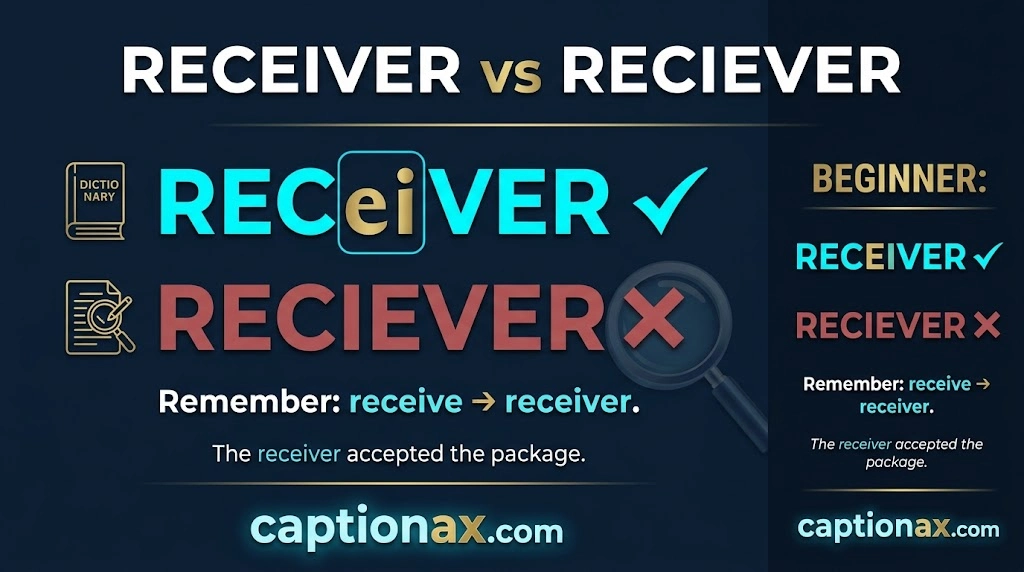
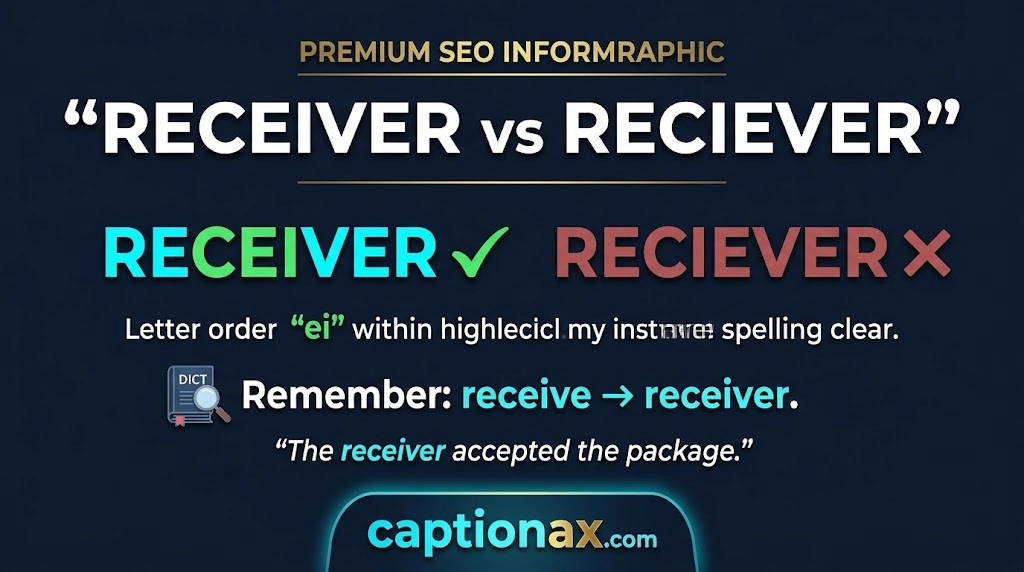
receive → receiver
The spelling of receive provides a useful guide to spelling receiver correctly.
Receiver vs Reciever: Key Differences
The difference between these two forms is spelling, not meaning. Receiver is a standard English word, while reciever is a misspelling.
| Feature | Receiver | Reciever |
| Standard English spelling | Correct | Incorrect |
| Recognized standard word | Yes | No |
| Suitable for formal writing | Yes | No |
| Related to receive | Yes | Intended relationship, but misspelled |
| Used for electronic equipment | Yes | No standard usage |
| Used in American football | Yes | No standard usage |
| Standard British English spelling | Yes | No |
| Standard American English spelling | Yes | No |
There is no situation in which you should deliberately choose reciever as an alternative spelling. If you intend to describe a person or device that receives something, write receiver.
How to Remember the Correct Spelling of Receiver
You do not need to memorize a complicated spelling rule. A simple connection between related words is often easier to remember.
Use the Receive-to-Receiver Trick
Start with the correct verb:
Receive
Then connect it to the noun:
Receive → Receiver
Both words contain the same core spelling sequence. When you are unsure whether to write receiver or reciever, check whether you can spell receive correctly.
Remember the CEI Sequence
Look at the middle of the word:
R-E-C-E-I-V-E-R
The important sequence is CEI. Pay attention to the order of the e and i rather than relying on how the word sounds.
Memorize a Short Sentence
Try this sentence:
The receiver will receive the package.
The sentence uses both related words, reinforcing the correct spelling through repetition.
Learn the Word Family Together
Practice these forms as a group:
- Receive
- Received
- Receiving
- Receiver
- Receivers
Learning related words together makes it easier to recognize the spelling pattern when writing quickly.
Why the “I Before E” Rule Can Be Confusing
Many English learners are taught the mnemonic “i before e, except after c.” Although this saying can help with some words, it is not a universal rule without exceptions.
In words such as receive, deceive, perceive, and conceive, the letters e and i appear in that order after c.
For example:
- Receive — correct
- Receiver — correct
- Deceive — correct
- Perceive — correct
- Conceive — correct
For this particular spelling question, the simplest approach is to remember the established spelling of receive and its related forms.
Treat spelling mnemonics as memory aids, not absolute rules. If you are uncertain about an unfamiliar word, consult a reliable dictionary.
Receive, Received, Receiving, and Receiver
These words belong to the same word family, but they have different grammatical functions.
| Word | Grammatical role | Example |
| Receive | Verb | I receive emails every morning. |
| Receives | Present-tense verb | She receives a weekly report. |
| Received | Past-tense verb | We received your application. |
| Receiving | Present participle or gerund | The warehouse is receiving new stock. |
| Receiver | Noun | The receiver signed the delivery form. |
| Receivers | Plural noun | The technicians tested the receivers. |
Notice that the core spelling remains recognizable across these forms.
When adding the ending -ing, the final e in receive is dropped, producing receiving. This change does not affect the important internal letter sequence.
Check for these common errors when proofreading:
- Recieve → Receive
- Recieved → Received
- Recieving → Receiving
- Reciever → Receiver
Learning the entire word family is more effective than memorizing each form in isolation.
How to Use Receiver in a Sentence
Example sentences show how the same word works in different situations.
Receiver in Everyday English
- The receiver signed for the delivery.
- Please confirm that the receiver has collected the parcel.
- The message reached its intended receiver.
- The receiver acknowledged the information.
- The sender contacted the receiver to confirm the details.
Receiver in Business and Workplace Writing
- The receiver must verify the shipment before signing.
- The company notified the receiver about the delayed delivery.
- The receiver confirmed receipt of the documents.
- Please provide the receiver’s contact information.
- The receiver reported that the package arrived damaged.
To Receiver in Technology
- The wireless receiver stopped working.
- We replaced the television receiver with a newer model.
- The satellite receiver detected the incoming signal.
- The technician checked the radio receiver.
- The audio receiver connects the speakers to the sound source.
Receiver in Sports
- The receiver caught the quarterback’s pass.
- The coach praised the receiver for making a difficult catch.
- The receiver ran toward the end zone.
- The quarterback looked for an open receiver.
- The team recruited a talented wide receiver.
Receiver in Legal and Financial Writing
- The court appointed a receiver to oversee certain property.
- The receiver reviewed the company’s financial records.
- The legal documents outlined the receiver’s responsibilities.
- The receiver was instructed to protect the relevant assets.
- The court specified the receiver’s authority.
These examples demonstrate how the word changes meaning according to context without changing its spelling.
- Explore More: https://captionax.com/anual-or-annual/
Different Meanings of Receiver in English
Understanding context helps you identify which meaning of receiver a writer intends.
Everyday Communication
In everyday communication, a receiver is a person who gets a message, delivery, or other item.
Example: The receiver replied to the email.
Electronics and Broadcasting
In electronics, a receiver is a device that picks up or processes incoming signals. Depending on the equipment, it may help convert signals into sound, pictures, or other usable information.
Example: The satellite receiver picked up the television signal.
American Football
In American football, a receiver is an offensive player whose role commonly includes catching forward passes from the quarterback.
Example: The receiver caught the ball near the sideline.
Law and Business
In certain legal or insolvency proceedings, a receiver is an appointed official who manages or takes control of specified assets or business affairs. The exact responsibilities depend on the legal arrangement and jurisdiction.
Example: The court appointed a receiver to manage the company’s assets.
The context determines the meaning, but the spelling remains receiver.
Receiver vs Recipient: What Is the Difference?
The Receiver and recipient are both correct words, but they are not interchangeable in every context.
Receiver can describe a person or thing that receives something, a piece of electronic equipment, an American football player, or an official with a particular legal role.
Recipient usually describes a person or organization that receives something such as an award, scholarship, payment, gift, message, or benefit.
Compare these examples:
- The receiver signed for the package.
- She was the recipient of the scholarship.
- The radio receiver picked up the signal.
- He was the recipient of the award.
- The quarterback passed the ball to the receiver.
When describing someone who receives a formal honor or benefit, recipient is often the more natural choice. When describing a device that receives a signal, receiver is appropriate.
Neither word should be confused with reciever, which is a misspelling.
Is Receiver the Same in American and British English?
Yes. Receiver is the standard spelling in both American and British English.
Unlike words such as color and colour, receiver does not have a conventional American-versus-British spelling difference.
Examples:
- American English: The receiver picked up the signal.
- British English: The receiver picked up the signal.
Both sentences use the correct spelling. Do not use reciever as a regional variant; it is not the standard form in either variety.
Common Receiver Spelling Mistakes
The following errors are worth checking when proofreading your writing.
| Incorrect form | Correct form | Example |
| Reciever | Receiver | The receiver signed the form. |
| Recieve | Receive | Did you receive my email? |
| Recieved | Received | We received the documents. |
| Recieving | Receiving | We are receiving new orders. |
Why Do These Errors Happen?
Vowel reversal: Writers put e and i in the wrong order.
Overgeneralized spelling rules: A writer may remember an incomplete spelling mnemonic and apply it incorrectly.
Typing too quickly: Adjacent vowels can be reversed accidentally.
Insufficient proofreading: A familiar-looking typo can escape notice when rereading a document.
How to Avoid These Mistakes
- Connect receiver with receive.
- Check the cei sequence.
- Use a spelling checker for longer documents.
- Search your draft for “reciever” before publishing.
- Check whether receiver is the right word for the sentence, rather than recipient.
Spell-checking helps, but choosing the right word still requires attention to context.
Receiver vs Reciever: Practice Quiz
Test your understanding with these five questions. Choose the correct spelling for each sentence.
1. The ______ signed for the package.
A. Reciever
B. Receiver
2. Did you ______ my message?
A. Receive
B. Recieve
3. We ______ your application yesterday.
A. Recieved
B. Received
4. The wireless ______ needs to be replaced.
A. Receiver
B. Reciever
5. The warehouse is ______ new shipments.
A. Recieving
B. Receiving
Quiz Answers
- B — Receiver. It refers to the person accepting the package.
- A — Receive. This is the correct spelling of the verb.
- B — Received. This is the correct past-tense form.
- A — Receiver. This refers to electronic equipment.
- B — Receiving. This is the correct present participle.
If you answered all five correctly, you understand the main spelling pattern. If you missed any, review the relationship between receive and receiver and try again.
People Also Ask
A:Receiver is correct. Reciever is a common misspelling and is not an accepted standard alternative.
A:Spell it R-E-C-E-I-V-E-R. Remember the relationship: receive → receiver.
A:Reciever is generally a misspelling of receiver, rather than a separate standard English word. The intended meaning depends on the context in which it appears.
A:People often reverse e and i because English spelling patterns can be confusing. Typing quickly and relying on memory instead of checking the spelling can also cause mistakes.
A:Receiver is a noun, while receive is the related verb. For example, “The receiver signed the form” uses a noun, while “I receive emails” uses a verb.
Final Verdict
When choosing between Receiver and Reciever, the answer is simple: receiver is correct, while reciever is incorrect in standard English.
The easiest way to remember the spelling is to connect the noun with its related verb:
Receive → Receiver
Both words contain the sequence cei, so you do not need to guess the order of the vowels every time.
Whether you are writing an email, completing an assignment, describing electronic equipment, discussing football, or using the word in a legal context, choose receiver.
A quick spelling check before publishing can prevent this common mistake and make your writing clearer. Explore more spelling comparisons on CaptionAx.com to keep improving your English vocabulary and writing skills.