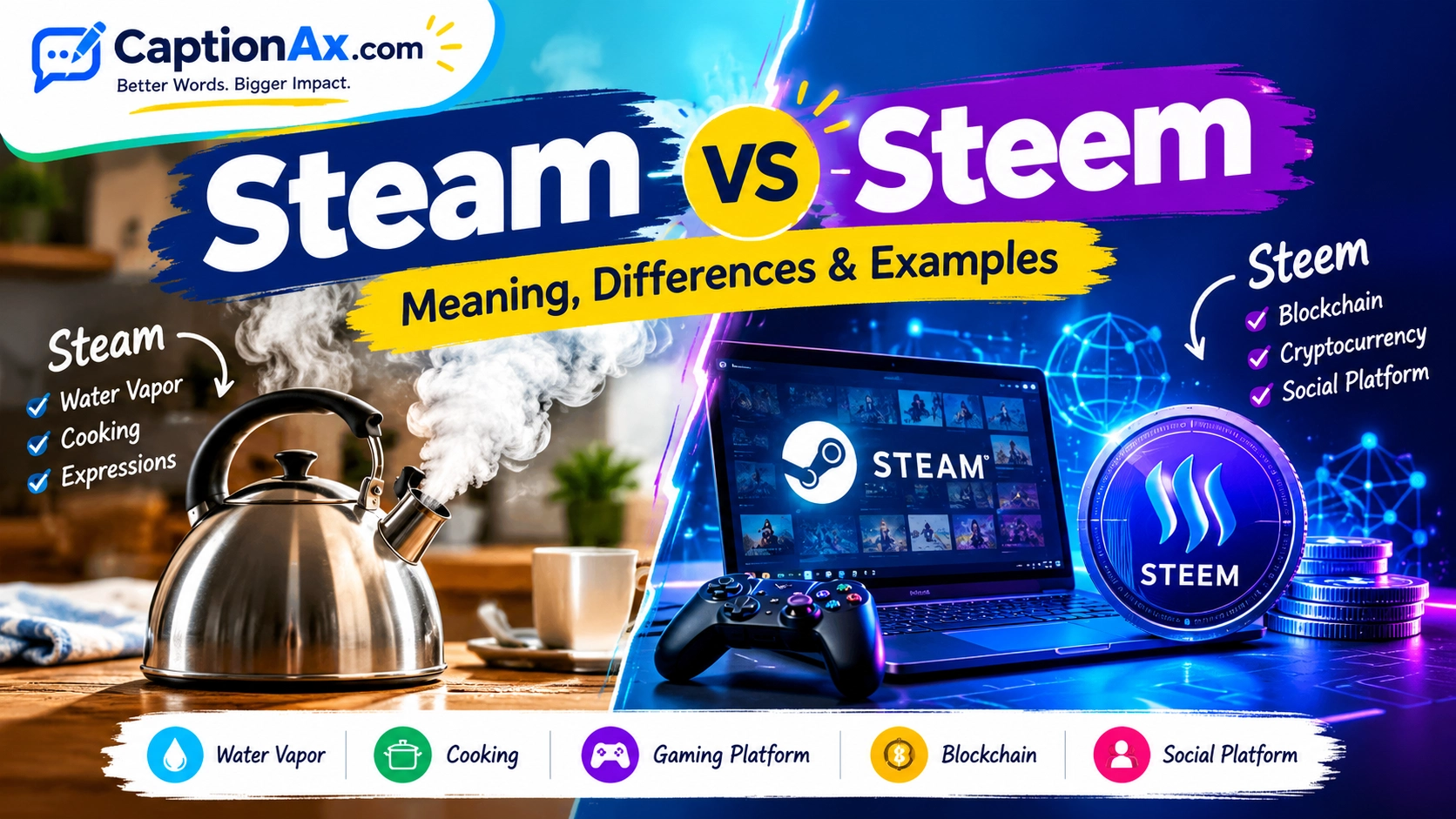
Steam vs Steem: Meaning & Difference
Have you ever wondered whether to write Steam or Steem? The two spellings look similar and can sound alike, but they have different meanings. Choosing the correct one depends on what you are talking about.
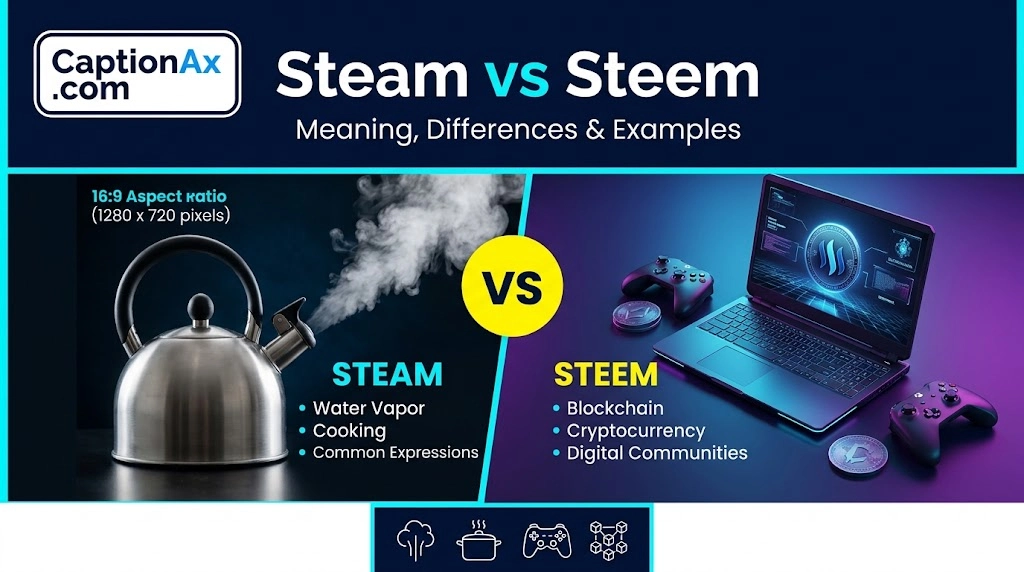
Steam is the standard English word for water vapor and is also used as a verb, as in “steam the vegetables.” It appears in expressions such as “let off steam” and “gain steam.” With a capital S, Steam is also the name of a popular digital gaming platform.
Steem, on the other hand, is a proper name associated with a blockchain ecosystem. STEEM is the name of its digital token, while Steemit is a social publishing platform built on the Steem blockchain.
Understanding the difference between steam and steem can help you avoid spelling mistakes, write more confidently, and recognize the right term in everyday conversations, gaming discussions, and cryptocurrency articles.
What Is the Difference Between Steam and Steem?
The main difference between steam and steem is their meaning. Steam is a standard English word for water vapor and related actions or expressions. Steem is a proper name associated with blockchain technology.
| Feature | Steam | Steem |
| Word type | Common noun and verb; also a proper name | Proper name |
| Main meaning | Water vapor or an action involving steam | Blockchain ecosystem |
| Everyday English | Correct spelling | Not a standard spelling variant |
| Gaming | Steam gaming platform | Not the same gaming service |
| Cryptocurrency | Not the name of the Steem token | Associated with the STEEM token |
| Example | Steam rose from the kettle. | The application uses the Steem blockchain. |
Quick rule: Use steam for water vapor, cooking, and familiar English expressions. Use Steam for the gaming platform and Steem or STEEM when referring to the blockchain ecosystem or its token.
What Does Steam Mean?
Steam is a standard English word that functions as both a noun and a verb. Its meaning depends on how it is used in a sentence.
Steam as a Noun
As a noun, steam refers to vapor associated with heated water. In everyday language, people commonly use the word for the visible vapor rising from hot food, a kettle, or a shower.
Examples:
- Steam rose from the boiling kettle.
- The bathroom mirror became foggy after the hot shower.
- The cook carefully lifted the lid to release the steam.
- The old steam engine moved along the railway track.
Steam can also refer figuratively to energy, progress, or momentum. For example, “The campaign is gaining steam” means that the campaign is becoming more active or successful.
Steam as a Verb
As a verb, steam can mean to cook something using steam, release steam, or treat an object with steam.
Examples:
- We steam the vegetables before serving them.
- She steamed her shirt before the interview.
- The kettle began to steam as the water heated.
- The chef steamed the dumplings until they were cooked.
In these sentences, steam describes an action rather than naming a substance.
Common Expressions With Steam
Steam appears in several common English expressions.
| Expression | Meaning | Example |
| Let off steam | Release stress or frustration | I went for a walk to let off steam. |
| Gain steam | Build momentum | The campaign began to gain steam. |
| Lose Steam | Lose energy or momentum | The team lost steam near the end. |
| Full steam ahead | Continue energetically | We are moving full steam ahead with the plan. |
| Run out of steam | Become tired or lose momentum | I ran out of steam after studying all afternoon. |
These expressions are useful in everyday conversations, workplace communication, and creative writing.
What Does Steem Mean?
Steem is the name of a blockchain ecosystem associated with digital communities, social applications, and cryptocurrency. It is not a standard alternative spelling of the ordinary English word steam.
The Steem ecosystem supports applications that interact with its blockchain. One example is Steemit, a social publishing platform built on Steem. The associated digital token is written as STEEM.
According to the project’s official resources, Steem was launched in March 2016 and was designed to support social applications and digital participation.
Examples:
- The developer is building an application on the Steem blockchain.
- The article explains the history of the Steem ecosystem.
- The discussion focuses on STEEM tokens.
- Steemit is a social publishing application built on Steem.
In these examples, Steem-related terms are proper names rather than ordinary English vocabulary.
What Is the Difference Between Steam, Steem, and STEEM?
Although the terms look similar, their capitalization and context help distinguish them.
- steam: The ordinary English word for water vapor, cooking with steam, and related expressions.
- Steam: The digital gaming platform operated by Valve.
- Steem: The blockchain ecosystem.
- STEEM: The digital token associated with the Steem blockchain.
- Steemit: A social publishing application built on the Steem blockchain.
| Term | Meaning | Example |
| steam | Water vapor or a related action | Steam escaped from the pot. |
| Steam | Gaming platform | I downloaded the game on Steam. |
| Steem | Blockchain ecosystem | The application uses Steem technology. |
| STEEM | Digital token | The article discusses STEEM tokens. |
| Steemit | Social publishing platform | She published a post on Steemit. |
These distinctions matter when writing about technology. Capitalization helps readers recognize whether you mean an everyday word, a platform, a blockchain, or a token.
Steam vs Steem Examples in Sentences
The easiest way to understand the difference is to see each term in context.
Everyday English Examples
- Correct: Steam rose from the hot cup of tea.
Why: Steam refers to vapor associated with heated water. - Correct: Please steam the vegetables for ten minutes.
Why: Steam is used as a verb. - Correct: He went jogging to let off steam.
Why: The expression means to release tension or frustration. - Incorrect: The steem from the kettle filled the kitchen.
Correct: The steam from the kettle filled the kitchen. - Incorrect: The company is gaining steem.
Correct: The company is gaining steam. - Correct: The project has gained steam over the last few months.
Why: The expression refers to increasing momentum.
Gaming Examples
- I purchased a new game on Steam.
- She opened the Steam application on her computer.
- The game is available through the Steam store.
- My friend added me on Steam.
Here, Steam refers to the gaming platform rather than water vapor or the Steem blockchain.
Blockchain and Cryptocurrency Examples
- The developer created an application for the Steem ecosystem.
- The article explains how the Steem blockchain works.
- The discussion focuses on STEEM, the network’s digital token.
- Steemit is an application built on the Steem blockchain.
The correct spelling depends on the specific subject being discussed.
Why Do People Confuse Steam and Steem?
Several factors make these spellings easy to mix up.
Similar Pronunciation
Steam is pronounced /stiːm/ and rhymes with team, dream, cream, and beam. Because the two spellings can be pronounced alike, hearing the word does not always tell you which spelling to use.
Similar Letter Patterns
Both words begin with “st” and end with “m.” The difference is in the vowel letters: ea in steam and ee in steem.
Writers may choose the wrong vowel combination when typing quickly or learning English.
Internet and Technology Terms
Online services, brands, usernames, and cryptocurrencies sometimes use unusual spellings. Someone who encounters Steem in a Steam vs Steem technical discussion might assume that it is simply another spelling of steam.
The solution is to identify the subject before choosing the word.
Typing and Editing Mistakes
Typing quickly, relying on autocorrect, or failing to proofread can produce spelling errors. Spellcheckers are useful, but they Steam vs Steem may not recognize every proper name or technical term.
Always check the context before replacing an unfamiliar spelling.
- Explore More: https://captionax.com/freshmen-vs-freshman/
How Are Steam and Steem Pronounced?
The standard pronunciation of steam is /stiːm/. It rhymes with team, dream, cream, and beam.
When steem is used as an attempted spelling of the ordinary English word, readers may pronounce it the same way. A particular brand or proper name, however, may have its own intended pronunciation.
The main distinction is therefore spelling and meaning, not necessarily sound.
A simple pronunciation reminder is:
- Steam rhymes with team.
- The vowel sound is the long “ee” sound.
- The ordinary English word is spelled steam.
Is Steem a Correct English Word?
Steem is not the standard spelling of the ordinary English word for water vapor. In everyday writing, use steam when discussing heated water vapor, cooking, steam engines, or expressions about momentum.
However, Steem is correct when referring to the specific blockchain ecosystem or another verified name that intentionally Steam vs Steem uses that spelling.
Compare these examples:
- Incorrect: The steem from the iron removed the wrinkles.
- Correct: The steam from the iron removed the wrinkles.
- Correct: The developer is working with the Steem blockchain.
The important distinction is between an ordinary English word and a proper name.
Steam vs Steem in Gaming and Cryptocurrency
Steam and Steem belong to different areas of technology.
What Is Steam in Gaming?
Steam is a digital platform for purchasing, downloading, playing, and discussing computer games. It also provides community features and tools for game developers.
For example, “I bought the game on Steam” means the speaker purchased the game through the gaming service.
What Is Steem in Cryptocurrency?
Steem is a blockchain ecosystem that supports applications and digital participation. STEEM is the name of its associated Steam vs Steem digital token.
For example, “The article explains STEEM token transactions” is a cryptocurrency-related sentence.
Readers should distinguish the blockchain, its token, and applications built on the network rather than treating these names as interchangeable.
Are Steam and Steem Connected?
No. Steam is a gaming platform operated by Valve, while Steem is a blockchain ecosystem. Their similar spellings do not mean that they are the same service or technology.
When writing about either one, use the official name and capitalization associated with the intended subject.
Common Steam vs Steem Spelling Mistakes
Here are common mistakes and their corrections.
| Incorrect usage | Correct usage | Reason |
| Steem from the kettle | Steam from the kettle | Standard English spelling |
| Steem the vegetables | Steam the vegetables | Correct verb spelling |
| Let off steem | Let off steam | Standard idiom |
| Gaining steem | Gaining steam | Standard expression |
| I downloaded a game on Steem | I downloaded a game on Steam | Gaming platform name |
| The STEAM token on the Steem network | The STEEM token on the Steem network | Correct token name |
The last two examples illustrate why context matters. A spelling that is incorrect in ordinary English may be correct as part of a Steam vs Steem specific official name, but technical terms should still be verified.
How to Remember the Correct Spelling
You can use three simple techniques to avoid confusing steam and steem.
Remember Steam and Team
The words Steam and Steem share the same “eam” ending. If you can spell team, use it as a reminder for steam.
Connect Steam With Hot Water
Picture a kettle releasing steam as water heats up. Connect the image directly with the spelling steam.
Remember the Technology Difference
Use this quick guide:
- Steam: Water vapor, related English expressions, or the gaming platform.
- Steem: The blockchain ecosystem.
- STEEM: The associated digital token.
Use the Sentence Test
Ask yourself what your sentence is about.
If it concerns boiling water, cooking, a steam engine, or an expression such as “gain steam,” write steam.
When it concerns the gaming platform, write Steam.
If it concerns the blockchain ecosystem or its token, use Steem or STEEM, as appropriate.
This context-based method is more reliable than choosing a spelling based only on how the word sounds.
Is There a Difference in American and British English?
No. The ordinary English word is spelled steam in both American and British English. Neither variety generally uses steem as an alternative spelling for water vapor.
Examples:
- American English: The steam from the kettle filled the kitchen.
- British English: The steam from the kettle filled the kitchen.
The spelling remains the same in both varieties.
When Should You Use Steam or Steem?
Use this decision guide whenever you are unsure which spelling belongs in your sentence.
| If you mean… | Use… |
| Vapor associated with heated water | steam |
| Cooking with hot vapor | steam |
| Steam-powered machinery | steam |
| Releasing frustration | let off steam |
| Building momentum | gain steam |
| The digital gaming service | Steam |
| The blockchain ecosystem | Steem |
| The blockchain’s digital token | STEEM |
| The social publishing platform | Steemit |
Before correcting an unfamiliar spelling, check whether it is an official name. Context determines whether a form is a spelling mistake or the correct spelling of a particular entity.
People Also Ask
A:Steam is correct when referring to water vapor, cooking with steam, steam-powered machinery, or familiar English expressions. Steem is used as a proper name in the blockchain ecosystem.
A:Steem refers to a blockchain ecosystem associated with digital communities and applications. It is not a standard alternative spelling for the ordinary English word steam.
A:No. Steam is the ordinary English word for water vapor and the name of a gaming platform. Steem refers to a blockchain ecosystem. They are different terms with different meanings.
A:Steem refers to the blockchain ecosystem, while STEEM is the name of its associated digital token. Capitalization helps distinguish the project from its token in technical writing.
A:They can be pronounced alike when steem is read as an attempted spelling of steam. The standard pronunciation of steam is /stiːm/, but similar sounds do not make the spellings interchangeable.
Conclusion
The difference between Steam vs Steem becomes easy to understand once you consider context. Steam is the standard English word for water vapor, a cooking method, and expressions such as “let off steam” and “gain steam.” It is also the name of a popular gaming platform.
Steem, by contrast, is the name of a blockchain ecosystem, while STEEM refers to its associated digital token. The spellings look similar, but their meanings are not interchangeable.
Remember this simple rule: Use steam for ordinary English meanings and the gaming platform, and use Steem or STEEM when referring to the relevant blockchain project or token.
Choosing the correct form will make your writing clearer and help readers understand exactly what you mean. For more helpful spelling comparisons and word-meaning guides, explore the related articles on CaptionAx.com.