Sleave or Sleeve: Correct Spelling, Meaning & Examples
Have you ever typed sleave instead of sleeve and wondered which spelling is correct? These two words look almost identical, and they can even sound the same in some varieties of English. However, they have different meanings and are not interchangeable.
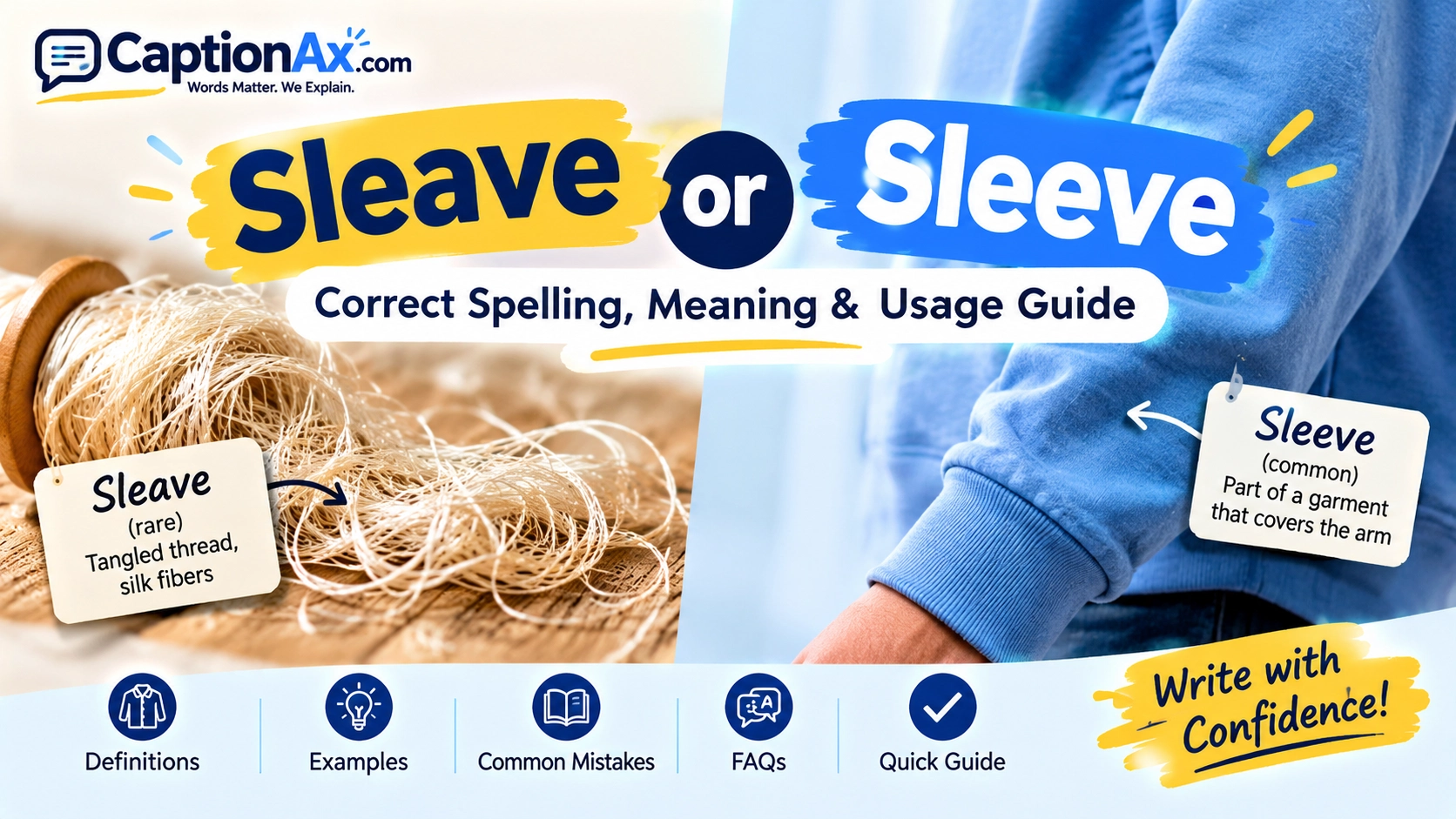
Sleeve is the standard modern English word for the part of a shirt, jacket, or dress that covers the arm. It can also describe a protective covering for a laptop, cable, record, or mechanical component. Sleave, on the other hand, is a genuine but rare English word associated with tangled thread, fine silk fibers, and historical textile terminology.
Understanding the difference helps you avoid spelling mistakes in essays, emails, articles, and professional documents. It also explains why your spell-checker might accept sleave even when you intended to write sleeve.
In this guide, you will learn the meanings of both words, how to use them in sentences, their pronunciation and word forms, and the historical reason sleave still appears in English literature. By the end, you will know which spelling to choose in everyday writing and when the less common word is appropriate.
Sleave or Sleeve: Which Spelling Is Correct?
Sleeve is the correct spelling for clothing and most modern protective coverings. Sleave is also a legitimate English word, but it has a rare, historical meaning associated with tangled thread and silk fibers. The correct choice depends on the context.
Consider these examples:
- Correct: She rolled up her sleeves before washing the dishes.
- Incorrect for the intended meaning: She rolled up her sleaves before washing the dishes.
- Correct: I bought a padded sleeve to protect my laptop.
- Historically appropriate: The old textile document described a tangled mass of silk as sleave.
The distinction is straightforward. Use sleeve when talking about shirts, jackets, dresses, protective cases, or mechanical coverings. Use sleave only when its specialized historical meaning is intended.
What Does Sleeve Mean?
A sleeve is the part of a garment that covers all or part of an arm. The word also describes a protective cover or a tubular component fitted around or inside another object.
Common examples include:
- Shirt sleeve: The part of a shirt that covers the arm.
- Jacket sleeve: The section of a jacket that extends over the arm.
- Laptop sleeve: A protective case designed to hold a laptop.
- Record sleeve: A paper or cardboard cover that protects a vinyl record.
- Cable sleeve: A covering that bundles or protects electrical wires.
- Engine sleeve: A cylindrical liner fitted inside an engine component.
The word also appears in familiar English expressions. To have something up your sleeve means to have a secret plan, idea, or advantage ready to use.
Examples in sentences:
- The tailor shortened the sleeves of my jacket.
- She placed her tablet inside a protective sleeve.
- The technician replaced the damaged cable sleeve.
- He rolled up his sleeves and started painting the room.
- The team had another strategy up its sleeve.
In each example, sleeve refers to a covering, component, or established expression. It is the word you will need in almost every everyday situation involving this spelling pair.
What Does Sleave Mean?
Sleave is a rare and largely archaic English word associated with tangled thread, silk fibers, or fine filaments separated from a thicker thread. Historical dictionaries also record a verb meaning to separate or disentangle threads.
The word is primarily encountered in older literature, textile history, and discussions of historical English vocabulary. It is not the normal term for a garment’s arm covering.
Examples of historical or specialized usage include:
- The glossary explained the meaning of sleave in traditional textile work.
- The researcher examined a historical reference to sleave silk.
- The literary commentary discussed the word sleave in a passage from Shakespeare.
These examples illustrate how the word might appear in historical research or literary analysis. They are not typical sentences in contemporary conversation.
The distinction matters because a word can be legitimate without being appropriate in every sentence. If you mean the arm covering of a shirt, writing sleave would be a spelling error in that context.
Sleave vs. Sleeve: Key Differences
Although the two words look similar, their meanings and normal uses are different.
| Feature | Sleeve | Sleave |
| Main meaning | Garment part or protective covering | Tangled thread or fine silk fibers |
| Modern usage | Common | Rare or archaic |
| Clothing context | Standard | Not normally used |
| Technical usage | Common in relevant fields | Historical textile usage |
| Part of speech | Noun; also a verb | Noun and, historically, verb |
| Pronunciation | Usually /sliːv/ in British English | /sliːv/ in British English; pronunciation can vary |
| Common word forms | Sleeves, sleeved, sleeveless, sleeving | Historical forms include sleaved and sleaving |
| Best Context | Everyday writing and technical descriptions | Historical literature and textile terminology |
The key difference is meaning, not simply spelling. Sleeve is the ordinary word for a garment part or covering, while sleave belongs mainly to historical and specialized contexts.
A simple decision rule makes the choice easier:
- Talking about clothing? Use sleeve.
- Describing a protective case or mechanical covering? Use sleeve.
- Discussing tangled silk in an old text? Sleave may be appropriate.
- Unsure which one you need? Check the meaning of the sentence before choosing.
Sleave or Sleeve: Examples in Sentences
Sentence examples show how each word works in context and why the spelling matters.
Correct uses of sleeve
- My shirt has a small tear in its left sleeve.
- She prefers dresses with long sleeves.
- Please put the document inside a plastic sleeve.
- The laptop sleeve protects the device from scratches.
- He pulled his sleeves down because the weather was cold.
- The mechanic inspected the metal sleeve inside the machine.
- The artist designed a colorful tattoo sleeve.
- The jacket has adjustable sleeves.
- She rolled up her sleeves before preparing dinner.
- The cable sleeve keeps the wires organized.
Uses of sleave in historical contexts
- The dictionary described sleave as a term associated with tangled thread.
- The researcher investigated the historical meaning of sleave silk.
- The literary commentary explained the word sleave in Shakespeare’s writing.
The second group is deliberately specialized. In contemporary writing, you are unlikely to need sleave unless you are discussing historical language, textile terminology, or a literary passage.
Quick correction test
Incorrect: The jacket has a torn sleave.
Correct: The jacket has a torn sleeve.
Incorrect: She placed her laptop inside its sleave.
Correct: She placed her laptop inside its sleeve.
Ask yourself what the word describes. If it means an arm covering or protective case, choose sleeve.
Why Do People Confuse Sleave and Sleeve?
Several factors explain why writers mix up these spellings.
Similar appearance: The words contain almost the same letters. A small typing error can change sleeve into sleave without making the result look obviously wrong.
Similar pronunciation: In standard British English, both words can be pronounced /sliːv/. When the words sound alike, hearing them may not reveal which spelling is intended.
Unfamiliar vocabulary: Most English speakers regularly encounter sleeve but rarely use sleave. Seeing the unusual word in an old text or dictionary can create uncertainty.
Spell-check limitations: Some spelling tools recognize rare dictionary entries. Because sleave is a real word, a spell-checker may accept it even when the sentence requires sleeve.
Confusion between spelling and meaning: Writers sometimes assume that similar-looking words are alternative spellings of the same term. In this case, they have distinct meanings.
The best solution is to review the entire sentence rather than relying only on automatic spelling corrections. A dictionary can confirm that a word exists, but context determines whether it is the right word for your sentence.
How to Remember the Correct Spelling
Use this simple memory trick:
Sleeve = shirt, jacket, or covering.
Sleave = rare historical word associated with silk and thread.
Imagine putting on your favorite shirt. The fabric covering your arm is its sleeve. If you are writing about a laptop cover, you still need sleeve.
Remember these familiar combinations:
- Long sleeves
- Short sleeves
- Shirt sleeves
- Jacket sleeves
- Laptop sleeve
- Protective sleeve
- Cable sleeve
You can also connect sleeve with the familiar expression up your sleeve, which refers to a hidden plan or advantage.
For everyday writing, there is no need to memorize every historical meaning of sleave. Simply recognize that it exists and understand when it belongs in a specialized or literary discussion.
When editing an article, search for the word sleave and check every occurrence. This is particularly useful in writing about fashion, clothing, electronics, and engineering, where sleeve is normally the intended term.
- Explore More: https://captionax.com/tweek-vs-tweak/
How Is Sleave or Sleeve Pronounced?
In standard British English, sleeve is pronounced /sliːv/, with one syllable and a long “ee” sound, similar to the vowel in leave.
Collins records the British pronunciation of sleave as /sliːv/ as well. Its American entry records a different pronunciation for the rare word, so pronunciation can vary by English variety and dictionary.
The important point is that pronunciation alone may not identify the intended spelling.
For example, if someone says a sentence about rolling up a shirt’s arm covering, the appropriate spelling is sleeve. If someone is discussing a historical poem about tangled silk, sleave may be the intended word.
For English learners, the most reliable strategy is to associate each spelling with its meaning rather than attempting to distinguish the words by sound alone.
What Is the Plural of Sleeve?
The standard plural of sleeve is sleeves.
Examples:
- The shirt has two sleeves.
- Her jacket sleeves are too long.
- The tailor shortened both sleeves.
- I bought protective sleeves for my documents.
Other common forms include:
| Word form | Meaning or use | Example |
| Sleeve | Singular noun | The sleeve is torn. |
| Sleeves | Plural noun | Both sleeves need repair. |
| Sleeved | Describes something fitted with sleeves | She wore a long-sleeved shirt. |
| Sleeveless | Without sleeves | He chose a sleeveless vest. |
| Sleeving | The process of fitting or covering something with a sleeve | The technician is sleeving the cable. |
These forms are useful in everyday writing and technical descriptions.
Do not write sleaves when you mean the plural of the clothing word. The correct spelling is sleeves.
The rare word sleave has its own historical forms, including sleaved and sleaving as a verb. These are specialized forms and should not be confused with the ordinary plural sleeves.
Common Uses of the Word Sleeve
The word sleeve appears in several everyday and technical contexts.
Fashion and clothing
A sleeve is the part of a shirt, coat, dress, or jacket that covers the arm.
Example: The designer added lace to the dress sleeves.
Electronics and accessories
A sleeve can protect an electronic device or accessory from scratches and other damage.
Example: She carried her tablet in a padded sleeve.
Records and documents
Paper or plastic sleeves protect records, photographs, cards, and documents.
Example: Keep the original photograph in a protective sleeve.
Engineering and machinery
A sleeve can be a tubular component fitted over or inside another part.
Example: The engineer replaced a worn metal sleeve.
Tattoos
A tattoo sleeve is a design covering much or most of a person’s arm.
Example: His new tattoo sleeve features flowers and geometric patterns.
Idiomatic expressions
In the expression have something up your sleeve, the word refers figuratively to a hidden plan, resource, or advantage.
Example: The negotiator had another proposal up her sleeve.
These examples demonstrate why sleeve is the appropriate spelling across a wide range of modern contexts. Its meaning extends well beyond clothing, but it does not become sleave simply because the object is technical or unfamiliar.
Is Sleave Used in Shakespeare?
Yes. One of the best-known historical appearances of sleave occurs in William Shakespeare’s tragedy Macbeth.
The play includes the phrase “Sleep, that knits up the ravell’d sleave of care,” an image connecting sleep with tangled thread and the easing of worries.
Here, sleave evokes a mass of tangled or unraveled silk fibers. The image suggests that sleep helps untangle the complications and anxieties of the day.
This is a specialized historical use, not an example of the ordinary word for a garment. Replacing sleave with sleeve changes the textile image behind the passage.
The spelling is worth preserving when quoting or analyzing the historical text. Editorial notes and editions of Macbeth may discuss differences in the early text and later editorial choices, so readers should consult the particular edition they are studying.
The Shakespeare connection explains why a word that is almost absent from everyday conversation still appears in dictionaries and literary discussions.
Is Sleave or Sleeve Correct in British and American English?
For ordinary modern English, sleeve is the standard spelling in both British and American English when referring to a garment’s arm covering or a protective casing.
This is not a typical British-versus-American spelling difference. Instead, sleave belongs to rare historical vocabulary, with dictionary entries recording different senses and pronunciations across English varieties.
Examples in both varieties include:
- British English: She rolled up her sleeves.
- American English: She rolled up her sleeves.
- British English: He bought a protective laptop sleeve.
- American English: He bought a protective laptop sleeve.
The spelling remains sleeve in these contexts.
There can be regional differences in the vocabulary for particular objects. For example, a record cover is often called a record sleeve in British English and a record jacket in American English. Neither difference makes sleave the normal alternative.
When reading older British or American texts, you may encounter sleave. Evaluate the word according to its historical meaning rather than assuming it is a regional spelling of sleeve.
Common Spelling Mistakes to Avoid
Avoid these common mistakes when writing about clothing and protective coverings.
| Incorrect or unsuitable usage | Correct usage |
| The shirt has long sleaves. | The shirt has long sleeves. |
| She rolled up her sleave. | She rolled up her sleeve. |
| Put the laptop in its sleave. | Put the laptop in its sleeve. |
| The jacket has a torn sleave. | The jacket has a torn sleeve. |
| The mechanic replaced the engine sleave. | The mechanic replaced the engine sleeve. |
| He had a trick up his sleave. | He had a trick up his sleeve. |
The first form in each pair is unsuitable because the sentence refers to an ordinary garment, covering, mechanical component, or established expression.
However, not every occurrence of sleave is a mistake. It may be correct when discussing historical silk fibers, older textile terminology, or a literary passage that uses the word deliberately.
A useful proofreading technique is to search your document for sleave. Review each occurrence and ask whether the intended meaning involves tangled thread or historical textile language. If not, you probably need sleeve.
This small check can prevent a genuine dictionary word from becoming an accidental spelling error.
People Also Ask
A:Yes. Sleave is a genuine but rare English word associated with tangled thread, silk fibers, and historical textile terminology. It is not the standard word for the arm covering of a garment.
A:Sleeve is correct. Write, “The shirt has short sleeves,” rather than “The shirt has short sleaves.”
A:In simple terms, sleave refers to tangled thread or fine silk fibers in historical usage. It is rarely needed in contemporary everyday writing.
A:They can be pronounced the same in British English. The pronunciation of the rare word may differ across dictionaries and English varieties, so context is useful when identifying the intended spelling.
A:The plural is sleeves. For example: “The jacket has two sleeves.”
Conclusion
The difference between Sleave and Sleeve becomes simple once you understand their meanings.
Use sleeve when referring to a shirt, jacket, dress, laptop cover, cable covering, mechanical component, or similar object. Its standard plural is sleeves, and it is the correct spelling in everyday modern English.
Use sleave only when discussing its rare historical meanings related to silk, tangled thread, or older literature.
Although both words are legitimate, they are not interchangeable. Understanding the context helps you select the correct spelling, avoid common mistakes, and recognize unusual vocabulary when you encounter it in historical writing.
When in doubt, ask yourself what you are describing. If it is an arm covering, protective case, or mechanical covering, the answer is almost certainly sleeve.
For more spelling comparisons and practical English guides, explore related articles on CaptionAx.com to strengthen your vocabulary and writing confidence.