Loot vs Lute: Meaning, Difference & Examples
Have you ever wondered whether to write Loot or Lute? These two English words look similar and are commonly pronounced the same, but their meanings are completely different. Choosing the wrong spelling can change the meaning of your sentence.
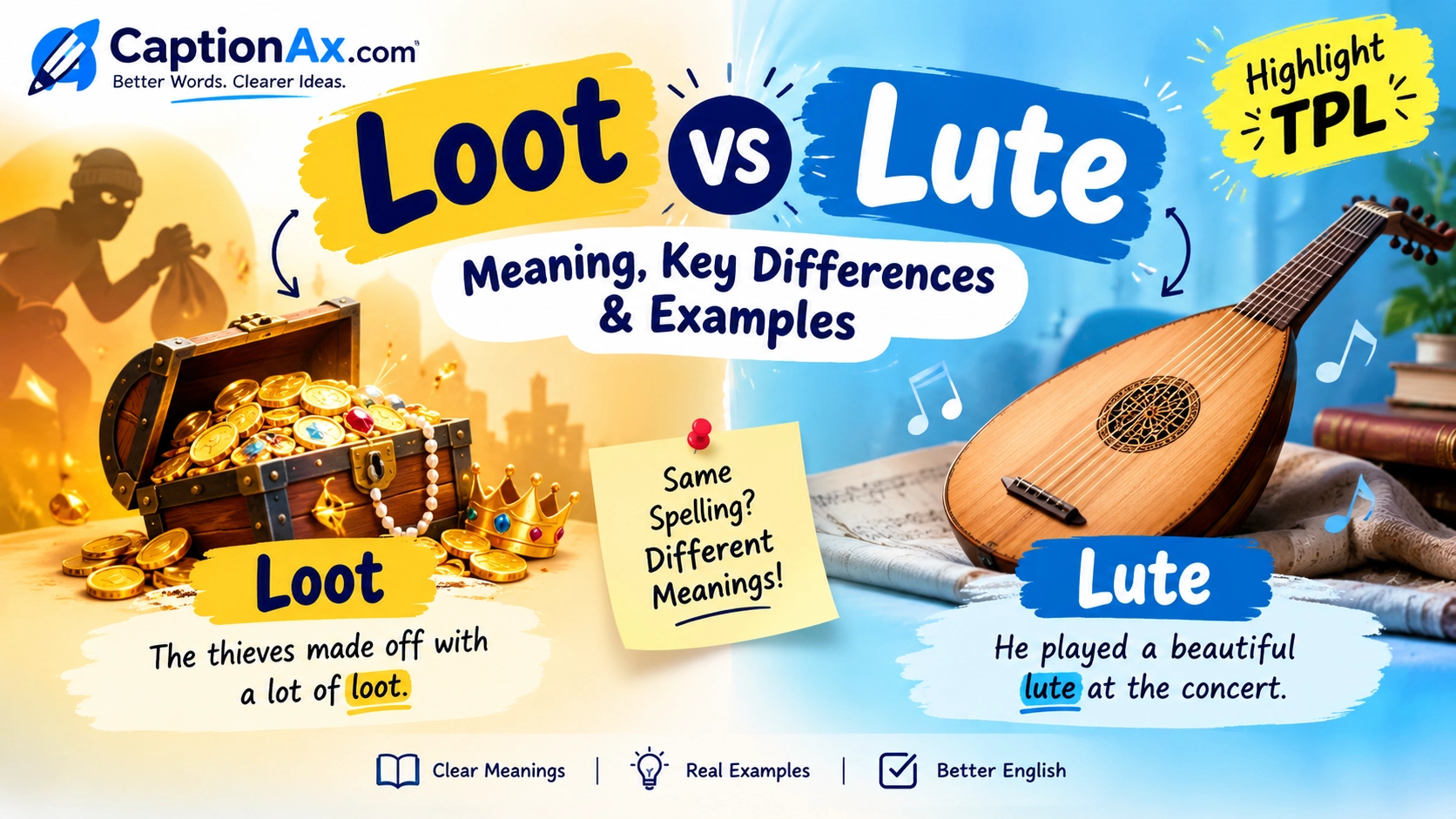
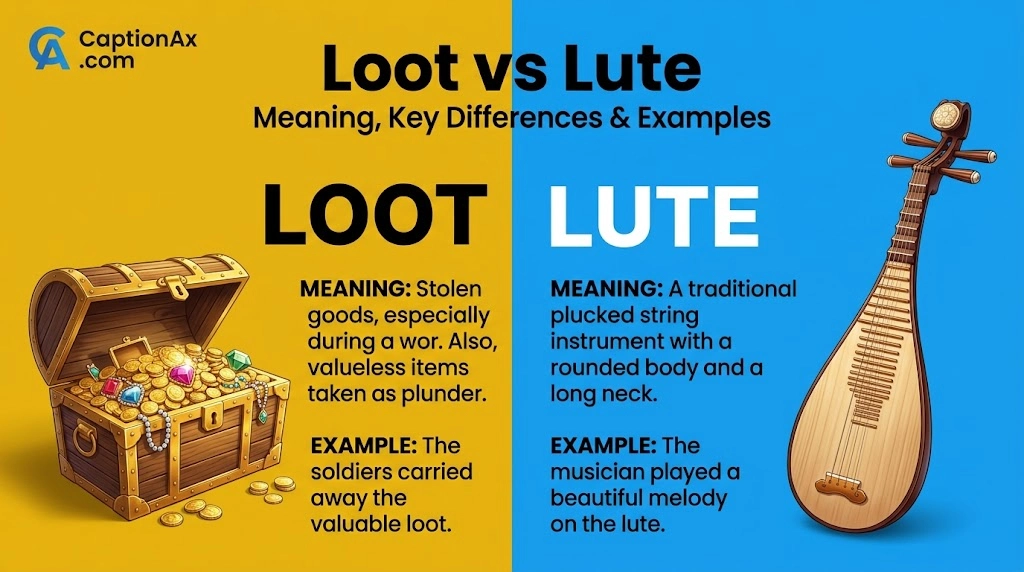
Loot refers to stolen valuables, plunder, or items collected as rewards in a video game. It can function as both a noun and a verb. Lute, on the other hand, is a traditional stringed musical instrument played by plucking its strings.
For example, a gamer might collect rare loot after defeating an enemy, while a musician might play a beautiful melody on a lute. Both words are correct, but each belongs in a different context.
In this guide, you’ll learn the difference between loot and lute, their definitions, pronunciation, grammar, origins, and practical sentence examples. You’ll also discover common spelling mistakes, an easy memory trick, and a short quiz to test your understanding.
Loot vs Lute: What Is the Difference?
The main difference between loot and lute is their meaning. Loot means stolen valuables, plunder, or game rewards, whereas a lute is a stringed musical instrument.
- Loot: A noun referring to stolen goods or valuable game items; also a verb meaning to steal or plunder.
- Lute: A noun naming a traditional stringed instrument played by plucking its strings.
Consider these examples:
- The adventurers divided the loot after defeating the bandits.
- The musician played a traditional melody on the lute.
In the first sentence, loot refers to valuables. In the second, lute refers to a musical instrument.
Both words can appear in the same sentence: “The rogue collected the loot while the bard played a lute.”
Easy rule: Collect loot, but play a lute.
What Does Loot Mean?
Loot means stolen goods, valuables taken by force, or items obtained as rewards in a video game. As a verb, it means to steal goods or plunder a place.
The word appears in crime reporting, historical accounts, adventure stories, and gaming discussions.
Loot as a noun
As a noun, loot commonly refers to stolen valuables or a collection of rewards. It is generally used as an uncountable noun.
Examples:
- The police recovered the stolen loot.
- The pirates divided their loot among the crew.
- The treasure chest contained gold and other loot.
- I found rare loot after completing the quest.
- The players collected valuable loot after defeating the boss.
In gaming, loot can include weapons, coins, armor, equipment, and other items that help a character progress.
Loot as a verb
As a verb, loot means to steal goods or plunder a location.
Examples:
- The thieves attempted to loot the warehouse.
- The robbers looted the abandoned building.
- The authorities worked to prevent people from looting shops.
- The raiders looted the settlement.
The verb often has a negative meaning when it describes real theft or destruction. In gaming, however, collecting loot is usually a normal part of gameplay.
When to use loot: Choose it when your sentence concerns stolen valuables, plunder, treasure, or video game rewards.
What Does Lute Mean?
A Lute is a stringed musical instrument with a rounded body, a soundboard, and a neck. It is played by plucking the strings and is especially associated with historical European music.
The Western lute has a close historical relationship with the Arabic ʿūd, another plucked string instrument. The lute became particularly prominent in European music during the Renaissance.
What does a lute look like?
A traditional lute typically has:
- A rounded, bowl-shaped back.
- A flat front or soundboard.
- A neck with strings running along it.
- Strings that are plucked to produce musical notes.
Its distinctive shape makes it different from many modern string instruments, although it shares some broad characteristics with instruments such as guitars.
How is a lute used?
Musicians use lutes to perform melodies, accompaniment, and other musical passages. The instrument appears in historical performances, early-music ensembles, museums, and discussions of traditional music.
Examples:
- The musician tuned the lute before the concert.
- She learned to play the lute for a Renaissance music performance.
- The museum displayed an antique lute.
- The historical novel described a performer carrying a lute.
- The composer wrote music for voice and lute.
When to use lute: Choose this word when discussing music, musicians, strings, historical instruments, or performances.
Loot vs Lute: Quick Comparison Table
Use this table to distinguish the two words at a glance.
| Feature | Loot | Lute |
| Meaning | Stolen valuables, plunder, or game rewards | A stringed musical instrument |
| Part of speech | Noun and verb | Primarily a noun |
| Pronunciation | Commonly /luːt/ | Commonly /luːt/ |
| Common context | Theft, treasure, gaming | Music, instruments, history |
| Related forms | Looted, looting | Lutes, lute player |
| Example | The player found rare loot. | The musician played the lute. |
| Memory clue | Collect loot | Play a lute |
The central distinction is meaning, not simply spelling or sound. Both are established English words, but they cannot be substituted for each other when their meanings differ.
Are Loot and Lute Homophones?
Yes. Loot and lute are commonly treated as homophones because they share the same pronunciation in many varieties of English while having different spellings and meanings.
A homophone is a word that sounds the same as another word but differs in spelling, meaning, or both.
Here are some familiar examples:
| Word pair | Meaning |
| Loot / lute | Stolen valuables / musical instrument |
| Knight / night | A warrior / the dark period between days |
| Flour / flower | A baking ingredient / a plant’s bloom |
| Sea / see | A body of salt water / to perceive with your eyes |
| Right / write | Correct or a direction / to form words |
Homophones can cause spelling mistakes because hearing a word alone may not tell you which spelling is intended.
For example:
- “The player found some loot” refers to game rewards.
- “The player performed on a lute” refers to a musical instrument.
Context helps resolve the difference, even when the spoken words sound identical.
Loot vs Lute Pronunciation Guide
Both words are commonly pronounced /luːt/ in standard British English and many American English contexts. Cambridge Dictionary lists this pronunciation for both words, although alternative American pronunciations of loot also occur.
Break the common pronunciation into three sounds:
- /l/ — the opening sound in look.
- /uː/ — the long vowel sound in blue.
- /t/ — the final sound in top.
Put them together: L + OO + T.
Because the words are often pronounced alike, listening alone may not help you choose the correct spelling.
Words that rhyme with loot and lute
In accents where the words share the same pronunciation, they rhyme with:
- Boot
- Root
- Shoot
- Flute
- Suit
How to choose the right spelling
Ask yourself what the sentence describes.
- If it involves stolen valuables or gaming rewards, use loot.
- If it involves a stringed musical instrument, use lute.
Meaning is the most reliable spelling clue.
How to Use Loot in a Sentence
Use loot when describing stolen valuables, plunder, or items collected during a game. As a verb, it describes the act of stealing or plundering.
Examples of loot as a noun
- The police recovered the stolen loot.
- The pirates divided their loot among the crew.
- The treasure chest contained gold and other loot.
- I found rare loot in the dungeon.
- The game rewarded players with loot after the battle.
- The thieves escaped with the loot.
- The explorer discovered a hidden cache of valuables and loot.
- The players sorted their loot after the mission.
- The stolen loot was returned to its rightful owner.
- The boss dropped legendary loot.
Examples of loot as a verb
- The thieves planned to loot the store.
- The robbers looted the abandoned building.
- The raiders looted the settlement.
- The authorities arrested people who had looted nearby shops.
- The criminals attempted to loot the warehouse.
A simple substitution test
Try replacing loot with “stolen goods,” “plunder,” or “valuable rewards.” If the sentence still communicates your intended meaning, loot may be the correct word.
For example:
- Original: The player collected valuable loot.
- Substitution: The player collected valuable rewards.
The meaning remains clear in the gaming context.
How to Use Lute in a Sentence
Use lute when referring to the musical instrument. It commonly appears in writing about musicians, historical settings, traditional instruments, and performances.
Example sentences using lute
- The musician played a melody on the lute.
- She bought a lute to study Renaissance music.
- The museum displayed an intricately decorated lute.
- The performer carefully tuned the lute’s strings.
- The historical novel described a musician carrying a lute.
- He listened to a recording of solo lute music.
- The teacher explained how a lute differs from a modern guitar.
- The composer wrote music for voice and lute.
- The student practiced playing the lute every afternoon.
- The instrument’s rounded body gave it a distinctive appearance.
A simple substitution test
Replace lute with “musical instrument.” If the sentence retains its intended meaning, lute is likely the correct choice.
For example:
- Original: The performer played a lute.
- Substitution: The performer played a musical instrument.
The second sentence is broader, but the meaning still fits.
Loot vs Lute in Gaming and Historical Writing
The surrounding subject often makes the correct spelling obvious. This is particularly helpful when writing gaming guides, fantasy stories, or historical articles.
In video games
Loot refers to items a player obtains during gameplay, such as coins, weapons, armor, equipment, and other rewards.
Examples:
- The boss dropped legendary loot.
- Players searched the dungeon for loot.
- The character lost all the loot after the battle.
- She upgraded her equipment using the loot she collected.
Using lute in these examples would be incorrect if you mean game rewards.
In historical writing
Lute is appropriate when discussing musicians, traditional instruments, and historical performances.
Examples:
- The royal musician performed a song on a lute.
- The exhibition included a Renaissance lute.
- The story described music played in a medieval court.
- The historian examined a lute preserved in a museum.
In fantasy fiction
Both words can appear naturally in the same story:
“The rogue gathered the loot while the bard played a lute beside the campfire.”
Here, loot refers to the valuables and lute identifies the instrument. The surrounding context makes both meanings clear.
- Explore More: https://captionax.com/traveled-or-travelled/
Common Loot vs Lute Mistakes
The most frequent mistake is choosing a spelling based on sound instead of meaning.
| Incorrect wording, if the intended meaning is shown | Correct wording | Reason |
| The musician played the loot. | The musician played the lute. | The sentence refers to an instrument. |
| The gamer collected rare lute. | The gamer collected rare loot. | The sentence refers to game rewards. |
| The performer tuned his loot. | The performer tuned his lute. | The instrument has strings to tune. |
| The pirates divided the lute. | The pirates divided the loot. | The intended meaning is valuables. |
| The musician carried his loot to the concert. | The musician carried his lute to the concert. | The intended meaning is an instrument. |
There is an important qualification: a lute can itself be stolen or included among someone’s loot.
For example, “The thief stole the lute” and “The thief escaped with the loot, including a lute” are both correct sentences.
Why these mistakes happen
- Sound-based spelling: The words sound alike in many accents.
- Unfamiliar vocabulary: Some readers know loot but have never encountered a lute.
- Fast typing: Writers may choose the wrong spelling without reviewing the sentence.
- Missing context: A short sentence may not reveal which meaning is intended.
The solution is simple: check the intended meaning before finalizing the spelling.
Easy Ways to Remember Loot vs Lute
You do not need to memorize complicated grammar rules to distinguish these words. Use a simple association.
Loot = valuables
Think of treasure chests, stolen goods, coins, and video game rewards.
Memory phrase: “Collect the loot.”
Lute = music
Think of strings, melodies, musicians, and historical performances.
Memory phrase: “Play the lute.”
A three-second spelling test
Ask yourself:
- Am I talking about stolen goods, treasure, or game rewards? Write loot.
- Am I talking about a stringed musical instrument? Write lute.
- Could either meaning fit? Read the complete sentence and choose the word that expresses your intention.
The short rule is easy to remember: Loot is collected; a lute is played.
Loot vs Lute: Grammar Rules and Word Forms
Understanding grammar makes it easier to use each word naturally.
Loot: noun and verb forms
Loot is commonly an uncountable noun when referring to stolen goods or a collection of game rewards.
Examples:
- The loot was recovered.
- The players collected valuable loot.
- The loot included several rare items.
As a verb, its common forms are:
| Form | Example |
| Base form: loot | They loot the abandoned store. |
| Third-person singular: loots | The character loots the chest. |
| Past tense: looted | The thieves looted the building. |
| Present participle: looting | The group was looting the store. |
Lute: noun forms
Lute is a countable noun.
- Singular: a lute
- Plural: lutes
- Related phrase: lute player
- Related phrase: lute music
Examples:
- The museum owns a lute.
- The musicians played two lutes.
- She studied the history of the lute.
- Several lute players performed at the festival.
In everyday English, lute is not used as a substitute for the verb loot. If you want to describe stealing valuables, use loot, looted, or looting as appropriate.
Where Do Loot and Lute Come From?
Although loot and lute sound similar, their histories are different.
Origin of loot
The English word loot entered English through South Asian usage and is associated with Hindi lūṭ, meaning plunder or stolen property. The word became established in English in the late eighteenth century and later developed additional uses.
Today, loot appears in historical accounts of plunder, crime reporting, and video games.
Origin of lute
The English word Lute developed through older European language forms, including Middle English and Old French, and is ultimately associated with the Arabic name al-ʿūd for a related stringed instrument.
The Metropolitan Museum of Art explains the historical relationship between the Western lute and the Arabic ʿūd. The lute became particularly important in European music during the Renaissance.
Their different histories help explain why these words have unrelated meanings despite their similar pronunciation.
Loot vs Lute Practice Quiz
Test what you have learned. Choose the correct word for each sentence, then check your answers.
- The musician played a beautiful ___ during the concert.
a) Loot
b) Lute - The gamer found rare ___ after defeating the boss.
a) Loot
b) Lute - The thieves escaped with the stolen ___.
a) Loot
b) Lute - The performer carefully tuned the strings of the ___.
a) Loot
b) Lute - They ___ the abandoned building.
a) Looted
b) Luted
Answer key
- Lute — A musical instrument is played during a concert.
- Loot — The gamer obtained rewards.
- Loot — The sentence refers to stolen valuables.
- Lute — The instrument has strings that can be tuned.
- Looted — This is the past tense of the verb meaning to plunder.
Score guide
- 5 correct: Excellent! You understand the distinction.
- 3–4 correct: Good work. Review the context clues.
- 0–2 correct: Revisit the comparison table and try again.
People Also Ask
A:Loot means stolen valuables, plunder, or rewards collected in a game. A lute is a stringed musical instrument. The correct word depends on what your sentence describes.
A:They are commonly pronounced alike in British English and many other English varieties. However, some American pronunciations of loot differ, so pronunciation can depend on the speaker’s accent.
A:Loot can be both. As a noun, it refers to stolen goods or game rewards. As a verb, it means to steal or plunder.
A:Lute is primarily a noun in everyday English. It names a stringed musical instrument played by plucking its strings.
A:The plural is lutes. For example: “The museum displayed several historical lutes.”
Conclusion
The difference between Loot vs Lute becomes simple once you connect each spelling with its meaning. Loot refers to stolen valuables, plunder, or rewards collected in games, and it can function as both a noun and a verb. Lute refers primarily to a stringed musical instrument associated with traditional and historical music.
Because the words are commonly pronounced alike, sound alone may not reveal which spelling you need. Context is the key.
Remember “collect loot, play a lute,” and you will be able to distinguish these commonly confused words with confidence. For more practical English spelling guides, explore related word comparisons on CaptionAx.com.