Bailer or Baler? Meaning, Spelling, Differences & Examples
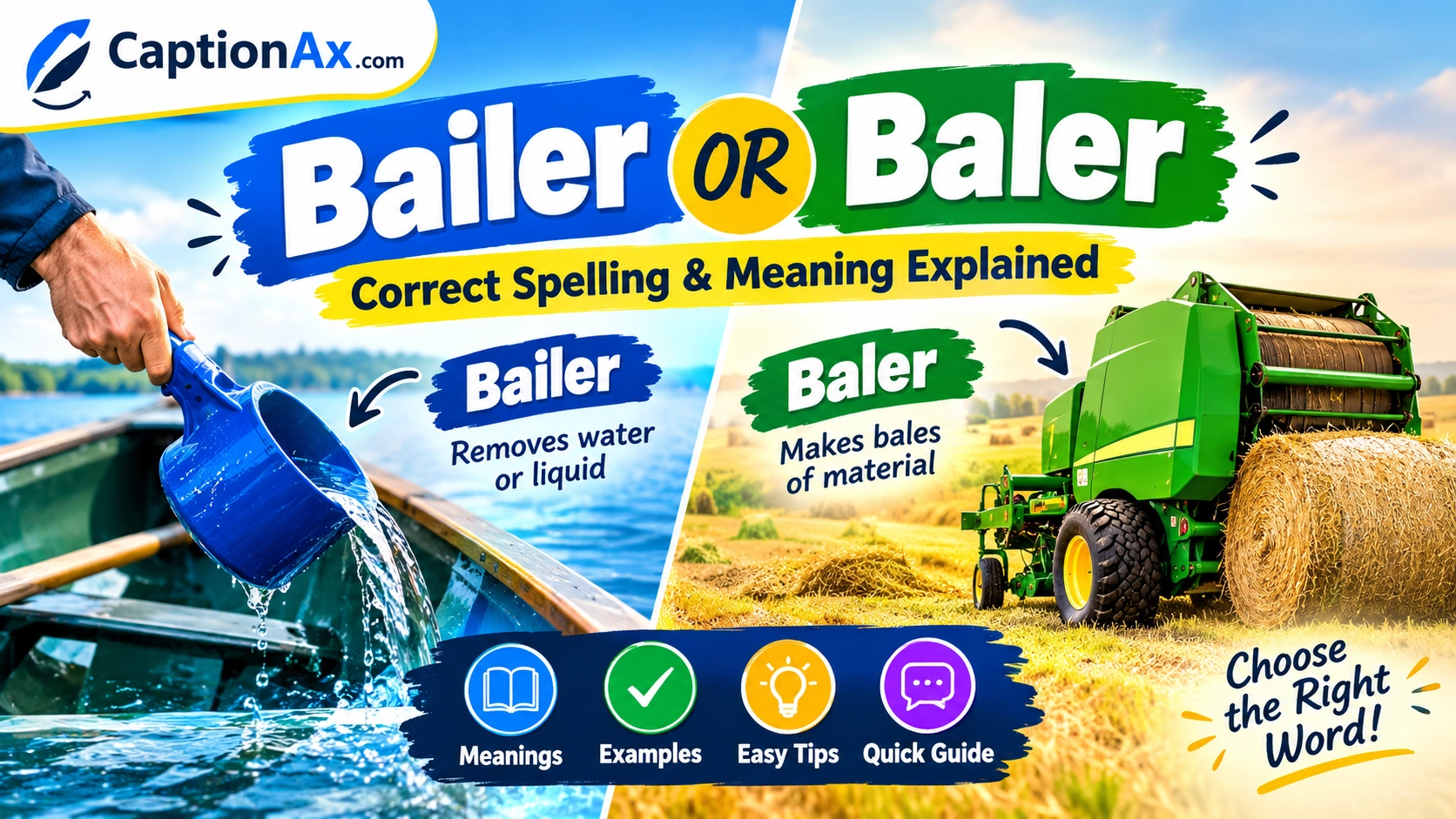
Have you ever wondered whether the correct word is Bailer or Baler? Although these words look and sound almost identical, they have different meanings. A baler is a machine that compresses materials such as hay, straw, paper, or cardboard into compact bundles called bales. A bailer is a person or device associated with bailing, especially removing water from a boat.
The correct spelling depends on what you want to describe. If you are writing about agricultural machinery or recycling equipment, baler is the right choice. If you mean a tool used to remove water from a canoe, bailer is appropriate.
The easiest way to remember the distinction is to connect each word to its root: bale → baler and bail → bailer. This guide explains both meanings, shows how to use each word in a sentence, and covers common spelling mistakes so you can choose confidently.
Bailer or Baler: Which Spelling Is Correct?
Both bailer and baler are correct English words, but they are not interchangeable.
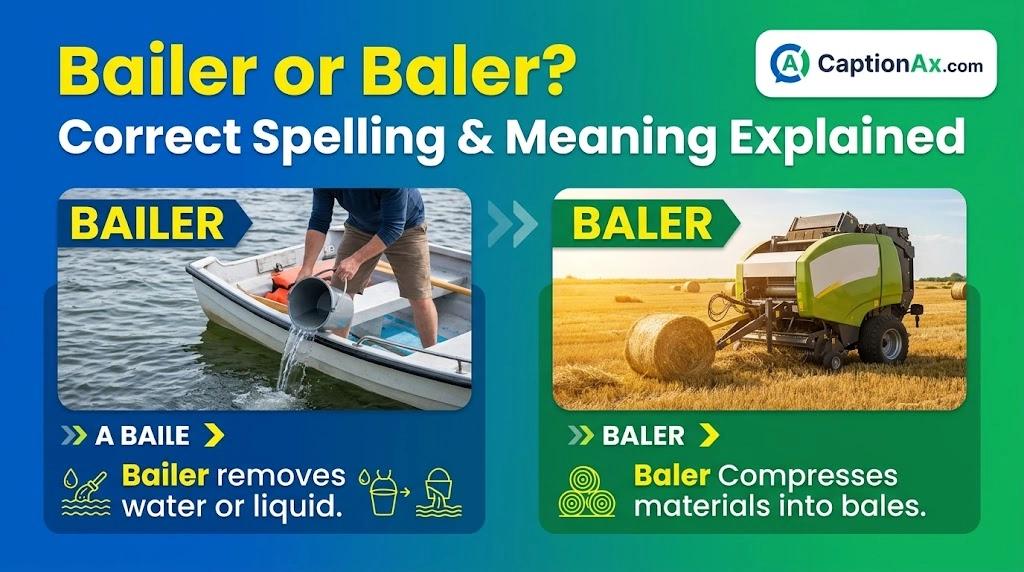
- Baler: A machine or person that forms materials into compact bales.
- Bailer: A person or device that bails something out, especially water.
For example, a farmer uses a hay baler to prepare crops for storage, while a sailor may use a bailer to remove water from a small boat. Cambridge Dictionary confirms the standard machinery meaning of baler.
Consider these sentences:
- Correct: The farmer repaired the hay baler.
- Correct: The sailor used a bailer to empty the canoe.
- Incorrect for the intended meaning: The farmer repaired the hay bailer.
- Incorrect for the intended meaning: The sailor used a baler to remove water.
Quick rule: Use baler for making bales and bailer for bailing water.
What Does Baler Mean?
A baler is a machine used to compress loose materials into compact bundles called bales. It is commonly used in agriculture, recycling, manufacturing, and waste management.
The machine makes materials easier to store, handle, and transport. Depending on its design, a baler may produce round or rectangular bales.
Common examples include:
- Hay baler: Compresses dried grass into bales for storage or livestock feed.
- Straw baler: Collects and bundles straw after harvesting.
- Cardboard baler: Compresses discarded cardboard for recycling.
- Paper baler: Forms waste paper into compact bundles.
- Cotton baler: Compresses cotton for handling and transportation.
Example sentence: The farm purchased a new baler to prepare the hay for winter.
In this sentence, baler is correct because the machine forms material into bales. Oxford Learner’s Dictionaries also defines the word in relation to machinery used for making bales.
What Does Bailer Mean?
A bailer is generally a person or device that performs the action of bailing. In everyday physical contexts, it is often associated with removing unwanted water from a boat or container.
The term can also be used in technical work. For example, a well bailer may be lowered into a groundwater monitoring well to collect a liquid sample.
Examples of bailer usage include:
- The sailor kept a bailer inside the canoe.
- We used a plastic bailer to remove rainwater from the boat.
- The crew checked the boat’s water-removal equipment before departure.
- The environmental technician used a well bailer to collect a water sample.
The exact design and purpose depend on the context. A simple boat bailer may be a scoop or container, while a sampling bailer is designed for retrieving liquid from a well.
Remember that bailer does not ordinarily refer to a machine that compresses hay, paper, or cardboard.
Bailer vs. Baler: Key Differences at a Glance
| Feature | Bailer | Baler |
| Main meaning | A person or device that bails | A person or machine that makes bales |
| Root word | Bail | Bale |
| Typical function | Removes or collects liquid | Compresses material into bundles |
| Common Settings | Boating and groundwater sampling | Agriculture, recycling, industry |
| Example | Boat bailer | Hay baler |
| Related action | Bailing | Baling |
| Example sentence | The bailer removed water from the canoe. | The baler compressed the hay. |
The most important distinction is the action each word describes. A bailer is associated with bailing, whereas a baler is associated with making bales.
Because the two words are pronounced alike in many English accents, understanding their meanings is more reliable than trying to distinguish them by sound.
When Should You Use a Baler?
Use baler when referring to equipment or a person that forms material into bales.
This spelling is especially common in farming, recycling facilities, warehouses, and industrial operations.
Examples:
- The farmer inspected the hay baler before harvest.
- The recycling center installed a new cardboard baler.
- The operator repaired the straw baler.
- Our warehouse uses an industrial baler to compress packaging waste.
- The agricultural supplier sells round balers and square balers.
Common expressions include hay baler, straw baler, round baler, square baler, paper baler, and cardboard baler.
If the machine’s purpose is to compress loose material into bundles, baler is the standard spelling.
When Should You Use Bailer?
Use bailer when referring to someone or something that bails, especially when removing water.
The surrounding sentence usually makes the intended meaning clear.
Examples:
- Keep a bailer in the canoe in case water collects inside.
- The sailor grabbed the bailer after rain filled the boat.
- We used a small bailer to empty the dinghy.
- The technician lowered a bailer into the monitoring well.
- The crew checked that the bailer was accessible.
Common expressions include boat bailer, canoe bailer, manual bailer, automatic bailer, and well bailer.
The Correct Term depends on the device and its function. For example, a boat bailer removes water, while a well bailer may collect a liquid sample.
Bailer or Baler: Correct Sentence Examples
Sentence examples make the difference easier to understand.
| Example sentence | Correct word | Reason |
| The farmer purchased a new hay ___. | Baler | It makes hay bales. |
| We grabbed the ___ to remove water from the canoe. | Bailer | It removes water. |
| The recycling plant needs cardboard ___. | Baler | It compresses cardboard. |
| The technician lowered a ___ into the well. | Bailer | It can collect a liquid sample. |
| The farm worker repaired the straw ___. | Baler | It bundles straw. |
| The sailor stored a ___ near the seat. | Bailer | It can help remove water. |
| The warehouse installed a paper ___. | Baler | It compresses paper waste. |
| The boat’s ___ was missing. | Bailer | The context indicates water-removal equipment. |
Test your understanding
Choose the correct word for each sentence.
1. The farmer bought new hay ___.
Bailer
Baler
2. We used a ___ to remove water from the canoe.
Bailer
Baler
3. The factory uses cardboard ___.
Bailer
Baler
Check answers
Common Spelling Mistakes to Avoid
The two words differ by just one letter, which makes them easy to confuse.
Mistake 1: Writing “hay bailer” for agricultural machinery
Incorrect: The farmer used a hay bailer to bundle the crop.
Correct: The farmer used a hay baler to bundle the crop.
Why? The machine compresses hay into bales.
Mistake 2: Writing “boat baler” for water-removal equipment
Incorrect: Keep a baler in the canoe to remove water.
Correct: Keep a bailer in the canoe to remove water.
Why? The tool removes water rather than producing bales.
Mistake 3: Assuming one word is always wrong
Both spellings are legitimate. The mistake occurs when a writer chooses the word that does not match the intended meaning.
Mistake 4: Relying on pronunciation alone
Since the words often sound alike, listening does not reliably tell you which spelling to use. Identify the action first.
Mistake 5: Confusing bailer with bailor
Bailor is a separate legal term used for someone who transfers possession of property to another party under a bailment arrangement. It should not automatically be replaced with bailer in legal writing.
- Explore More: https://captionax.com/eying-or-eyeing/
Why Are Bailers and Baler Confused?
There are three main reasons these words are frequently mixed up.
First, their spellings are almost identical. Both words contain the same general letter pattern, with only one letter distinguishing them.
Second, they are homophones in many accents. This means they sound alike even though their spellings and meanings differ.
Third, both words describe a person or device associated with an action. Without knowing the underlying words bail and bale, it is easy to choose the wrong form.
The solution is to focus on meaning:
- Is the object removing water? Consider bailers.
- Is the machine compressing material into bundles? Use baler.
This approach is more dependable than memorizing the words as unrelated spellings.
How to Remember Bailer vs. Baler
Use this simple memory trick:
BAIL → BAILER
Remove or bail out water.
Think of a canoe bailer.
BALE → BALER
Make compact bundles of material.
Think of a hay baler on a farm.
Memorize the base word before the longer word. Once you know whether the action involves bailing or baling, the spelling becomes easier to remember.
Baler in Farming, Recycling, and Industry
Balers are used across several industries because compact bundles can be easier to store, handle, and transport.
Agriculture
Farmers use balers to compress hay, straw, and other suitable crop materials. Different machines produce different bale shapes and sizes.
Example: The farmer used a round baler to collect the dried grass.
Recycling
Recycling facilities use balers to compress materials such as cardboard and paper. This helps businesses manage recyclable waste more efficiently.
Example: The recycling center installed a cardboard baler to handle packaging waste.
Manufacturing and warehousing
Industrial Balers can compact suitable waste materials to reduce the space they occupy.
Example: The warehouse uses an industrial baler to compress discarded cardboard boxes.
Across these applications, the defining feature remains the same: a baler makes bales.
Bailer in Boating and Technical Work
A bailer is associated with removing or collecting liquid, although its design varies by application.
Boating
A boat bailer may be a scoop, container, or purpose-built device used to remove unwanted water from a vessel.
Example: The crew checked that the boat’s bailer was ready before departure.
Canoeing and small vessels
A handheld bailer can help remove water that splashes or leaks into a canoe.
Example: She used a plastic bailer to empty the canoe after heavy rain.
Groundwater sampling
In environmental monitoring, a sampling bailer can be lowered into a well to retrieve water for testing.
Example: The technician used a well bailer to collect a groundwater sample.
These uses share a connection to bailing or retrieving liquid, not to compressing material into bundles.
Is Bailer or Baler Different in American and British English?
The basic distinction is not an American-versus-British spelling difference. Baler is the standard term for a machine that forms materials into bales in both varieties of English.
The word bailer is associated with bailing, particularly removing water, and also has additional specialized uses.
British English has some variation in the use of the verb bale for removing water from a boat. However, this does not make bailer an alternative spelling for agricultural or recycling machinery.
For international audiences, use the word that matches the intended action and include the specific context when needed.
People Also Ask
A:Both are correct English words. Use baler for a machine that makes bales and bailer for a person or device that bails, especially water.
A:Hay baler is the standard expression. It refers to agricultural machinery that compresses hay into bales.
A:A bailer commonly removes water from a boat or another space. In technical settings, a sampling bailer may also be used to collect liquid from a well.
A:They sound alike in many English accents. Because pronunciation may not distinguish them, use the meaning and context to choose the correct spelling.
A:A bailer can be a tool or device, depending on its purpose. A boat bailer removes water, while a well bailer may collect liquid samples.
Final Verdict
The choice between Bailer and Baler becomes straightforward once you understand their meanings.
- Bailer: A person or device that bails, especially one used to remove water or collect liquid.
- Baler: A person or machine that forms materials into compact bales.
Use baler when writing about hay, straw, cardboard, paper, or recycling equipment. Choose bailer when discussing water-removal tools or relevant liquid-sampling devices.
The simplest memory trick is bail → bailer; bale → baler. Rather than guessing from pronunciation, identify the action first and let the meaning guide your spelling.
If you are exploring other commonly confused English words, continue with related spelling and usage guides on CaptionAx.com.