Eying or Eyeing? Meaning, Spelling Rules & Examples
Have you ever started writing a sentence and wondered whether it should be Eying or Eyeing? The confusion makes sense: English often drops a silent e before adding -ing, yet this word has two accepted spellings.
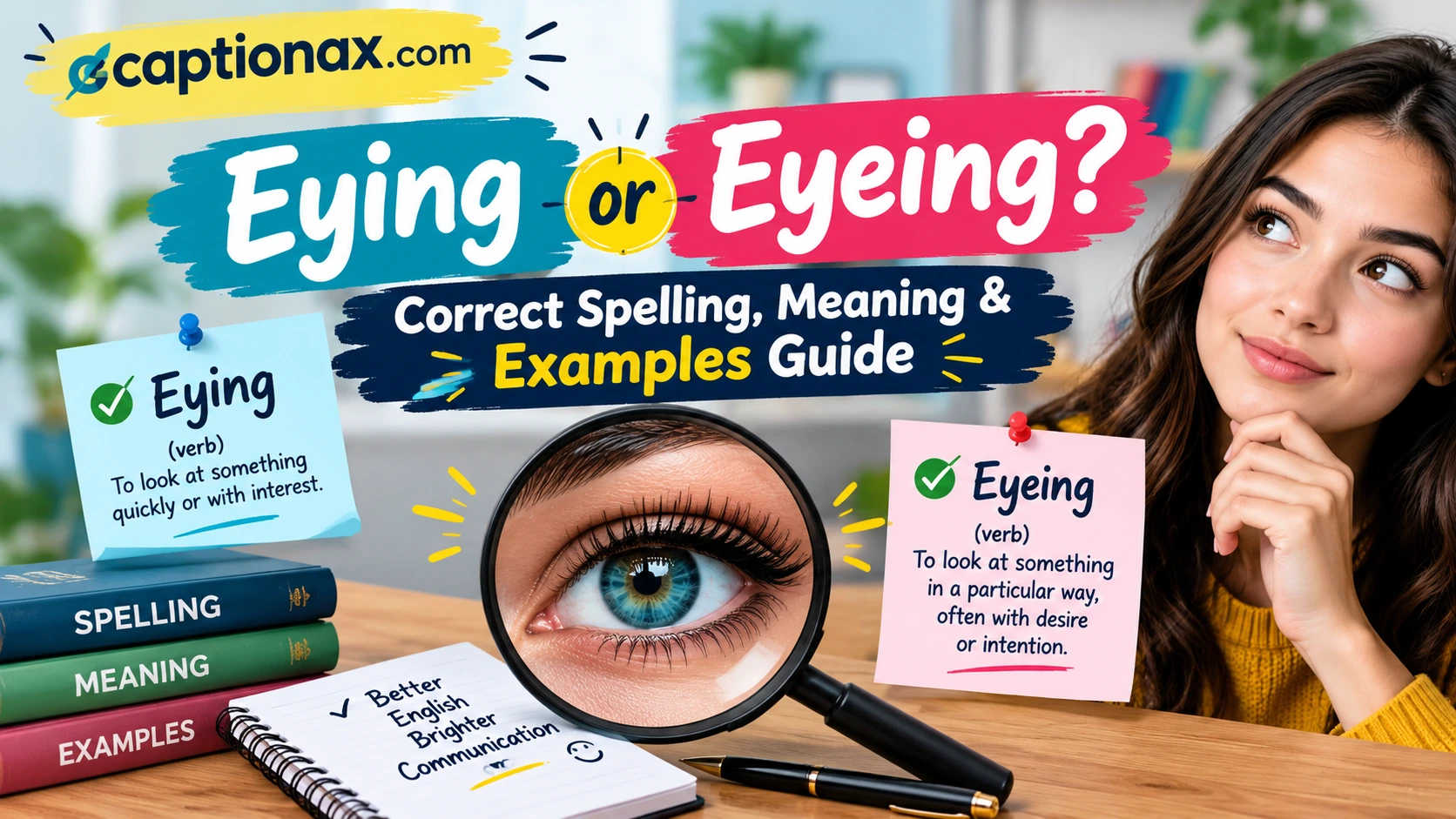
The good news is that both eyeing and eying are correct. They are alternative forms of the verb eye, meaning to look at someone or something with particular attention, interest, curiosity, or suspicion. The two spellings have the same basic meaning and pronunciation.
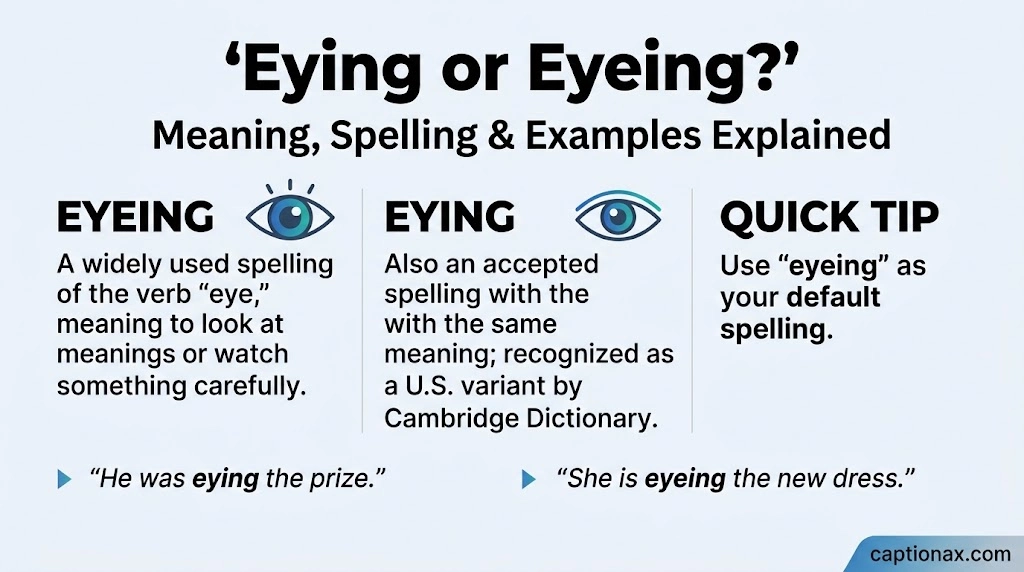
For everyday writing, eyeing is a practical default because it keeps the base word eye visible and is easy for readers to recognize. However, eying is not automatically a spelling mistake. Cambridge Dictionary identifies it as a U.S. alternative, while Merriam-Webster recognizes both forms.
Whether you are writing an essay, publishing a blog post, sending a professional email, or checking a sentence, understanding this small spelling difference can help you write with confidence. This guide explains the definitions, grammar, regional usage, examples, and simple ways to remember the correct form for your needs.
Eying or Eyeing: The Quick Answer
Both eying and eyeing are accepted spellings of the present participle of the verb eye. They mean looking at someone or something with attention, interest, or suspicion.
- Eyeing: A familiar spelling and a practical default for general writing.
- Eying: An accepted alternative, identified by Cambridge as a U.S. form.
- Meaning: The same basic meaning in both cases.
- Pronunciation: Both are pronounced approximately EYE-ing.
For example:
- She was eyeing the last piece of chocolate cake.
- She was eying the last piece of chocolate cake.
Both sentences are acceptable and communicate the same idea.
What Does Eyeing Mean?
Eyeing means looking at, watching, or considering someone or something with particular attention. Depending on the context, it can suggest curiosity, interest, desire, suspicion, or careful assessment.
The word comes from the verb eye. When someone eyes an object, they do more than simply see it: they focus on it or consider it in some way.
For example:
- Interest: He was eyeing a new laptop at the electronics store.
- Desire: The child was eyeing the cookies on the table.
- Suspicion: The detective was eyeing the stranger carefully.
- Opportunity: The company is eyeing expansion into another market.
- Competition: Both players were eyeing the championship trophy.
The context determines the precise implication. Eyeing a dessert may suggest that someone wants to eat it, while eyeing a suspicious package may suggest concern.
What Does Eying Mean?
Eying has the same basic meaning as eyeing. It is an alternative spelling of the present participle of eye, not a separate word with a different definition.
Consider these examples:
- He was eying the bicycle in the shop window.
- Investors are eying opportunities in renewable energy.
- The players were eying each other cautiously.
- She is eying a promotion at work.
You can replace eying with eyeing in each sentence without changing the intended meaning.
The distinction is primarily spelling preference and usage. If you encounter eying in a book, article, or online post, you should not automatically assume that the writer has made an error.
Eyeing vs. Eying: Key Differences at a Glance
| Feature | Eyeing | Eying |
| Accepted spelling? | Yes | Yes |
| Base verb | Eye | Eye |
| Basic meaning | Looking at or considering | Looking at or considering |
| Pronunciation | EYE-ing | EYE-ing |
| Grammatical use | Present participle or gerund | Present participle or gerund |
| Dictionary recognition | Recognized | Recognized |
| Practical choice for general writing | Recommended default | Accepted alternative |
The key takeaway is simple: the meaning does not change when you switch between eyeing and eying. For consistent, reader-friendly writing, choose eyeing unless your preferred dictionary or publication style guide specifies otherwise.
Why Are Both Spellings Accepted?
English spelling follows patterns, but those patterns do not always produce a single accepted form.
Many verbs ending in a silent e drop that letter before adding -ing:
- Make → making
- Write → writing
- Hope → hoping
- Dance → dancing
Following this familiar pattern, a writer might expect the eye to become eying. That spelling is indeed recognized.
However, Eyeing is also established in English. It preserves the recognizable base word eye, making the connection between the spelling and its meaning immediately apparent.
Both forms are accepted, so you should not rely on a general spelling rule alone to decide that one must be wrong. When a word has established variants, a reputable dictionary is a more reliable guide.
Is Eyeing or Eying More Common?
For general writing, eyeing is a sensible default. It preserves the visible base word eye and provides a familiar spelling for a broad audience.
However, recognizing both spellings and measuring their frequency are two different things. A dictionary can establish that a form is accepted without proving exactly how often it appears in books, newspapers, or websites.
If you need verified frequency comparisons, use a suitable language corpus or published usage data rather than relying on assumptions.
For practical purposes:
- Use eyeing in articles, essays, emails, and professional documents when no other style rule applies.
- Accept eying when it follows a publication’s established style or appears in quoted material.
- Maintain one spelling consistently throughout a piece of writing.
Consistency improves readability without requiring you to label a recognized variant incorrect.
Eyeing vs. Eying in American and British English
Regional usage can add to the confusion, but the available dictionary evidence should be interpreted carefully.
Cambridge labels eying as a U.S. alternative to eyeing. This establishes that the form is recognized in U.S. usage; it does not prove that all American writers prefer it or that writers elsewhere never use it.
For an international audience, eyeing is a straightforward default. If you are writing for a particular newspaper, university, publisher, or business, check its style guide for the preferred spelling.
The most useful rule is to distinguish a dictionary’s regional label from an absolute rule that supposedly applies to every English speaker.
Eyeing in a Sentence: 10 Clear Examples
These examples demonstrate how eyeing works across different situations.
- Food: She was eyeing the freshly baked cookies on the counter.
- Shopping: He is eyeing a new laptop for college.
- Career: Maria is eyeing a senior management position.
- Business: The company is eyeing expansion into Europe.
- Suspicion: The detective was eyeing the suspect carefully.
- Competition: Both athletes were eyeing the championship trophy.
- Travel: We are eyeing a quiet beach destination for our holiday.
- Real estate: They are eyeing a larger house outside the city.
- Investment: The startup is eyeing a new funding opportunity.
- Curiosity: The child kept eyeing the mysterious box.
In every example, the word conveys focused attention or consideration. The surrounding sentence determines whether that attention suggests desire, curiosity, suspicion, or a possible future decision.
When Should You Use Eyeing in Everyday and Formal Writing?
Both spellings are recognized, but using a consistent form makes your writing easier to follow.
Choose eyeing as your default in:
- Academic assignments: The student was eyeing the clock during the examination.
- Professional emails: We are eyeing several options for the upcoming project.
- Business reports: The organization is eyeing expansion into new markets.
- Blog posts: Shoppers are eyeing the latest seasonal offers.
- News and editorial content: Investors are eyeing the company’s next announcement.
- Everyday messages: I’m eyeing that slice of pizza.
You can also use Eying when it matches the style you are following. The important point is not to confuse a preference for one spelling with a rule that makes the alternative universally incorrect.
Common Spelling Mistakes to Avoid
1. Assuming eying is always wrong
Both forms are recognized by reputable dictionaries. Use eyeing as a default, but do not automatically mark eying as an error.
2. Assuming the words have different meanings
They share the same basic meaning. The difference lies in spelling, not in the action being described.
3. Switching between both forms unnecessarily
Writing eyeing in one paragraph and eying in another can distract readers. Choose a consistent form for the article.
4. Confusing eyeing with eyed
Eyeing describes an ongoing action or functions as a gerund. Eyed is the past-tense and past-participle form.
5. Treating regional labels as absolute rules
A dictionary’s U.S. label is useful evidence about usage, but it should not be turned into an unsupported claim about every writer in a country.

Eyeing vs. Eyed vs. Eye
These forms come from the same verb but serve different grammatical purposes.
| Word | Grammatical form | Example |
| Eye | Base verb | I eye the available options carefully. |
| Eyes | Third-person singular present | She eyes the painting carefully. |
| Eyeing | Present participle or gerund | She is eyeing the painting. |
| Eying | Alternative present participle or gerund | She is eying the painting. |
| Eyed | Past tense or past participle | She eyed the painting yesterday. |
A present participle commonly appears in a continuous verb phrase, as in “She is eyeing the painting.” A gerund uses the -ing form as a noun, as in “Eyeing the prize became his main focus.”
The spelling eying can serve the same participial or gerund function as eyeing.
- Explore More: https://captionax.com/reins-vs-reigns/
Easy Tricks to Remember the Spelling
Use these practical reminders when deciding which form to write.
1. Remember: “Eyeing keeps the word eye visible.”
The spelling Eyeing preserves the base word, so readers can immediately recognize its connection to looking.
2. Remember that both forms exist.
Do not automatically reject eying just because the final e disappears in many other words before -ing is added.
3. Choose a default for your writing.
If you are unsure, use eyeing in your article, essay, or email and maintain that spelling consistently.
4. Check a trusted dictionary.
When spelling patterns seem confusing, dictionary evidence is more reliable than guessing from a general rule.
5. Focus on context as well as spelling.
Ask whether the sentence describes looking, observing, assessing, or considering something. If so, eyeing or eying may fit, depending on your intended meaning and style.
People Also Ask
A:Yes. Eying is a recognized spelling of the present participle of eye. Merriam-Webster lists both eying and eyeing, and Cambridge identifies eying as a U.S. alternative.
A:Yes. Eyeing is correct and is a practical default for general writing. Eying is also an accepted spelling, so the two forms should not be treated as a universally correct-versus-incorrect pair.
A:Yes. Both are pronounced approximately EYE-ing. The difference is in the written form rather than the pronunciation.
A:No. Both forms describe looking at someone or something with attention, interest, or suspicion. The surrounding sentence determines the specific implication.
A:Cambridge identifies eying as a U.S. alternative to eyeing. This is a regional usage label, not proof that the form is exclusive to the United States.
Conclusion
Both Eying and Eyeing are accepted spellings of the present participle of eye. They have the same basic meaning and pronunciation, so the difference is a matter of spelling preference and usage.
For general writing, choose eyeing as your default. It keeps the base word visible and offers a clear, consistent choice for readers. However, do not assume that eying is always incorrect: reputable dictionaries recognize it too.
When in doubt, consult a trusted dictionary, follow your publication’s style guide, and use your chosen spelling consistently. With that simple approach, you can write confidently without getting caught up in an unnecessary spelling debate.