Lacs or Lakhs: Correct Spelling, Meaning & Examples 2026
Have you ever wondered whether to write Lacs or Lakhs when describing money, salaries, property prices, or large numbers? Both spellings appear in English, particularly in South Asian contexts, which can make the correct choice confusing.
The simple answer is that both lakh and lac are recognized spellings of the number 100,000, but lakh and lakhs are the recommended default for most new English content. Collins English Dictionary recognizes lac as a variant spelling of lakh, while Cambridge Dictionary defines lakh as 100,000 and provides useful references for understanding the distinction.
For example, 5 lakhs and 5 lacs can both refer to 500,000. The spelling does not change the numerical value.
In this guide, you will discover the meaning of lakh and lac, their singular and plural forms, number conversions, practical examples, and the best spelling to use in Pakistan, India, and international writing. You will also learn how to avoid common mistakes when writing financial amounts and large numbers.
Lacs or Lakhs: Which Is Correct?
Both spellings are recognized, but lakh and lakhs are the best default choices for most contemporary English writing. Lac and lacs are established alternatives rather than universally incorrect forms.
Here is a quick comparison:
| Word | Meaning | Recommended use |
| Lakh | 100,000 | Preferred singular form |
| Lakhs | Multiple units of 100,000 | Preferred plural form |
| Lac | Alternative spelling of lakh | Acceptable variant |
| Lacs | Alternative plural spelling | Acceptable variant |
For example:
- The house costs 5 lakhs.
- The company invested 20 lakhs in its new project.
- The house costs 5 lacs.
When used to describe numbers, these examples communicate the same quantities. However, choosing lakh/lakhs for new content makes your spelling consistent with the main entry used by Cambridge Dictionary.
What Do Lakh and Lac Mean?
A lakh is a unit in the South Asian numbering system equal to 100,000, or one hundred thousand. The word is widely used in discussions of money, salaries, population, property prices, and business figures.
The spelling lac can refer to the same numerical unit.
Here are some simple examples:
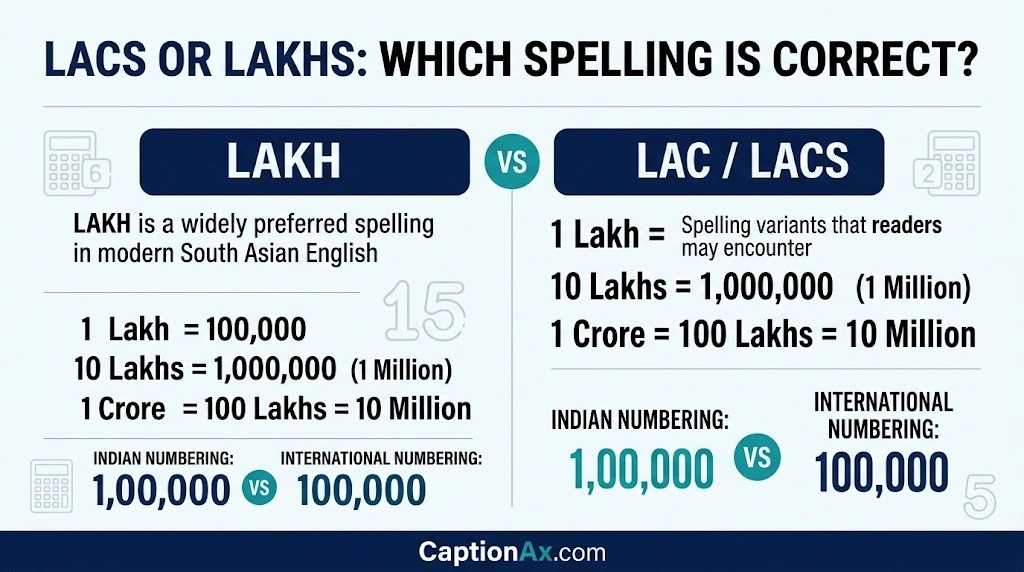
- 1 lakh = 100,000
- 2 lakhs = 200,000
- 5 lakhs = 500,000
- 10 lakhs = 1,000,000
- 50 lakhs = 5,000,000
For instance, if a property costs 30 lakhs, its price is 3,000,000 in international number formatting.
There is another meaning of lac in English: a natural resin associated with lac insects and used in making shellac. The intended meaning depends on context. When discussing numbers, lakh is a particularly clear choice.
Lakh vs. Lac: What Is the Difference?
The primary difference is spelling, not numerical value.
Lakh is the principal spelling used in modern dictionary references, while lac is an established alternative. Collins explicitly lists both forms and their associated plurals.
Consider these examples:
| Expression | Numerical value |
| 1 lakh | 100,000 |
| 1 lac | 100,000 |
| 5 lakhs | 500,000 |
| 5 lacs | 500,000 |
| 10 lakhs | 1,000,000 |
| 10 lacs | 1,000,000 |
The distinction is useful when editing articles, business documents, or educational content. Rather than declaring every occurrence of lac incorrect, explain which spelling your publication prefers and use it consistently.
For new articles, school assignments, and general professional writing, lakh/lakhs is a sensible default.
Is Lacs a Correct Spelling?
Yes. Lacs is a recognized alternative plural spelling of lakh, although lakhs is generally the better default for contemporary writing.
Dictionary recognition and editorial preference are not the same thing. A spelling can be established in English without being the most useful choice for every publication or audience.
For example:
- Preferred default: The business earned 15 lakhs.
- Alternative spelling: The business earned 15 lacs.
Both can describe 1,500,000. The choice depends on the writing convention, intended audience, and context.
If you are editing an older document, quoting a source, or following an organization’s established spelling, retaining lacs may be appropriate. Otherwise, choose lakhs and keep the spelling consistent throughout your article.
Is It 5 Lacs or 5 Lakhs?
For most new English content, 5 lakhs is the recommended choice.
Five lakhs means five units of 100,000, giving a total of 500,000.
Examples include:
- The car costs 5 lakhs.
- She saved 5 lakhs for her education.
- The company invested 5 lakhs in new equipment.
- The alternative expression is: The company invested 5 lacs in new equipment.
If your audience is unfamiliar with South Asian numbering, include the international equivalent:
“The property costs 5 lakhs (500,000 rupees).”
This approach communicates the value clearly without assuming that every reader knows the term lakh.
Should You Write One Lakh or One Lac?
Both one lakh and one lac can refer to 100,000. However, one lakh is the preferred default for most new content.
Examples:
- The organization received one lakh rupees in donations.
- The repair work cost one lakh rupees.
- She saved one lakh for an emergency.
- The alternative spelling is one lac.
The important point is consistency. If your article uses lakh in the introduction, continue using lakh and lakhs in the headings, examples, tables, and conclusion unless you have a reason to reproduce another spelling.
Lakh vs. Lakhs: Singular and Plural Rules
The choice between lakh and lakhs depends on how the word functions in a sentence.
Use Lakh for a single unit and in common South Asian English expressions where a numeral directly describes an amount, such as “5 lakh rupees.” Use lakhs when the word functions as a plural noun, such as “five lakhs.”
Examples of lakh
- One lakh people attended the event.
- The project cost 5 lakh rupees.
- The organization allocated 20 lakh rupees.
- His annual salary is 12 lakh rupees.
Examples of lakhs
- The project cost 5 lakhs.
- Several lakhs were spent on repairs.
- The organization raised 10 lakhs.
- The property is worth 50 lakhs.
Both “5 lakh rupees” and “5 lakhs” are commonly encountered in South Asian English. Follow your publication’s style guide rather than assuming that every phrase must use an identical grammatical pattern.
Also remember that lacs is the plural associated with the alternative spelling lac. Avoid mixing the two conventions without a clear reason.
How to Write Lakhs in Numbers
The South Asian numbering system uses a different comma-placement pattern from the international system.
In international formatting, digits are grouped in sets of three from the right. In South Asian formatting, the first group contains three digits, followed by groups of two.
For example, one lakh is written as:
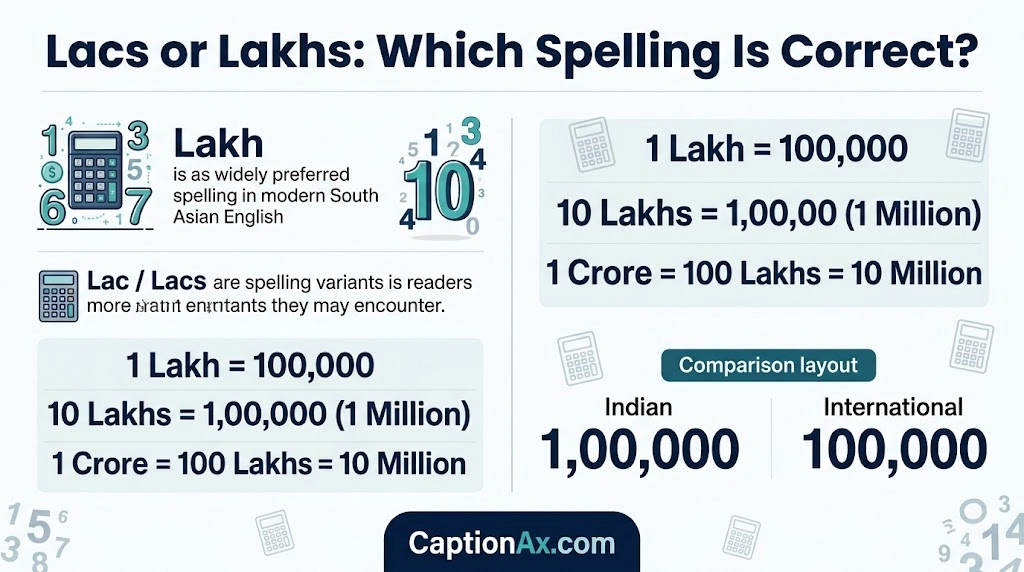
- South Asian format: 1,00,000
- International format: 100,000
Both represent the same number.
Here are additional examples:
| In words | South Asian format | International format |
| One lakh | 1,00,000 | 100,000 |
| Two lakhs | 2,00,000 | 200,000 |
| Five lakhs | 5,00,000 | 500,000 |
| Ten lakhs | 10,00,000 | 1,000,000 |
| Twenty-five lakhs | 25,00,000 | 2,500,000 |
| Fifty lakhs | 50,00,000 | 5,000,000 |
| One crore | 1,00,00,000 | 10,000,000 |
For example, an annual salary of 12 lakhs can be written as 12,00,000 in South Asian formatting or 1,200,000 in international formatting.
The value remains the same. Use the format your readers or organization expect.
Lakh, Million, and Crore Conversion Table
Understanding the relationship between lakh, million, and crore makes large numbers easier to read.
| South Asian unit | International equivalent |
| 1 lakh | 100,000 |
| 5 lakhs | 500,000 |
| 10 lakhs | 1 million |
| 25 lakhs | 2.5 million |
| 50 lakhs | 5 million |
| 100 lakhs | 10 million |
| 1 crore | 10 million |
| 10 crores | 100 million |
Remember these four basic rules:
- 1 lakh = 100,000.
- 10 lakhs = 1 million.
- 100 lakhs = 1 crore.
- 1 crore = 10 million.
For example, a business reporting revenue of 2 crore rupees has revenue of 20 million rupees.
When writing for an international audience, showing both formats can prevent misunderstandings.
How to Use Lakh and Lakhs in Sentences
The following examples show how the words are commonly used in everyday and professional writing.
Money and savings
- I saved 2 lakhs for my future.
- The repair work cost 1 lakh rupees.
- She invested 10 lakhs in a savings plan.
Salaries and employment
- He earns 12 lakh rupees annually.
- The position offers a salary of 8 lakhs per year.
- The employee received a bonus worth 2 lakh rupees.
Property and real estate
- The apartment costs 45 lakhs.
- They purchased land worth 20 lakh rupees.
- The house was valued at 1 crore rupees.
Business and finance
- The company invested 50 lakhs in expansion.
- The project received 10 lakh rupees in funding.
- Annual revenue increased by 25 lakhs.
Population and statistics
- The city has a population of several lakhs.
- The campaign reached more than 2 lakh people.
- The program benefited approximately 5 lakh residents.
These examples illustrate common usage rather than a single mandatory grammatical pattern. For formal publication, follow the preferred style of your audience and remain consistent.
Lacs or Lakhs in Cheques and Financial Documents
Financial documents require particular care because a mismatch between written amounts and numerals can create confusion.
When preparing a cheque, invoice, agreement, receipt, or financial report, follow the relevant bank’s or organization’s instructions.
For example:
- Amount in figures: ₹5,00,000
- Amount in words: Rupees five lakh only.
The precise wording required may vary by institution or document type. Do not assume that one general grammar rule determines every legal or banking requirement.
For invoices and reports, check that the written amount and the numerical amount agree. ₹5,00,000 represents five lakh rupees, not fifty lakh rupees.
This article explains language usage, not bank-specific legal requirements. If you are completing a formal financial transaction, verify the applicable instructions before submitting the document.
- Explore More: https://captionax.com/cancelled-or-canceled/
Which Spelling Should You Use in Pakistan and India?
Both Pakistan and India commonly use lakh when discussing money, salaries, property prices, budgets, and large quantities.
Examples include:
- The house costs 80 lakhs.
- His annual salary is 15 lakh rupees.
- The company invested 2 crore rupees in a new project.
The alternative spellings lac and lacs may also appear in particular local, organizational, or historical contexts. Usage can vary between writers and publications.
For new web content aimed at readers in Pakistan or India, lakh/lakhs is a practical default. To an international audience, consider adding an equivalent in millions.
For example:
“The property costs 50 lakhs, equivalent to 5 million rupees.”
This extra context helps readers understand the amount without needing to learn the entire South Asian numbering system.
When Should You Use Lakhs or Millions?
Use lakhs when your audience is familiar with South Asian numbering, especially in content about regional salaries, property prices, or currencies.
Use millions when writing for readers who are more familiar with the international numbering system or when your publication’s style guide requires it.
Compare these examples:
- South Asian format: The property costs 50 lakhs.
- International format: The property costs 5 million rupees.
- Combined format: The property costs 50 lakhs (5 million rupees).
The combined version is useful for international articles, financial explainers, and educational content.
Always specify the currency where necessary. “Five million” alone does not tell the reader whether the amount refers to rupees, dollars, pounds, or another currency.
Common Mistakes to Avoid
1. Calling lacs completely incorrect
Lac and lacs are recognized variants in major dictionaries. It is more accurate to recommend lakh/lakhs as the default than to claim that the alternatives never exist.
2. Mixing spellings unnecessarily
Avoid switching between “10 Lakhs” and “20 lacs” in the same article unless you are quoting a source or following a specific convention.
3. Confusing a lakh with a million
One lakh is 100,000. Ten lakhs equal one million.
4. Using the wrong comma format
One lakh is written as 1,00,000 in South Asian formatting and 100,000 in international formatting.
5. Leaving out the currency
When discussing financial amounts with an international audience, specify whether the figure is in rupees or another currency.
6. Assuming every financial institution follows the same wording
Use the bank’s or organization’s own instructions for cheques and formal documents.
7. Overlooking the other meaning of lac
In contexts involving natural materials or shellac, lac can refer to a resin rather than a numerical unit. Use enough context to make your intended meaning clear.
People Also Aak
A:Both are recognized spellings, but lakhs is the recommended default for most contemporary English content. Both forms can represent the same numerical value.
A:Yes. Lacs is an established alternative plural form of lakh. However, lakhs is generally the more useful default for new articles, educational content, and professional writing.
A:Both spellings can refer to 100,000. Use lakh as your default spelling unless you need to follow another established convention or reproduce a source.
A:For contemporary writing, use 5 lakhs as your default. Both expressions can mean 500,000.
A:Yes. One lakh equals one hundred thousand, written as 100,000 internationally or 1,00,000 in South Asian formatting.
Conclusion
When deciding between Lacs or Lakhs, remember that both spellings are recognized, but lakh and lakhs are the recommended defaults for most new English content.
One lakh equals 100,000, ten lakhs equal one million, and one crore equals 100 lakhs. The alternative spelling does not change these numerical values.
For blog posts, school assignments, business reports, and general writing, choose one spelling convention and use it consistently. When your audience may not be familiar with South Asian numbering, include the international equivalent. For cheques and formal financial documents, follow the relevant institution’s instructions.
That simple approach will help you write numbers clearly, accurately, and confidently.